
We may earn a commission if you buy through links on this page. It never changes a score or a ranking. How we make money
The bottom line
Good free entry point for developers; full market data costs $99/month.
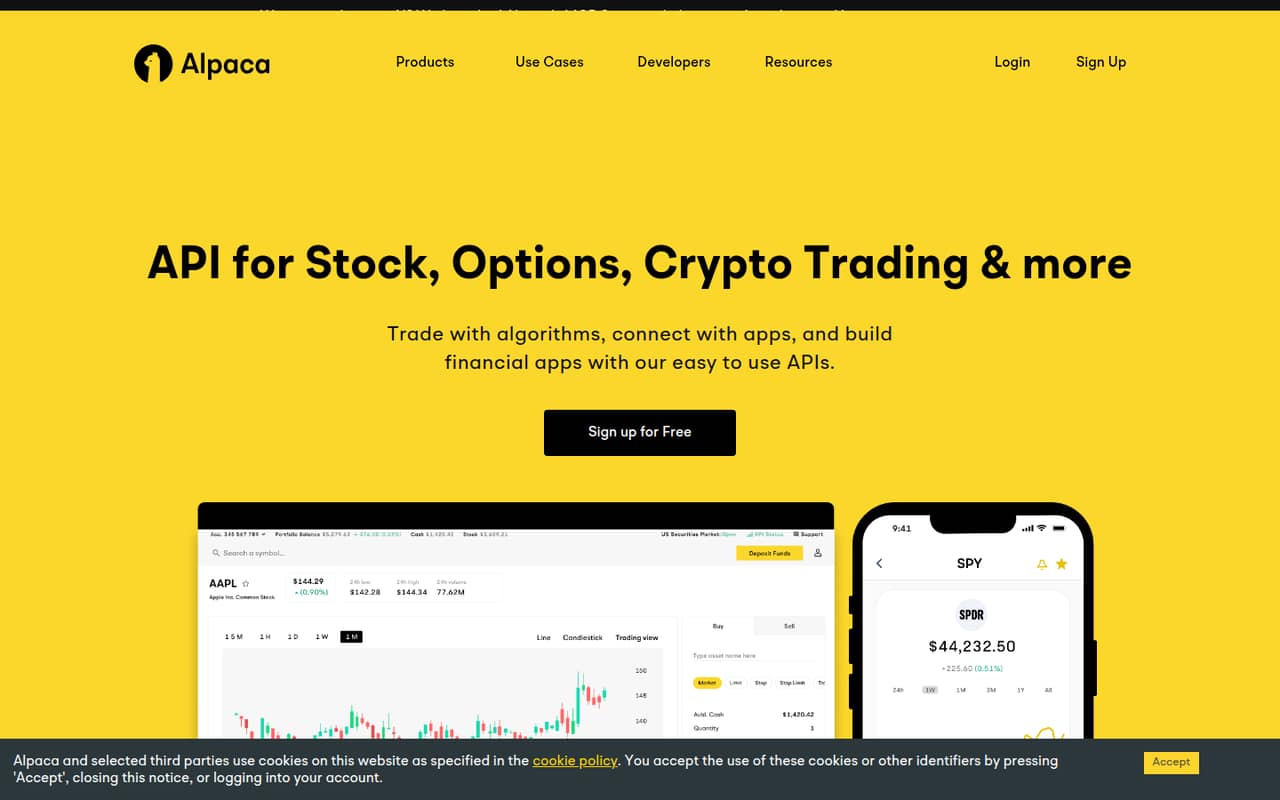
Alpaca is for developers and businesses building algorithmic trading tools or adding investing to an app. Its free Trading API plan covers basic use, while richer real-time data starts at $99/month.
For a small team, the main trade-off is clear: low-cost access to trading APIs, but a coding project to set up and a meaningful price jump for full market data. Reddit users describe the API as intuitive, while some say they rely on other data sources.
Good fit if
- Developers building trading apps
- Small teams testing trading strategies
- Businesses embedding brokerage services
Skip it if
- Teams wanting a no-code trading tool
- Teams needing full data for free
- Businesses seeking published per-seat pricing
ScoresHow it rates
What works
- Free Basic plan for trading API access
- Paper trading and historical data for strategy work
- SDKs for Python, .NET/C#, Go, and Node
- Broker API supports embedded brokerage services
- Options and crypto trading API capabilities
What doesn't
- Free plan has limited API and data access
- Full market data costs $99/month
- Latest 15 minutes of historical data restricted on Basic
- Broker API options data can add $1,000/month
- Setup requires coding knowledge
01Who Alpaca is for
Alpaca fits a solo developer or a small team of roughly 1–10 people building a trading app, testing an algorithm, or adding brokerage features to a product. Its Trading API supports algorithmic trading, while the Broker API is for businesses that want to offer brokerage services through their own products. Market data can support strategy backtesting and paper trading before deployment.
The budget-friendly starting point is Free (Basic), at $0/month. That can work for a prototype or a modest trading project that can live with its data limits. Teams that need real-time SIP and OPRA feeds can budget $99/month for Algo Trader Plus. Broker API pricing is a separate set of plans, starting at $0/month for equities on Standard. This is a developer tool, not a ready-made trading interface: a small team needs someone comfortable working with APIs and code.
02Alpaca free plan and trial
Free (Basic) costs $0/month and includes 200 API calls per minute, 200 historical-data requests per minute, and a WebSocket limit of 30 equity symbols and 200 options quotes. The pricing page lists real-time equity data from IEX and indicative options feeds. Historical data goes back to 2016, but the latest 15 minutes are restricted. There is no free trial listed because the Basic plan is already free.
The free plan is a reasonable place to start with API development, paper trading, or a strategy that does not need richer feeds. It is not the right tier for unlimited market-data calls or real-time SIP and OPRA feeds. Those features are listed under Algo Trader Plus at $99/month. Broker API customers have separate plans, including Standard at $0/month for equities.
03What a small team pays for Alpaca
Alpaca does not publish per-seat pricing, so a team of three or five does not automatically pay three or five times the plan price. Free (Basic) is $0/month, and Algo Trader Plus is $99/month for the listed market-data package. If each of three people independently needed an Algo Trader Plus subscription, that would be $297/month; for five, $495/month. Those are conditional totals, not published team rates. Annual-billing prices are not published.
Broker API pricing is different: Standard is $0/month for equities, StandardPlus3000 is $500/month, StandardPlus5000 is $1,000/month, and StandardPlus10000 is $2,000/month. The options indicative feed costs $1,000/month on Standard and StandardPlus3000; it is included on the two higher plans. For a small team, confirm which API product and data feeds you need before budgeting. Seat minimums and team discounts are not published.
04Getting started with Alpaca
Alpaca is an API product, so expect setup work rather than a plug-and-play team workspace. A developer will need to connect an app or trading bot to the APIs and decide which data feed and plan fit the project. The pricing page lists paper trading and historical data for strategy work before deployment, which gives a team a way to develop and validate its approach without starting with live trading.
Alpaca lists SDKs for Python, .NET/C#, Go, Node, and more. It also supports OAuth integrations for apps, algo bots, and platforms such as TradingView. That gives a coding team several routes to connect its tools, but the vendor does not publish a setup-time estimate. One Reddit commenter described the API as relatively intuitive for basic algorithmic trading, while noting that it assumes some coding and technical-analysis knowledge.
05When small teams outgrow Alpaca
The first pressure point is market data. Free (Basic) caps API calls and WebSocket coverage, uses IEX for real-time equities, and restricts the latest 15 minutes of historical data. Algo Trader Plus raises the limits and adds real-time SIP and OPRA feeds for $99/month. A growing team that needs Broker API throughput faces larger jumps: $500/month for StandardPlus3000 and $1,000/month for StandardPlus5000.
Options data can be another budget trigger. The indicative feed adds $1,000/month on Standard and StandardPlus3000, though it is included on StandardPlus5000 and StandardPlus10000. Per-seat rates and annual discounts are not published, so ask Alpaca how a multi-person deployment is priced. Reddit feedback is mixed: some users find the API intuitive, while others say data access changed or they use other sources for data. Teams that need data or execution they can rely on from another provider may consider moving those parts elsewhere.
From the threadsWhat users say
Reddit sentiment is mixed. Some users find the API approachable for basic algorithmic trading, while others report changes to data access and prefer other sources for market data.
for basic algotrading, it's relatively intuitive to implement strategies if you have some basic knowledge of coding and TA
Their data api has been nerfed to a certain degree
I use alpaca API to manage assets since it's relatively intuitive but I use other sources for data
I used Alpaca when it launched and for about two years. It's okay, then they changed the data feed so I left
Questions people ask
What is Alpaca?
Alpaca provides APIs for stock, options, and crypto trading, along with tools for businesses embedding investing. Developers can use its Trading API for algorithmic trading or its Broker API to offer brokerage services through their products.
Is Alpaca free to use?
Alpaca lists Free (Basic) at $0/month. It includes limited API calls, historical-data requests, and WebSocket coverage. The free plan uses IEX for real-time equity data, and the latest 15 minutes of historical data are restricted.
How much does Alpaca market data cost?
Free (Basic) costs $0/month and has limited data access. Algo Trader Plus costs $99/month and includes real-time SIP and OPRA feeds, 10,000 API calls per minute, and unlimited calls on the market-data interface. Broker API data pricing follows separate plans.
Can I use Alpaca for options and crypto?
Alpaca supports options and crypto trading APIs. Its Free (Basic) plan lists indicative options feeds, while the Broker API has a separate options-feed add-on on some plans. Check the plan details for the data access and options features your use case needs.
What coding languages does Alpaca support?
Alpaca lists SDKs for Python, .NET/C#, Go, Node, and more. The APIs are intended for developers building trading tools, apps, and brokerage services, so a team should plan for coding work rather than expect a no-code setup.