
We may earn a commission if you buy through links on this page. It never changes a score or a ranking. How we make money
The bottom line
Strong sales toolkit, steep starting cost: Startup is $600 per month on an annual term.
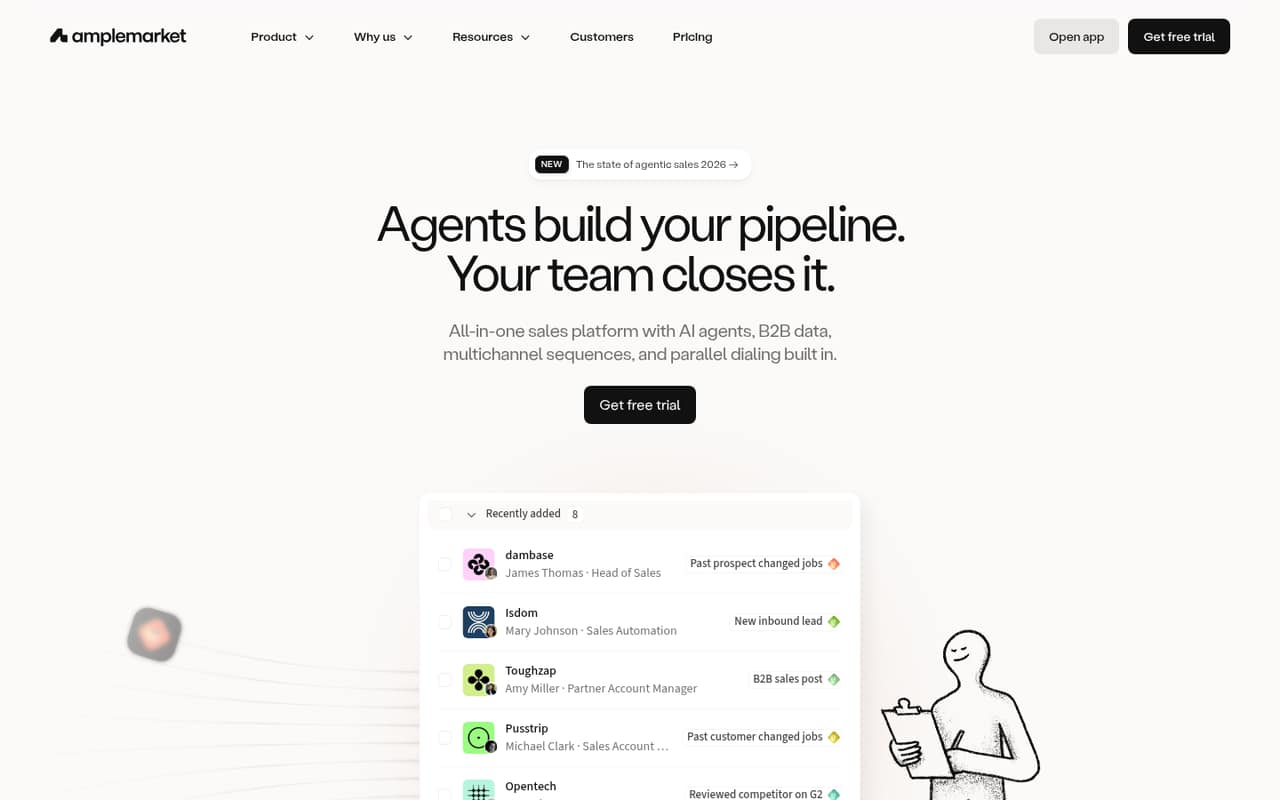
Amplemarket brings prospect research, B2B data, AI-assisted outreach, multichannel sequences, a dialer, and deliverability tools into one platform. That breadth can suit a small sales team that wants one workflow instead of several separate tools.
The trade-off is price and commitment: the pricing page lists Startup at $600 per month on an annual term, with two users included. There’s no free plan, and the vendor doesn’t publish monthly billing rates or the cost of additional users.
Good fit if
- Small teams with active outbound sales
- Founders who want one outreach workflow
- Teams using email, calls, and social
Skip it if
- Founders testing outbound on a tight budget
- Solo users seeking a free plan
- Teams needing published monthly pricing
ScoresHow it rates
What works
- Combines prospecting data and outreach tools
- Coordinates email, calls, and social outreach
- AI agents use CRM context and buying signals
- Startup includes two users
- Includes email and phone credits
What doesn't
- No free plan
- Startup costs $600 per month on an annual term
- Monthly billing rates are not published
- Additional-user prices are not listed
- Growth and Elite require custom pricing
01Who Amplemarket is for
Amplemarket is aimed at small sales teams that are ready to run regular outbound, not founders who just want to test a channel on a shoestring. The Startup plan is listed for small businesses and founder-led teams, with two users included. At $600 per month on an annual term, it makes most sense when a team can put both seats and the included contact and outreach credits to work.
The platform brings B2B prospect data, buying signals, CRM context, AI-assisted research and messaging, and multichannel sequences together. Teams can coordinate email, calls, and social outreach, and use the parallel dialer and deliverability tools as part of the same sales operation. A Reddit commenter who said they had used Amplemarket for about eight months praised its data in North America and EMEA, while another said it didn’t fit their niche. We’d consider it when unified prospecting and outreach matter more than a low entry price.
02Amplemarket free plan and trial
Amplemarket doesn’t offer a free plan. The vendor doesn’t publish the length of its free trial, so ask whether a trial is available, how long it lasts, and whether it includes the data and outreach features your team needs before budgeting for a contract.
The cheapest listed way in is Startup at $600 per month on an annual term. It includes two users, 27,000 contacts, 13,500 email credits per user per year, 600 phone credits per user per year, and starts from two mailboxes per user. That may be more capacity than a solo founder needs, but there’s no lower-priced free tier to grow into.
03What a small team pays for Amplemarket
The pricing page lists Startup at $600 per month on an annual term, with two users included. That is $7,200 over a year, or $300 per included seat per month if both seats are used. A solo buyer still faces the $600 monthly bill; the vendor doesn’t list a one-user price or monthly billing rate.
For three people, budget $600 per month plus the price of one additional user. For five, it’s $600 plus three additional-user charges. Those seat prices aren’t published, so ask for a written quote before comparing a team total. Growth is custom-priced and includes four users; Elite is custom-priced and includes ten.
Startup also lists 27,000 contacts and per-user email and phone credits. Additional users, MCP, and AI Agents are listed as add-ons, but their prices aren’t published. Confirm whether your planned seats, mailbox setup, and add-ons fit the quote.
04Getting started with Amplemarket
Plan for setup work before a small team starts sending. The product combines CRM context, prospect data, buying signals, email, calls, and social outreach, so a practical first step is to confirm your CRM and mailbox connections, then decide how your team will organize prospects and sequences. The available product details don’t name specific integrations or spell out setup steps; ask the vendor which CRM and mailbox connections are supported and what onboarding includes.
The feature set also means users will need to get comfortable with sequence creation, sales conversations in Duo Inbox, and the dialer and deliverability tools they plan to use. That’s a wider learning curve than adopting a single-purpose email sender. We can’t judge the actual setup time from the published information. A Reddit user described the technology as impressive but said the product wasn’t a fit for their niche, so confirm your workflow in a demo before committing.
05When small teams outgrow Amplemarket
Amplemarket’s listed plan structure leaves two common pressure points: seats and usage. Startup includes two users, 27,000 contacts, and per-user email and phone credits. A team that needs a third or fifth seat has to ask for the unlisted additional-user price; Growth and Elite move to custom pricing. Before expanding, check the quote against your seat count, contact needs, and credit use.
A team may also outgrow the all-in-one approach if it wants more control over each channel or finds the platform a poor fit for its market. In one Reddit discussion, a commenter argued that bundling prospecting, email, LinkedIn, and a dialer trades off some channel-by-channel control. Another user said Amplemarket didn’t fit their niche. A separate Reddit post raised a concern about LinkedIn access, but that claim wasn’t verified in the discussion. Treat platform fit and channel requirements as demo questions, not assumptions.
From the threadsWhat users say
Reddit sentiment is mixed: one customer praised the data and their experience, while others questioned niche fit and the cost of an annual commitment. The comments offer individual views, not a broad measure of customer satisfaction.
The data is much better than other platforms I have used
The tech is very cool, just didn’t fit well into our niche industry
Great product, but the pricing is insane for an early-stage founder validating a channel
Amplemarket bundles prospecting, email, LinkedIn, and a dialer, but that convenience trades off granular control over each channel's individual sending limits
Questions people ask
Does Amplemarket have a free plan?
No. The pricing information lists no free plan. The vendor doesn’t publish a free-trial duration either, so ask whether a trial is available and what it includes. Startup is the cheapest listed plan, at $600 per month on an annual term with two users included.
How much does Amplemarket cost for a small team?
Startup costs $600 per month on an annual term and includes two users. For three or five users, add the price of one or three extra seats, respectively; the vendor doesn’t publish those prices. Growth and Elite are custom-priced, so request a quote for your team size.
What does Amplemarket Startup include?
Startup includes two users, 27,000 contacts, 13,500 email credits per user per year, 600 phone credits per user per year, and starts from two mailboxes per user. The plan is listed at $600 per month on an annual term. Confirm with the vendor how mailbox counts and credits apply to your specific setup.
Can a small team use Amplemarket for multichannel outreach?
Yes. Amplemarket describes sequences that coordinate personalized email, calls, and social outreach in one workflow. It also lists a parallel dialer, deliverability tools, and a sales inbox. Ask the vendor which channels and integrations are available for your team and how the workflow handles your specific outreach requirements.
Is Amplemarket a good fit for a founder-led team?
It may fit a founder-led team that is already committed to outbound and will use the included seats, contacts, and credits. The annual Startup price is substantial for a team still testing a sales channel. Reddit comments include both a positive customer account and a report that the product didn’t fit a particular niche.