
We may earn a commission if you buy through links on this page. It never changes a score or a ranking. How we make money
The bottom line
Powerful telecom quoting and order workflows, with no public price to make a small-team case.
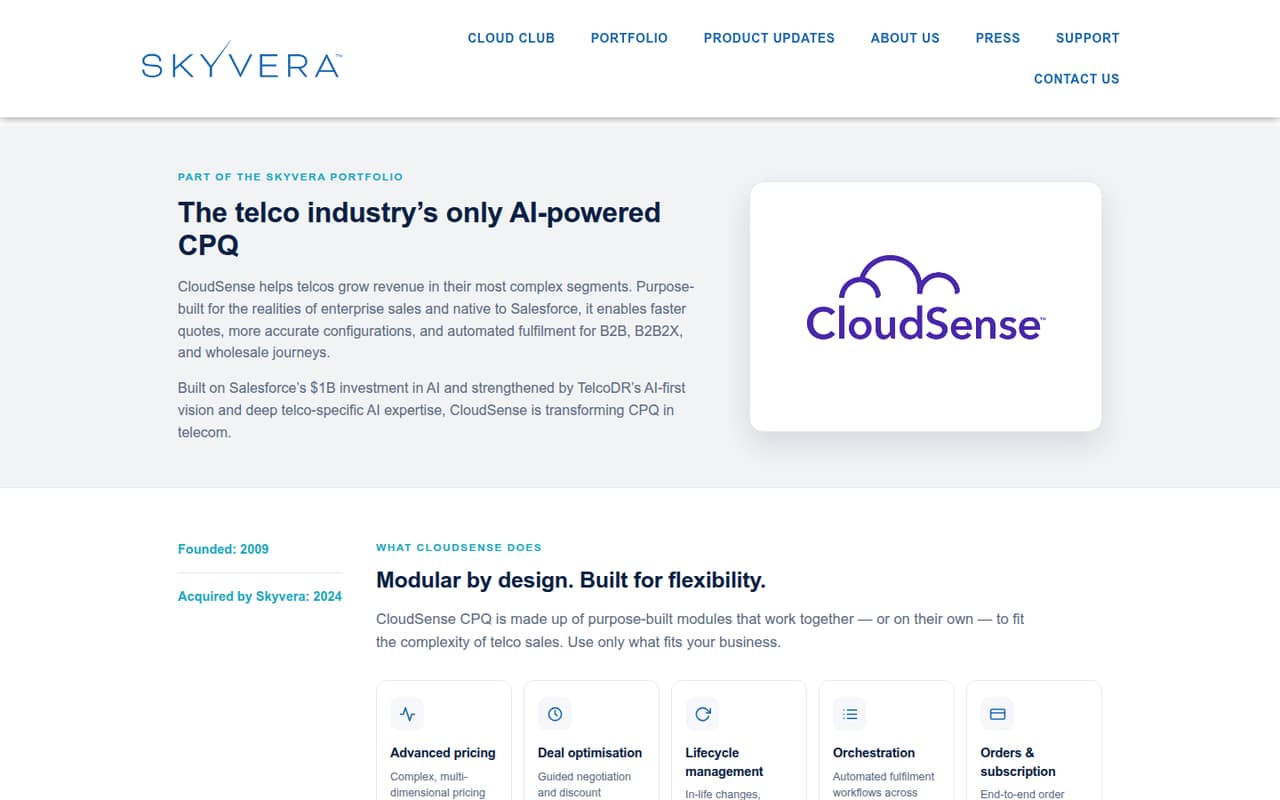
CloudSense CPQ is Salesforce-native software for complex telecom quoting and quote-to-order work. Its modules cover pricing, negotiation, lifecycle changes, fulfilment, orders and subscriptions, with Totogi Ontology connecting existing systems for AI context.
For a 1–10-person team watching costs, the main hurdle is commercial uncertainty: CloudSense does not publish prices or billing terms. There is no free plan, and trial terms are not published. Ask for a scoped quote and implementation estimate before committing.
Good fit if
- Telecom sales teams with complex pricing
- Enterprise quote-to-order operations
- Salesforce-based B2B2X and wholesale sellers
Skip it if
- Teams needing a free CPQ plan
- Buyers requiring transparent seat pricing
- Simple, low-volume quoting workflows
ScoresHow it rates
What works
- Supports multidimensional telecom pricing
- Includes guided negotiation and discount management
- Handles amendments, renewals and in-life changes
- Automates fulfilment across systems and teams
- Tracks orders and subscriptions from quote to cash
What doesn't
- Starting price and billing terms are not published
- No free plan is listed
- Trial availability and terms are not published
- Per-seat costs for small teams cannot be calculated
- Setup effort and implementation costs need vendor confirmation
01Who CloudSense CPQ is for
CloudSense CPQ is aimed at telecom enterprise, B2B2X and wholesale sales teams handling complicated quotes and orders. It is for teams that need pricing rules, discounts, amendments, renewals and fulfilment to work together, rather than a lightweight tool for sending a basic proposal.
A 1–10-person team can fit if its deals are complex enough to justify specialist software and it already works in Salesforce. Team size alone is not the deciding factor: the budget is. CloudSense does not publish a starting price or billing terms, so a small team cannot check affordability from a public rate card. Ask for a quote covering the actual users, workflows and implementation needs before evaluating it against the budget.
In plain terms, CloudSense turns a configured quote into an order and supports the changes that follow. Its modules cover pricing, deal optimisation, lifecycle management, fulfilment orchestration, orders and subscriptions.
02CloudSense CPQ free plan and trial
CloudSense CPQ has no free plan listed. Trial availability and terms are not published, so a small team should not count on being able to evaluate the full product at no cost. Ask CloudSense whether it offers a trial, guided evaluation or paid proof of concept, and what each option includes.
The cheapest way in is also not published: there is no public entry plan or starting price to compare. Before arranging a demo, ask for the minimum contract, required modules, user count and any implementation charges. Those details will show whether a limited rollout is possible or whether the product is priced for a larger telecom operation. Get the answer in writing before budgeting.
03What a small team pays for CloudSense CPQ
The pricing page lists no plans, add-on prices, starting price or billing terms. As a result, the cost for one person, three people or five people is not published, and we cannot calculate monthly or annual totals. CloudSense CPQ has no free plan listed; trial terms are not published either.
The product is modular, with capabilities for pricing, deal optimisation, lifecycle changes, fulfilment orchestration, and orders and subscriptions. But no module or add-on prices are listed, so a small team should ask which capabilities are included in its quote and which would cost extra. Don’t assume that a per-seat price alone covers the workflow you need.
Request a written quote for one, three and five users, with monthly and annual billing options if available. Ask separately about implementation, support, minimum contract size and the cost of adding modules or users. Until CloudSense supplies those numbers, a few-seat budget comparison is not possible.
04Getting started with CloudSense CPQ
CloudSense CPQ is Salesforce-native, so Salesforce is central to the setup conversation. Its product scope also includes fulfilment workflows across systems and teams, plus an AI context layer that connects existing systems. The product description does not specify a setup timeline, technical prerequisites or a list of integrations beyond Salesforce-native positioning.
For a small team, plan for a scoping conversation rather than assuming a quick self-serve setup. Complex pricing, negotiation rules, lifecycle changes and fulfilment workflows all need to match how the business sells and delivers. That is an inference from the product’s stated scope, not a published implementation estimate.
Ask CloudSense to identify the systems that must connect on day one, who configures each workflow, what data needs preparing and whether implementation is included in the quote. Also request role-based training details and an estimate of the team’s time commitment. The vendor should confirm these points before you compare setup effort with a simpler CPQ tool.
05When small teams outgrow CloudSense CPQ
CloudSense CPQ is already designed for complex telecom sales, so a small team may find it is more system than it needs before it ever outgrows it. If quotes are simple, the modules for multidimensional pricing, deal optimisation, lifecycle changes and fulfilment orchestration may be difficult to justify against an unpublished price.
A growing team may need to revisit its agreement when it adds users, modules or more workflows. CloudSense does not publish seat limits, module prices or billing terms, so there is no public threshold at which an upgrade becomes necessary. Ask how user additions, new business units and added capabilities affect the contract before signing.
If the team’s needs shift toward basic quoting, compare the cost and implementation scope with a simpler tool. If it expands into more telecom pricing and order complexity, CloudSense may remain a fit, but get a revised quote and confirm capacity, integrations and support for the new workflows.
Questions people ask
Does CloudSense CPQ have a free plan?
No free plan is listed for CloudSense CPQ. The vendor also does not publish trial availability or terms, so ask whether a trial, guided evaluation or proof of concept is available. Confirm what features and users it includes before treating it as a way to assess the product.
How much does CloudSense CPQ cost?
CloudSense does not publish a starting price, plan prices or billing terms. That means the costs for one, three or five users are not available for a public per-seat calculation. Ask the vendor for a quote that separates user fees, modules, implementation and any contract minimum.
What does CloudSense CPQ do?
CloudSense CPQ supports complex telecom quoting and quote-to-order workflows. Its modules cover advanced pricing, guided negotiation and discount management, lifecycle changes, fulfilment orchestration, and orders and subscriptions. The product also describes Totogi Ontology as a layer that connects existing systems to give AI operational context.
Does CloudSense CPQ work with Salesforce?
CloudSense CPQ is described as Salesforce-native. The vendor's site does not spell out technical prerequisites, supported Salesforce configurations or other specific integrations. Ask CloudSense which Salesforce setup is required and which external systems need connecting for your pricing and fulfilment workflows.
How long does CloudSense CPQ take to implement?
CloudSense does not publish an implementation timeline in the product details. Timing will depend on the workflows, pricing rules and systems your team needs to configure; that is an estimate to discuss, not a published guarantee. Ask the vendor for a project plan, your team’s time commitment and any implementation fees.