
We may earn a commission if you buy through links on this page. It never changes a score or a ranking. How we make money
The bottom line
Compt organizes stipends and reimbursements, but its $3,000 annual starting price favors bigger budgets.
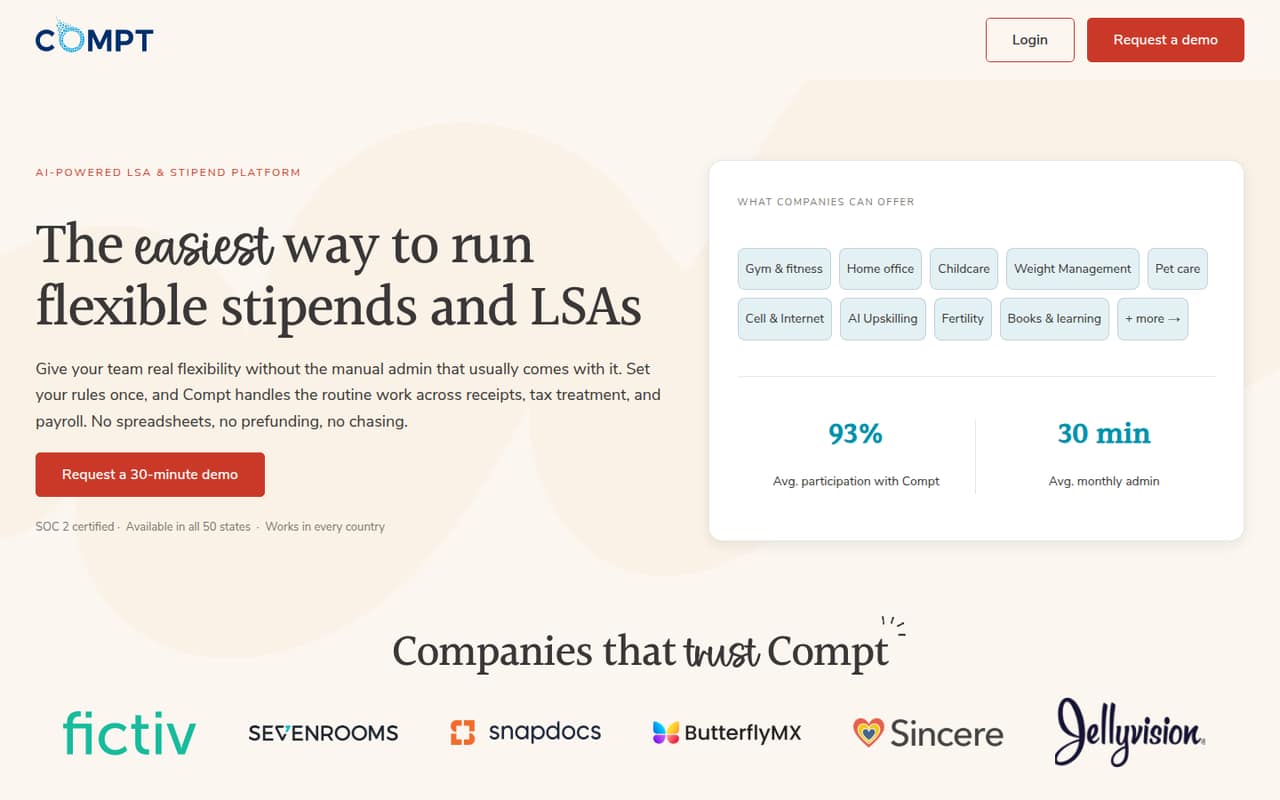
Compt helps HR and Finance manage stipends and lifestyle spending accounts, including program rules, receipt review, tax treatment and payroll reimbursements. Employees can check their benefits and claim status.
The pricing page lists a starting price of $3,000 per year for companies with up to 50 employees. There’s no free plan, and monthly billing isn’t published, so a team of a few people pays the same starting company price.
Good fit if
- Teams running several stipend programs
- HR and Finance coordinating reimbursements
- Companies with a $3,000 annual budget
Skip it if
- Teams that need a free plan
- Small budgets needing monthly billing
- Companies seeking published per-seat pricing
ScoresHow it rates
What works
- Unlimited stipend programs at the starting tier
- No prefunding or minimums listed
- Automates tax treatment using IRS guidelines
- Routes approved reimbursements through existing payroll
- Receipt intelligence can reduce employee data entry
What doesn't
- No free plan
- $3,000 annual starting price
- Monthly billing isn’t published
- Starting tier is priced by company size, not seat
- Higher-size pricing and add-on costs aren’t listed
01Who Compt is for
Compt is for companies that want HR and Finance to manage employee stipends or lifestyle spending accounts in one place. The pricing page lists a starting tier for companies with up to 50 employees, so it can technically fit a team of 1–10. The bigger question is whether that team has enough budget and enough benefit-program administration to justify the company-wide price.
In plain terms, HR sets budgets, eligible spending categories and rules. Compt checks claims against those rules, helps process receipts and applies tax treatment based on IRS guidelines and program settings. Approved reimbursements can go through the company’s existing payroll system. Employees can see available benefits and claim status, while HR and Finance get usage and pending-claim reporting. It’s most relevant when handling these tasks manually has become a recurring job, rather than for a small team seeking a basic employee perk.
02Compt free plan and trial
Compt doesn’t have a free plan, according to the pricing details. A free trial isn’t listed, so ask the vendor whether it offers a trial or a guided evaluation before signing an annual contract.
The cheapest published way in is the starting tier for companies with up to 50 employees: $3,000 per year. It includes unlimited stipend programs and lists no prefunding or minimums. That means a five-person team doesn’t get a smaller published tier just because it has fewer employees; the starting price is set by company size, not by a per-seat monthly rate. Monthly billing isn’t published either. For a small team watching recurring costs, confirm the contract term, renewal terms and any implementation charges directly with Compt before budgeting.
03What a small team pays for Compt
The pricing page lists $3,000 per year as the starting price for a company with up to 50 employees. That works out to $250 per month as an annualized equivalent, but monthly billing isn’t published. Compt’s starting price is per company, not a charge of $250 for each employee.
To compare team sizes, dividing the annual price by headcount gives an effective average of $3,000 per person per year, or $250 per person per month, for one person. For three people, it’s $1,000 per person per year, or about $83.33 per person per month. For five, it’s $600 per person per year, or $50 per person per month. These are comparisons, not published per-seat rates; the company still pays $3,000 annually at the starting tier.
The listed tier includes unlimited stipend programs and no prefunding or minimums. Add-on prices aren’t listed. Ask Compt about any implementation charges, payroll-related costs and pricing above 50 employees before committing.
04Getting started with Compt
Compt’s product description centers setup on defining stipend or lifestyle spending account budgets, eligible categories and program rules. The platform then uses those settings to check claims, guide employees and apply tax treatment. Approved payments route through the company’s existing payroll system.
The setup time and learning curve aren’t published, so we wouldn’t assume this is a same-day task. The key day-one question is payroll compatibility: Compt describes routing reimbursements through an existing payroll system, but a specific integration list isn’t published. Ask the vendor whether your payroll platform is supported and what configuration is needed. It’s also worth confirming who in HR or Finance needs access to reporting and who will maintain program rules. The product description mentions reporting and plain-language questions about program data, but doesn’t spell out setup steps or required staff time.
05When small teams outgrow Compt
For a small team, the first limit may be the budget rather than a feature cap: the listed starting price is $3,000 per year, with no smaller or free tier. A team that only needs one simple stipend may find that cost hard to justify, especially if it wants monthly billing, which isn’t published.
The starting tier covers companies with up to 50 employees. If your company grows beyond that, the pricing details don’t list the next tier or its price, so ask Compt for a quote before planning expansion. The listed starting tier includes unlimited stipend programs, so adding programs alone isn’t a stated reason to move up. A team may still need to reassess if it wants more detailed payroll integration information, different reporting or other capabilities; the published feature details don’t establish whether those are available. Compare the contract and costs with the work your team actually needs the platform to handle.
Questions people ask
How does Compt work?
HR sets up stipend or lifestyle spending account budgets, eligible categories and program rules. Compt checks claims against those rules, helps review receipt details and applies tax treatment based on IRS guidelines and the program configuration. Employees can check benefits and claim status, while HR and Finance can view usage and pending claims.
Does Compt have a free plan or trial?
Compt has no free plan in the published pricing details. A free trial isn’t listed, so ask the vendor whether one is available. The lowest published price is $3,000 per year for companies with up to 50 employees, with monthly billing not published.
How much does Compt cost for a small team?
The pricing page lists a starting price of $3,000 per year for a company with up to 50 employees. That is a $250 monthly equivalent, not a published monthly payment option. The price is per company, so a smaller team should confirm its contract and any additional charges with Compt.
Can Compt reimburse employees through payroll?
Compt’s product description says approved reimbursements can be routed through the company’s existing payroll system. It doesn’t publish a specific payroll integration list, so check with the vendor that your payroll platform is supported and ask what configuration is required.
How does Compt handle stipend taxes?
Compt applies taxable or nontaxable treatment based on IRS guidelines and the program’s configuration. Because the treatment depends on how a company sets up its program, ask Compt how your intended stipend categories should be configured and confirm any tax questions with your tax adviser.