
We may earn a commission if you buy through links on this page. It never changes a score or a ranking. How we make money
The bottom line
A broad identity platform with a generous free tier and a steep first paid step.
A small team may not need a separate identity platform if its app only needs basic login. Descope makes more sense when you need customer, partner, or AI-agent identity, or want visual workflows for authentication and access control.
Free Forever includes 7,500 MAUs, but Pro starts at $249 per month billed annually. That price is for the plan, not each employee seat; whether it fits depends on your active-user and tenant needs.
Good fit if
- B2B apps with tenant needs
- Teams building custom login journeys
- Products with AI-agent identities
Skip it if
- Apps needing only basic login
- Teams requiring monthly Pro billing
- Teams with very tight paid budgets
ScoresHow it rates
What works
- Free Forever includes 7,500 MAUs
- Visual workflows cover common auth journeys
- Supports passwords, passkeys, and social login
- Includes RBAC, ReBAC, and ABAC capabilities
- Agent identity includes consent and token management
What doesn't
- Pro costs $249 monthly, billed annually
- Monthly Pro and Growth prices aren't published
- Free plan has only three SSO connections
- Free plan includes just five test users
- Setup time and support pricing aren't published
01Who Descope is for
Descope is for small product teams building an app where identity is more than a login form. It can suit a solo founder or a team of 3–10 people working on customer, partner, or AI-agent identity, especially when the product needs tenant controls, SSO, consent, or several authentication methods.
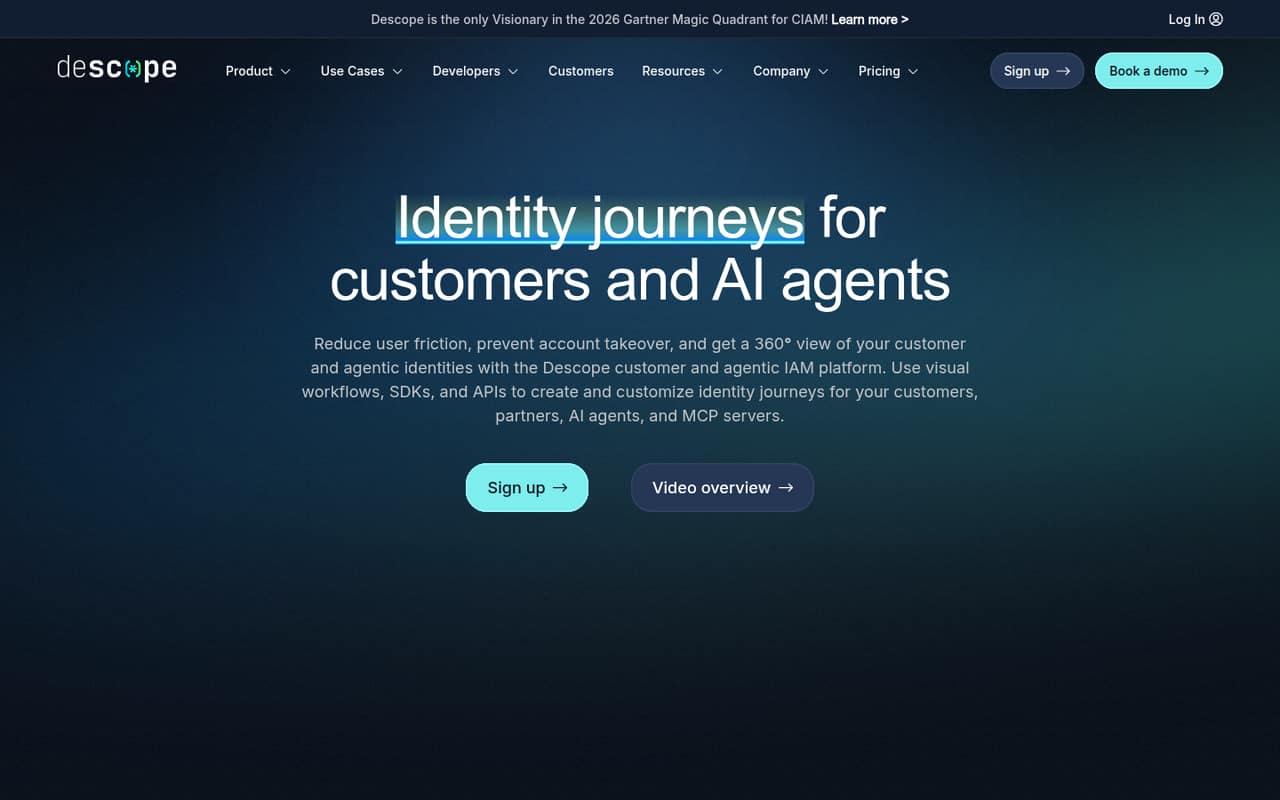
In plain terms, Descope helps a team build signup, login, MFA, and other identity journeys with visual workflows, SDKs, and APIs. It also offers identity management and access-control capabilities, including RBAC, ReBAC, and ABAC. For AI agents and MCP servers, the platform covers authentication, consent, scope-based access, and token management.
The budget fit depends more on active users and tenants than on staff headcount. A solo builder can start free. A team that needs Pro should budget $249 per month on an annual billing basis, even if only a few people manage the app.
02Descope free plan and trial
Free Forever costs $0 and includes 7,500 monthly active users (MAUs), 10 active tenants, three SSO connections, 10,000 M2M exchanges, and five test users. That gives a small team room to build and support a meaningful authentication setup before paying, as long as those limits fit its product.
The plan's constraints are clearest around SSO and testing: it has three SSO connections and five test users. Descope lists no free-trial period in its pricing details; the free plan itself is the way to start without a subscription. If you exceed its limits, check the overage rates and plan caps before launch. The next listed tier is Pro, at $249 per month billed annually, with monthly billing prices not published.
03What a small team pays for Descope
Descope prices plans by product limits such as MAUs, tenants, and SSO connections, not by employee seats. Free Forever is $0. Pro is $249 per month billed annually, or $2,988 for a year; Growth is $799 per month billed annually, or $9,588 for a year. Descope doesn't publish monthly billing prices for either plan.
So a one-person team, a team of three, and a team of five all pay the same plan price if they choose the same tier. For comparison only, dividing Pro's $249 monthly equivalent by those headcounts works out to $249, $83, and $49.80 per team member per month. Those are not seat prices, and the annual commitment remains $2,988.
Listed overages include $0.05 per MAU, $1 per tenant, $50 per SSO connection, and $2 per 1,000 M2M exchanges. MAC and MATK overages are each $0.05. SSO, audit-retention, FedRAMP High, and premium-support add-ons are listed, but their prices aren't published.
04Getting started with Descope
Descope describes visual workflows, SDKs, and APIs as ways to build and customize identity journeys. A small team will need to decide which flows it needs—such as signup, login, MFA, SSO, or step-up checks—and connect those journeys to its app. The right SDK or API depends on the app's stack, so confirm language and framework support with Descope before committing.
Visual workflows may help teams shape journeys without putting every decision in application code, while SDKs and APIs provide ways to integrate with an app. But the setup time, implementation steps, and support costs aren't published in the pricing details. We wouldn't assume this is a plug-and-play job: identity, permissions, tenant structure, and agent access need deliberate design. Ask Descope for a setup estimate and confirm what help is included at your intended tier.
05When small teams outgrow Descope
The first reason to move up is hitting a plan limit, not adding employees. Free Forever allows 7,500 MAUs, 10 active tenants, three SSO connections, and five test users. Pro raises those limits to 10,000 MAUs, 35 tenants, five SSO connections, and 100 test users. Growth lists 25,000 MAUs, 100 tenants, 10 SSO connections, and 500 test users. Its $799 monthly equivalent is a substantial jump from Pro's $249.
A team may also need to ask about Enterprise when it needs custom deployments or the unlimited federated apps, test users, and anonymous users listed for that plan; its price is custom. Reddit discussions show founders weighing migration risk, cost, and how much identity logic to keep in their own database. One B2B SaaS commenter recommends keeping organizations and roles in the app's database so the identity provider can be swapped more easily. That's a design consideration, not a Descope-specific complaint.
From the threadsWhat users say
Reddit discussion offers little direct feedback on Descope itself; one MVP builder names it as an option while weighing identity providers. The wider conversation reflects caution about migration, cost, and where to keep authorization data.
descope is also an option
Trying to avoid rebuilding auth later 😭
Keep orgs, memberships, invites and base roles in Postgres, let the provider only authenticate
Still 10 times more expensive than the product it replaced
Questions people ask
What is Descope?
Descope is a customer and agentic identity platform. It provides visual workflows, SDKs, and APIs for building authentication and authorization journeys, and supports customer, partner, and AI-agent identities.
What does Descope's free plan include?
Free Forever includes 7,500 MAUs, 10 active tenants, three SSO connections, 10,000 M2M exchanges, and five test users. It costs $0 per month.
Does Descope support SSO and passkeys?
Descope lists SSO and passkeys among its authentication capabilities. Free Forever includes three SSO connections, Pro includes five, and Growth includes 10.
Can Descope manage AI-agent identity?
Yes. Descope lists authentication, consent, scope-based access, and token management for AI agents and MCP servers among its capabilities.
Does Descope offer monthly billing for Pro?
Descope lists Pro at $249 per month when billed annually. A monthly billing price isn't published, so ask the vendor what payment options are available before budgeting.