
We may earn a commission if you buy through links on this page. It never changes a score or a ranking. How we make money
The bottom line
Useful M&A data and workflow tools, but opaque pricing makes small-team value hard to judge.
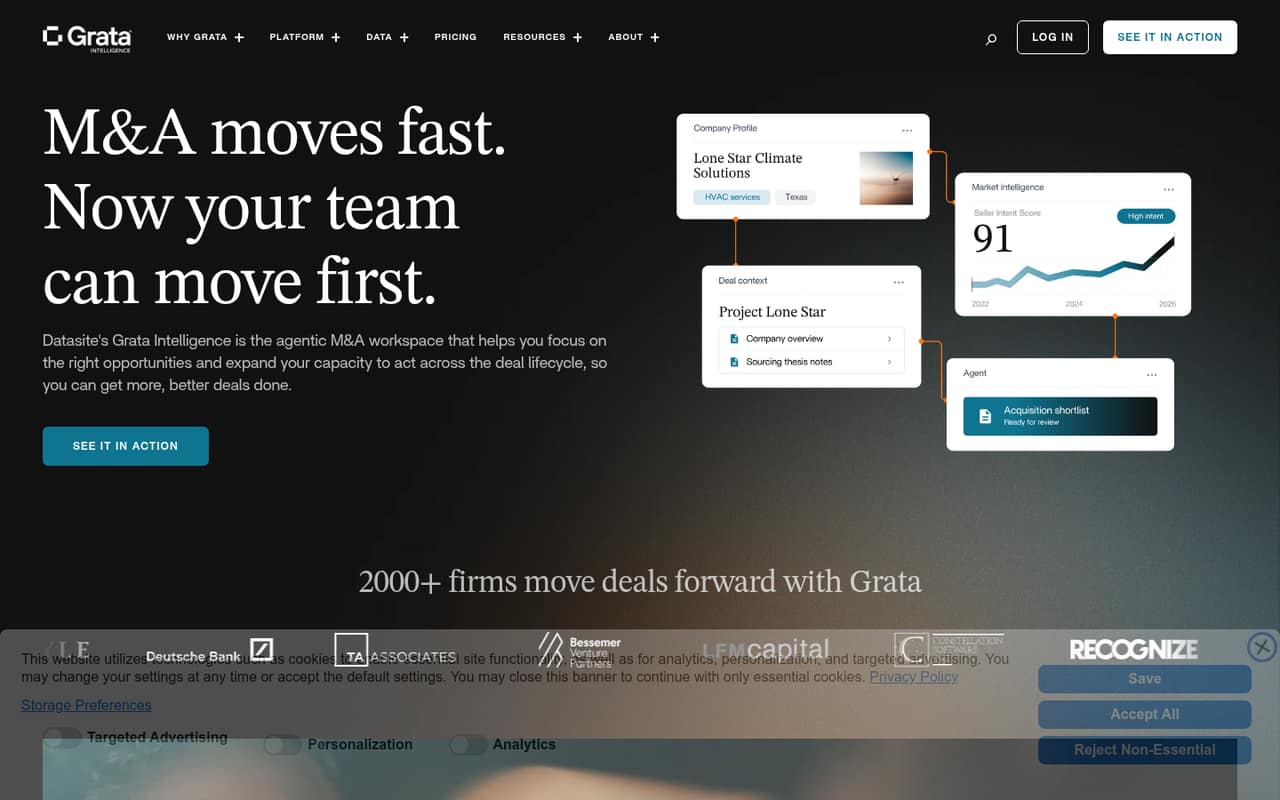
A small team only needs Grata if private-market deal research is a regular job. It brings company data, executive contacts, live deal information and firm deal context into one M&A workspace, with CRM connections and Blueflame for workflow support.
There’s no free plan, trial details aren’t published, and the vendor doesn’t list prices. Growth is the entry plan, but even a one-person team needs a quote to know whether it fits the budget.
Good fit if
- M&A teams sourcing private companies
- Independent sponsors with recurring research
- Teams using a supported CRM
Skip it if
- Teams needing a free database
- Buyers requiring clear per-seat pricing
- Teams seeking a standalone sourcing service
ScoresHow it rates
What works
- Covers 22M+ private companies and 10M executive contacts
- Includes 55K+ live deals and mandates
- Connects firm knowledge, transaction data and deal context
- Integrates with Salesforce, HubSpot, DealCloud and Affinity
- Growth includes basic CRM and O365 connectors
What doesn't
- No free plan or published free trial
- Growth, Scale and Alpha prices aren’t published
- The vendor directs buyers to book a demo
- Scale has an ingestion setup fee plus credits
- Reddit users describe private-company data as hit or miss
01Who Grata is for
Grata is for teams that repeatedly find and prioritize private-market companies, then move opportunities through M&A work. That can include a small independent sponsor, family office or corporate development group, as well as larger investors and advisors. The vendor’s plan descriptions point Growth at family offices and independent sponsors, Scale at advisors and mid-market investors, and Alpha at investment banks and mega funds.
For a team of one to ten, the fit depends less on headcount than on whether private-company research is core work. Grata lists data on 22M+ companies, 10M executive contacts and 55K+ live deals and mandates, alongside deal context and CRM connections. It’s a database and workspace to help a team qualify opportunities—not a promise of ready-made deals or outreach. Reddit commenters make that distinction too. If your team only needs occasional company lookups, an ongoing subscription with a quote-only price may be hard to justify.
02Grata free plan and trial
Grata has no free plan, and the vendor doesn’t publish a free-trial offer. That means a small team can’t use a free tier to check company coverage, test its research workflow or see whether the interface fits before budgeting for a subscription.
The cheapest way in is Growth, which the vendor lists for family offices and independent sponsors. It includes private-company data and financials, executive contacts and EU reported financials, basic CRM integration and sync, and basic O365 email and calendar connectors. The monthly and annual prices aren’t published, so the plan name doesn’t tell you what one or several seats will cost. Ask the vendor for a quote and confirm whether a demo gives your team access to the data and connectors you need to evaluate.
03What a small team pays for Grata
The vendor doesn’t publish prices for Growth, Scale or Alpha, or list monthly and annual rates. It directs buyers to book a demo. So the one-person cost is a quote, and the same is true for three or five people: there’s no published per-seat figure to multiply or reliable monthly-versus-annual comparison to make. Ask whether seats are priced individually, whether there’s a minimum contract, and how annual billing changes the total.
Growth is the lowest listed tier and includes company data, financials, executive contacts, basic CRM sync and basic O365 connectors. Scale adds deal data with multiples and valuations, advanced CRM sync, and an ingestion setup fee plus credits. Alpha adds seller-intent signals, API access, and ingestion setup included plus credits. The listed add-ons include Data Warehouse and API modules. Before comparing plans, ask for the full cost of your seat count, any required credits or setup, and which add-ons are optional.
04Getting started with Grata
The vendor doesn’t publish a setup timeline or a detailed learning curve, so a small team should treat implementation effort as a demo question rather than assume it’s plug-and-play. Growth lists basic CRM integration and sync plus basic O365 email and calendar connectors. Grata also lists connections for Salesforce, HubSpot, DealCloud and Affinity; Scale includes advanced CRM integration and sync.
For day one, pick the CRM your team actually uses and ask the vendor to confirm what the listed integration syncs, what needs configuration, and whether any setup or credits are required for your plan. Also ask how the team brings firm knowledge and deal context into the workspace. Blueflame is described as an agent that retrieves, reasons, analyzes and acts across M&A workflows, but the vendor doesn’t publish a setup estimate. Reddit users emphasize that these tools still need human work to qualify opportunities; plan for researchers to review the data, not just accept exports.
05When small teams outgrow Grata
Grata’s listed tiers divide features by buyer and workflow: Growth has basic CRM connections, Scale adds deal data, advanced CRM sync and ingestion credits, while Alpha adds seller-intent signals and API access. A team may need to move up when it wants those features, but the vendor doesn’t publish the price difference, seat costs or usage limits. Get a quote for the next tier before you build a process around it.
A different kind of growing pain is expecting a database to do all the sourcing work. One Reddit thread says Grata and similar products are databases, and another commenter says these tools help qualify opportunities when a team has the people to source. A commenter also warns that private-company information can be hit or miss and that teams may need manual work or more than one tool. If your team needs guaranteed coverage, fully managed outreach or predictable costs, ask the vendor what it can commit to—or compare other options before expanding.
From the threadsWhat users say
Reddit sentiment is mixed: commenters see Grata as a company-data database that can help qualify opportunities, not a complete sourcing solution. They also flag uneven private-company information and the need for manual work.
FYI grata and similar are not sourcing platforms. They are databases
Private company info is hit or miss regardless of what you spend
These tools help you qualify opportunities
At best you buy more than one tool. At worst, you do a good bit of manual work on top of the exports from the system
Questions people ask
How much does Grata cost?
The vendor doesn’t publish prices for Growth, Scale or Alpha, and doesn’t list monthly or annual rates. It directs buyers to book a demo. Ask for a quote that spells out the cost for your seat count, any contract minimum, and whether setup fees, credits or add-ons apply.
Is Grata free to use?
No free plan is listed, and the vendor doesn’t publish a free-trial offer. Growth is the lowest listed tier, aimed at family offices and independent sponsors. It includes private-company data and financials, executive contacts, basic CRM sync, and basic O365 email and calendar connectors.
What does Grata do?
Grata is an M&A workspace for finding and prioritizing private-market opportunities and moving deals forward. It combines company and transaction data, firm knowledge and deal context. The listed capabilities include executive contacts, live deal data, CRM connections and Blueflame, an agent for M&A workflows.
Which CRMs does Grata connect to?
Grata lists connections for Salesforce, HubSpot, DealCloud and Affinity. Growth includes basic CRM integration and sync; Scale includes advanced CRM integration and sync. Ask the vendor which sync features are available for your chosen CRM and whether configuration or additional fees apply.
Does Grata include seller-intent data?
Seller-intent signals are listed in Alpha, not Growth or Scale. The vendor describes these signals as identifying companies preparing to sell six to twelve months before going to market. Ask for a demo to see how the signals are presented and confirm the Alpha quote.