
We may earn a commission if you buy through links on this page. It never changes a score or a ranking. How we make money
The bottom line
HasData combines scraping APIs and no-code tools, with a free plan and paid plans from $49 monthly.
Small teams that need public website data in a usable format may not need to build and maintain their own scrapers. HasData manages scraping APIs and no-code tools, returning structured data, with proxies, rendering, and retries handled by the service.
The free plan includes 1,000 monthly credits, API requests, and no-code rows. Startup costs $49 per month for 200,000 of each, but pricing is based on usage quotas, not published per-seat rates. Check seat access and your expected usage before budgeting for a team.
Good fit if
- Small teams collecting public web data
- Teams that prefer visual scraper setup
- Developers who need scraping APIs
Skip it if
- Teams needing unlimited monthly collection
- Buyers who require published per-seat pricing
- Teams needing a named integration upfront
ScoresHow it rates
What works
- Free plan includes access to every API and scraper
- 63 API endpoints and 21 no-code scrapers
- No-code exports include CSV, XLSX, and JSON
- Managed rendering, proxies, and retries
- AI extraction turns webpages into structured JSON
What doesn't
- Free plan is capped at 1,000 monthly units in each quota
- Startup allows only five concurrent requests
- Seat-based pricing is not listed
- Annual per-month equivalent is not stated
- Enterprise pricing is custom
01Who HasData is for
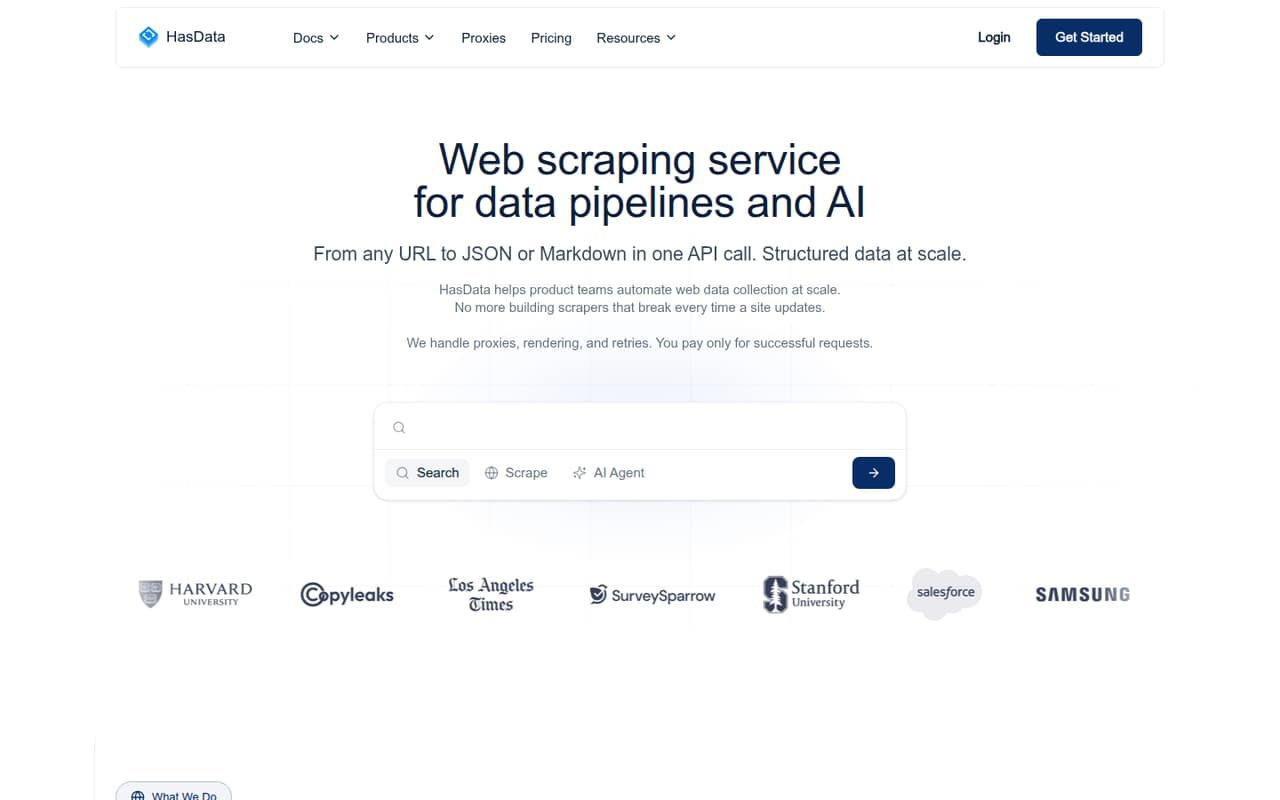
HasData fits a small team that needs recurring data from public websites but would rather not build and maintain its own scraping infrastructure. It collects website data and returns JSON or Markdown through managed APIs, or through visual no-code scrapers.
For a 1–10 person team, the job could be tracking public listings, gathering product information, or turning pages into structured records. The API route suits a developer who wants to send requests from an existing workflow. The no-code option is aimed at teams that want to configure scrapers visually, schedule collection, and export rows to CSV, XLSX, or JSON.
The free plan is enough to assess a small collection job. A team with regular usage can start at $49 per month, though that buys a usage allowance rather than a published number of seats. Confirm that the plan’s access and quotas fit your team before committing.
02HasData free plan and trial
HasData’s free plan costs $0 and includes 1,000 credits, 1,000 API requests, and 1,000 no-code rows per month. It allows five concurrent requests and access to every API and no-code scraper. That makes it a practical way to check whether a supported scraper or a small collection workflow meets your needs.
The main stop is volume: each listed monthly allowance is capped at 1,000. The pricing also lists no separate free trial; the free plan is the way to start without paying. When you need more usage, Startup costs $49 per month and raises the listed monthly quotas to 200,000 credits, API requests, and no-code rows. Its concurrency limit remains five, so higher volume does not automatically mean more simultaneous requests on that tier.
03What a small team pays for HasData
Startup is the cheapest paid plan at $49 per month, with 200,000 monthly credits, API requests, and no-code rows, plus five concurrent requests. For one person, that is $49 per month. HasData does not list a per-seat price, so the following is only a budget comparison: dividing $49 across three people is about $16.33 each; across five, it is $9.80 each. Confirm how many team members can use a plan before treating those figures as actual seat costs.
The next tiers are Basic at $99 per month for 1,000,000 of each monthly quota and 15 concurrent requests, and Growth at $208 for 3,000,000 and 50 concurrent requests. Annual billing is advertised as two months free, but its per-month equivalent is not stated. No separate small-team add-on prices are listed. Enterprise pricing is custom for volumes past 20 million monthly credits or terms outside the self-serve plans.
04Getting started with HasData
A team can approach HasData through an API or a visual no-code scraper. The no-code tools can be configured visually, scheduled, and exported to CSV, XLSX, or JSON. Developers can use the scraping APIs, while AI extraction can turn a webpage into JSON based on fields you describe.
The service handles browser rendering for dynamic content, single-page apps, and client-side JavaScript, along with proxy rotation and retries. That reduces the infrastructure a team needs to manage, but it does not tell you how long your own scraper setup will take. HasData does not publish a typical setup time in the published details. Before choosing a plan, ask whether your target sites and required workflow are supported, and whether HasData connects to the systems where your team needs the data. Those questions matter more than the size of your team alone.
05When small teams outgrow HasData
The first reason to upgrade is usage. Startup tops out at 200,000 monthly credits, API requests, and no-code rows, with five concurrent requests. Basic raises those quotas to 1,000,000 and concurrency to 15; Growth lists 3,000,000 and 50. A team hitting those limits should compare its collection needs with the next tier’s monthly price before upgrading.
Growth is the largest named self-serve plan in the pricing. Enterprise is custom for volumes past 20 million monthly credits or terms outside self-serve plans; it lists concurrency of 2,000 or more, credit rollover, and SAML single sign-on. Ask HasData about pricing and limits if you need more than Growth but are below that stated enterprise threshold. Since the listed prices are usage-based rather than seat-based, also confirm access rules and costs as more colleagues need to work with the data.
Questions people ask
Does HasData have a free plan?
Yes. The free plan costs $0 and includes 1,000 monthly credits, 1,000 API requests, and 1,000 no-code rows. It also allows five concurrent requests and access to every API and no-code scraper. The listed quotas are monthly, so check that your expected collection volume fits.
How much does HasData cost for a small team?
Startup is the cheapest paid plan at $49 per month. It includes 200,000 monthly credits, API requests, and no-code rows, with five concurrent requests. HasData lists usage quotas rather than per-seat prices, so ask how team access works before turning the plan price into a headcount budget.
Is HasData priced per user or per request?
The listed self-serve plans specify monthly credits, API requests, no-code rows, and concurrency limits; they do not list per-user prices. For example, Startup costs $49 monthly and includes 200,000 of each stated quota. Ask HasData whether your intended number of users can share a plan.
What does the HasData free plan include?
It includes 1,000 credits, 1,000 API requests, and 1,000 no-code rows per month, plus five concurrent requests. The free plan also provides access to every API and no-code scraper. A separate free trial is not listed; the free plan is the no-cost way to start.
When should a team upgrade from Startup?
Consider Basic when Startup’s 200,000 monthly credits, API requests, or no-code rows are not enough, or when you need more than five concurrent requests. Basic lists 1,000,000 of each quota and 15 concurrent requests for $99 per month. Compare your actual usage with those limits before upgrading.