
We may earn a commission if you buy through links on this page. It never changes a score or a ranking. How we make money
The bottom line
Kargo offers cross-screen ad tools, but custom pricing makes the cost tough to plan.
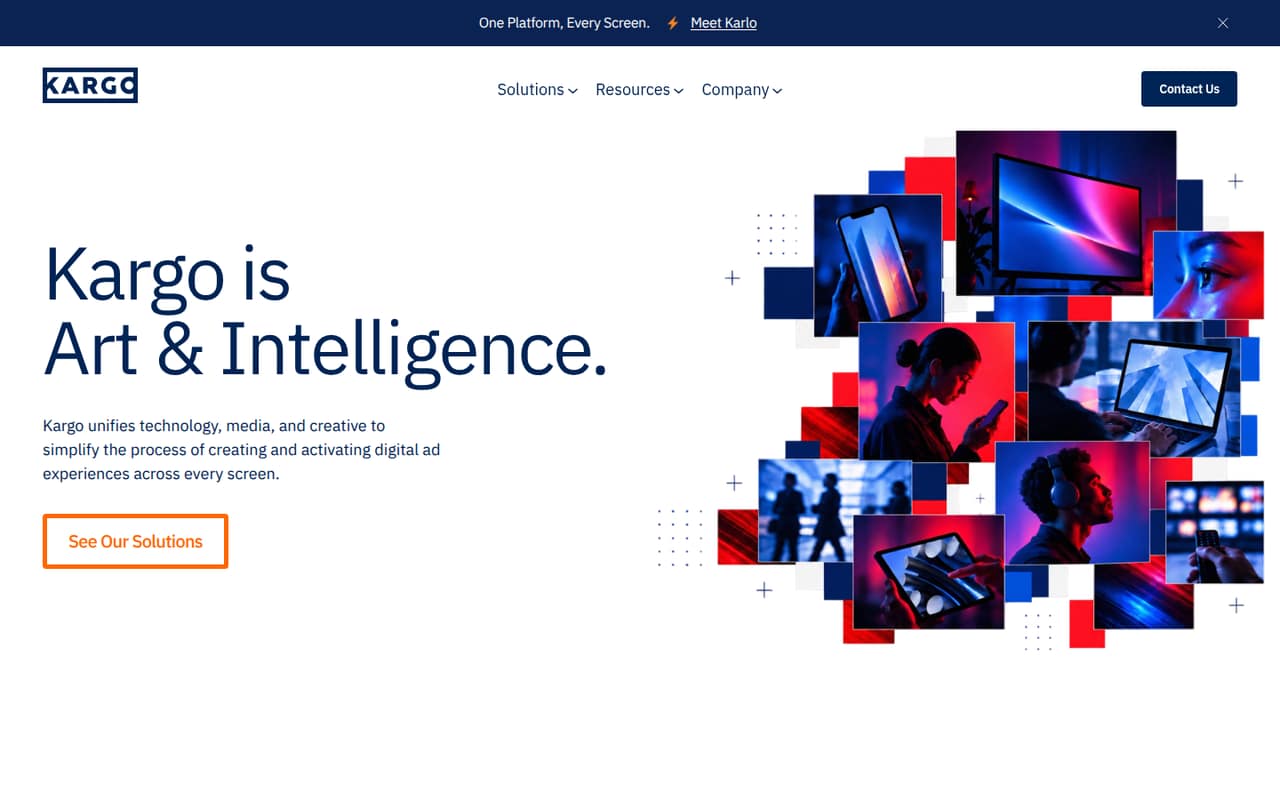
Kargo combines digital ad inventory, audience and contextual intelligence, and creative tools for campaigns across screens. Its offering includes CTV, social, open web, and emerging platforms, plus Kargo OS, which is designed to streamline campaigns from brief to business outcomes.
For a small team, the main hurdle is the buying model: the pricing page lists custom pricing, with costs potentially based on ad spend, CPM, or performance. There’s no listed free plan or public starting price, so teams will need to contact Kargo to assess fit and budget.
Good fit if
- Advertisers planning cross-screen campaigns
- Teams using CTV and social ads
- Brands seeking creative performance tools
Skip it if
- Teams needing a free ad platform
- Buyers requiring a published rate card
- Small teams seeking self-serve setup
ScoresHow it rates
What works
- Inventory spans CTV, social, open web, and emerging platforms
- Combines audience data with contextual signals
- Adapts creative across several screen types
- Includes cross-platform creative measurement
- Kargo OS is designed to streamline campaign work
What doesn't
- No free plan is listed
- Starting price is not published
- Pricing may depend on spend, CPM, or performance
- Setup effort and integrations are not published
- Small-team costs are hard to forecast
01Who Kargo is for
Kargo is for advertisers that want to plan and activate campaigns across screens, rather than a small team looking for a basic ad account with a public monthly fee. The offering combines an invitation-only inventory marketplace with audience and contextual intelligence, creative tools, and cross-platform measurement. Inventory spans CTV, social, the open web, and emerging platforms.
For a team of one to 10, Kargo may fit if digital advertising is a core job and the team has budget for a custom media arrangement. It could be relevant to a marketer coordinating CTV, video, display, and social creative, or a brand looking to adapt assets across channels. But there’s no published entry price to compare with a small-team budget, and invitation-only inventory means buyers should ask what access requires. If the team mainly needs a low-cost, self-serve way to run a few campaigns, Kargo’s public offer doesn’t establish that fit.
02Kargo free plan and trial
The pricing information lists no free plan and no free trial. That means there’s no published no-cost tier for a small team to use while it learns the platform or tests a campaign. The vendor also doesn’t publish a trial length or trial terms.
The cheapest way in is custom pricing for advertisers buying digital media. The pricing page says fees may be based on ad spend, CPM, or performance metrics, but it doesn’t give a minimum commitment or a sample quote. Before investing time in a sales process, ask Kargo whether it offers a pilot, what spend or campaign scope is required, and whether creative or measurement tools are included in the proposed price.
03What a small team pays for Kargo
Kargo’s listed plan is custom pricing for advertisers buying digital media. The pricing page says costs may be based on ad spend, CPM, or performance metrics. It doesn’t publish monthly or annual subscription rates, a starting price, or per-seat pricing.
So we can’t calculate a reliable cost for one person, three people, or five people, or compare monthly and annual billing. Kargo’s offer is media buying, not a published per-user subscription, and the number of seats may not be the main cost driver. Ask for a quote based on your intended channels, campaign scope, and spend, and request the total cost for the full team.
The vendor doesn’t publish add-on prices or a list of paid extras. Ask whether creative adaptation, measurement, audience intelligence, and access to specific inventory are included or priced separately. Until Kargo provides a quote, a small team can’t set a dependable subscription budget.
04Getting started with Kargo
Kargo describes its Kargo OS as a unified agentic system designed to streamline campaigns from brief to business outcomes. Its offering also includes tools for adapting brand assets across channels. Those descriptions indicate the intended workflow, but the vendor doesn’t publish a setup checklist, onboarding timeline, or learning curve.
Integration details and specific third-party connections aren’t published either. A small team should ask what account, campaign, creative, and measurement information it needs to provide on day one, and whether Kargo handles campaign setup or expects the advertiser to do it. It’s also worth confirming who will be the day-to-day contact and what training is included. Without those details, we can’t say whether setup is light enough for a one-person marketing team or better suited to a dedicated media buyer.
05When small teams outgrow Kargo
For Kargo, the bigger question may be whether a team’s budget and buying needs fit before it outgrows the platform. There’s no published seat limit, campaign limit, or price ladder to indicate when a team would need to upgrade. Pricing is custom and may depend on ad spend, CPM, or performance, so costs could change with campaign scope; the vendor doesn’t publish a formula or thresholds.
A growing team may need to reconsider Kargo if it requires predictable subscription costs, a self-serve entry point, or clear per-seat budgeting. That’s not proof Kargo lacks those options; its public pricing information doesn’t establish them. Before signing, ask how pricing changes as spend or channel coverage grows, whether multiple team members are included, and what happens to campaign access if the relationship ends. If the quote doesn’t fit the budget, a tool with published rates may be easier to plan around.
Questions people ask
What is Kargo?
Kargo is an advertising company combining technology, media, and creative services for digital campaigns across screens. Its offering includes an invitation-only inventory marketplace, audience and contextual intelligence, creative adaptation, and cross-platform measurement. The listed inventory spans CTV, social, the open web, and emerging platforms.
What does Kargo AI do?
Kargo describes Kargo OS as a unified agentic system designed to streamline campaigns from brief to business outcomes. The vendor’s description doesn’t spell out specific AI functions or which tasks the system automates. Ask Kargo for a walkthrough of the workflow and what requires advertiser input.
How much does Kargo cost?
The pricing page lists custom pricing for advertisers buying digital media. It says pricing may be based on ad spend, CPM, or performance metrics, but does not publish a starting price or monthly and annual rates. Request a quote that covers your campaign scope, channels, and team.
Does Kargo have a free plan or trial?
The listed pricing information shows no free plan and no free trial. It also doesn’t publish trial terms. The listed route is custom pricing, so ask Kargo whether it can offer a pilot and what budget, campaign scope, or commitment that would require.
Which advertising channels does Kargo support?
Kargo says its invitation-only marketplace spans CTV, social, the open web, and emerging platforms. Its creative tools adapt assets for CTV, online video, display, social, and other platforms. Ask the vendor which specific inventory and creative formats are available for your campaign.