
We may earn a commission if you buy through links on this page. It never changes a score or a ranking. How we make money
The bottom line
Useful operations coverage for convenience businesses, but custom pricing makes the small-team value hard to judge.
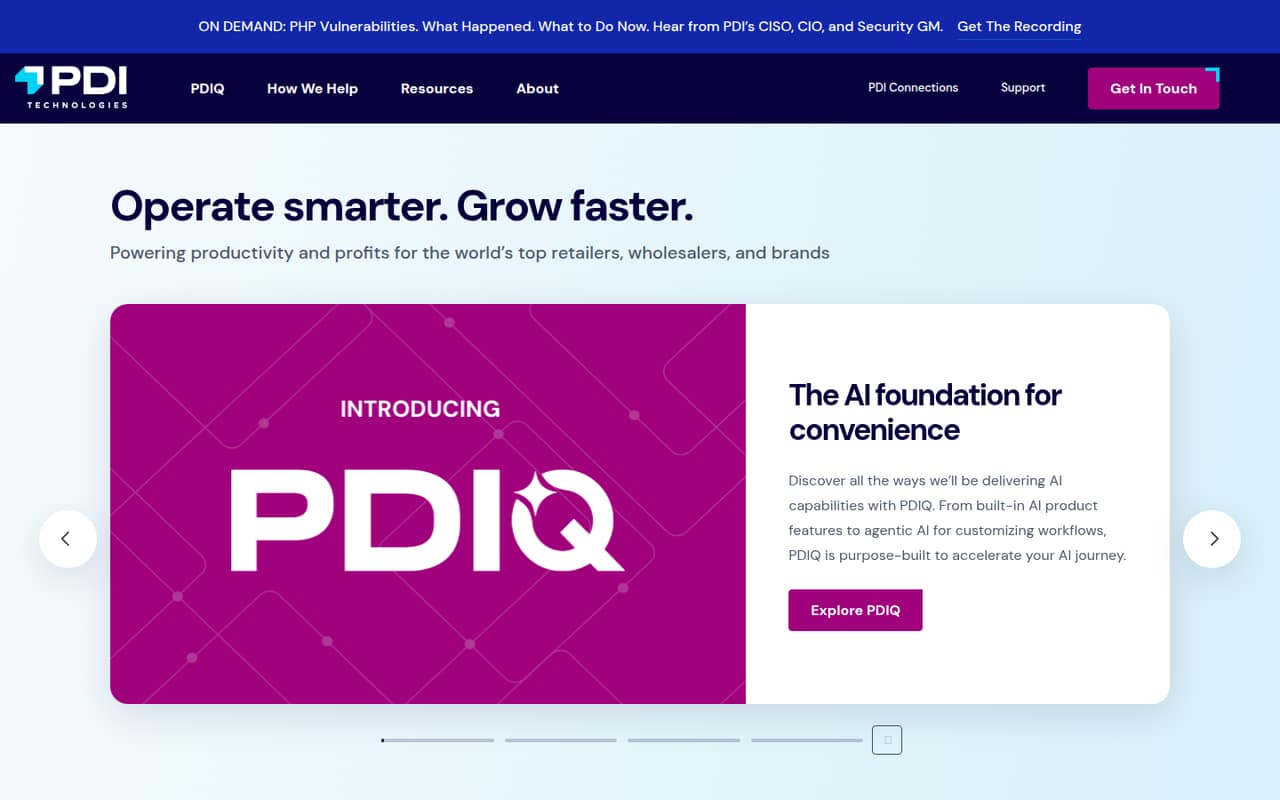
PDI Enterprise brings together operations capabilities for convenience retailers, petroleum wholesalers, and brands. Its listed features include payroll, scheduling, employee self-service, invoicing, AI capabilities, and consumer loyalty tools.
The fit depends on whether your business needs that industry-specific mix. The vendor lists no free plan or trial, and its pricing is custom, so small teams should ask for a quote covering their required modules and seats.
Good fit if
- Convenience retailers managing staff
- Petroleum wholesalers handling invoicing
- Operators seeking loyalty tools
Skip it if
- Teams needing a free plan
- Buyers requiring published seat pricing
- Businesses seeking a general-purpose tool
ScoresHow it rates
What works
- Payroll is included in the listed capabilities
- Scheduling can account for foot traffic
- Employees can access pay and schedules
- Invoicing is a listed use case
- PDI Loyalty includes offers, payments, and rewards
What doesn't
- Pricing requires contacting sales
- No free plan is listed
- No free trial is listed
- Seat costs are not published
- Setup and integration details are not published
01Who PDI Enterprise is for
PDI Enterprise is aimed at businesses in convenience retail and petroleum wholesale, rather than teams looking for a general-purpose business app. The vendor highlights payroll, employee scheduling, self-service for staff, and invoicing. Its homepage says Colonial Oil Industries handles all its invoicing through PDI Enterprise.
For a small team, the practical question is whether you need several of those jobs handled together. A convenience operator managing employee pay and schedules may value having those functions in one industry-focused system; a wholesaler may care more about invoicing. The vendor does not publish a minimum team size, so it is not clear whether a one-person business or a ten-person team is its intended starting point. Budget matters, too: pricing is custom, with no published starting price. Ask sales to quote your actual team size and required functions before treating it as a fit.
02PDI Enterprise free plan and trial
The vendor does not list a free plan or free trial for PDI Enterprise. That means a small team should not expect to use a no-cost tier to check whether its payroll, scheduling, or invoicing needs fit the platform. The cheapest way in is to contact sales for a custom quote; the vendor does not publish a starting price.
Before agreeing to a purchase, ask whether the quote includes the specific functions you need, how many employee or administrator accounts it covers, and whether there are separate fees for setup or support. Those details can change the real cost of a small deployment. Also ask whether the vendor can show the relevant workflows before you commit, since no public trial terms are listed. Without a trial or published entry tier, budget-conscious teams should get the full scope and cost in writing.
03What a small team pays for PDI Enterprise
PDI Enterprise pricing is custom. The pricing information lists no monthly or annual amount, and the vendor does not publish a starting price. So there is no reliable per-seat calculation for one person, three people, or five people—and no monthly-versus-annual comparison to make. Contact sales for a quote based on your actual team and requirements.
The vendor lists capabilities including payroll, scheduling, employee self-service, invoicing, PDIQ AI features, and PDI Loyalty. It does not publish which functions are bundled into a base package or priced separately, so we cannot identify add-on costs. Ask for a written breakdown that names each included product, account or seat assumptions, billing frequency, and any setup or support charges. For a small business watching every subscription, compare the total quote with the cost of the functions you will actually use. Until the vendor supplies that quote, the budget impact remains unknown.
04Getting started with PDI Enterprise
The vendor does not publish a setup timeline, onboarding steps, or learning-curve estimate for PDI Enterprise. Its listed functions span employee operations, invoicing, AI workflow customization through PDIQ, and consumer loyalty through PDI Loyalty, but the public feature descriptions do not explain how a new customer configures them.
Integration details are not published either, so a small team should confirm whether PDI Enterprise connects to the payroll, accounting, point-of-sale, or other systems it already uses. Ask who handles data setup, what information you need to provide, how employees get access to pay and schedules, and whether training or implementation is part of the quote. These answers will help you estimate the internal time required. Until the vendor outlines those steps for your package, setup effort and the day-one integration list are unknown.
05When small teams outgrow PDI Enterprise
PDI Enterprise’s published descriptions do not give seat limits, usage caps, or feature thresholds that indicate when a customer must upgrade. Since pricing is custom, a growing team also cannot forecast from a public per-seat rate how payroll or employee access might affect its bill. Ask the vendor what happens to your quote as headcount, locations, or required functions change.
A small team may find the platform is more than it needs if it only wants one function, such as scheduling, and does not plan to use the broader operations features. On the other hand, a business that needs more workflows than its quoted package includes should clarify whether it can add them and what that costs. Before choosing, get the package boundaries, account assumptions, and expansion pricing in writing. Without published limits or rates, the point where the tool becomes too costly or restrictive depends on your quote.
Questions people ask
Is PDI Enterprise an ERP?
PDI describes Enterprise as software for businesses in convenience retail and petroleum wholesale, with capabilities including payroll, scheduling, employee self-service, and invoicing. The vendor does not label it an ERP in the information available here. Ask PDI whether the specific business processes you consider part of an ERP are covered by your proposed package.
What companies use PDI Enterprise?
PDI’s homepage names Colonial Oil Industries and says the company handles all its invoicing through PDI Enterprise. The vendor positions the software for convenience retailers, petroleum wholesalers, and brands. Ask PDI for customer references in your business segment if you want examples beyond the one named customer.
What does PDI mean in business?
PDI is the name used by PDI Technologies, the company offering PDI Enterprise. The vendor does not publish an expansion of the initials in the information available here. In this context, PDI Enterprise refers to its operations software for convenience retail and petroleum wholesale businesses.
Is PDI Enterprise a POS system?
PDI Enterprise is described as operations software, with listed capabilities such as payroll, scheduling, employee self-service, and invoicing. PDI Loyalty includes payments and rewards, but that alone does not establish that PDI Enterprise is a point-of-sale system. Ask the vendor which POS functions and integrations are included in your quote.
Does PDI Enterprise offer a free plan or trial?
The vendor does not list a free plan or free trial for PDI Enterprise. Pricing is custom and requires contacting sales, and no starting price is published. If you want to evaluate the software before buying, ask sales whether it can provide a demonstration and what evaluation options are available.