
We may earn a commission if you buy through links on this page. It never changes a score or a ranking. How we make money
The bottom line
Useful wallet infrastructure for digital-asset products; small teams should check usage limits before paying $299 a month.
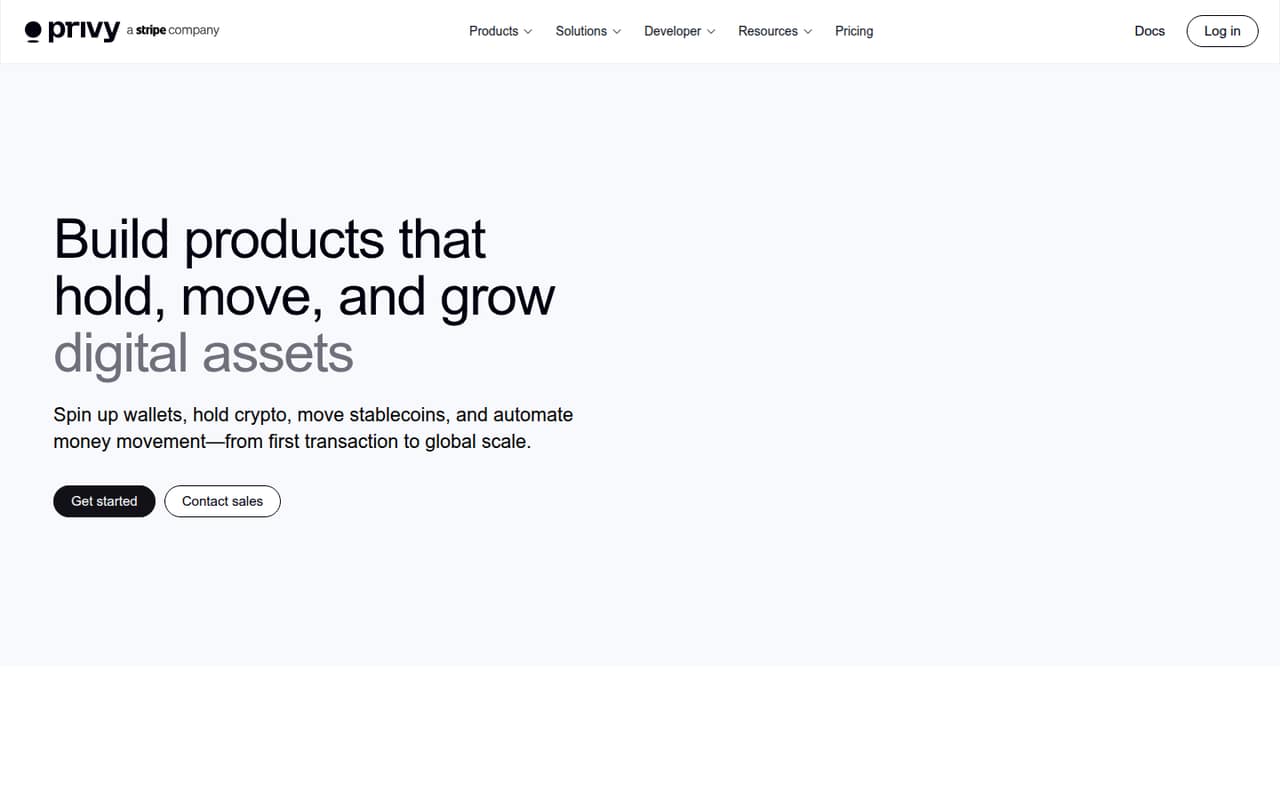
Privy provides embedded wallets, key management, programmable transfer controls, funding tools, cards and agent wallets. It’s aimed at products that handle digital assets, not teams looking for a general-purpose app or a simple wallet for everyday use.
The Free plan includes up to 500 monthly active users (MAU), 50,000 signatures and $1 million in monthly transaction volume. Core starts at $299 per month, with the same listed signature and transaction-volume allowances. There’s no published annual rate or per-seat price.
Good fit if
- Crypto products embedding user wallets
- Teams automating stablecoin money movement
- Products needing programmable transfer controls
Skip it if
- Teams that don’t handle digital assets
- Buyers seeking a no-code wallet app
- Small budgets above the free limits
ScoresHow it rates
What works
- Free plan includes up to 500 MAU
- 50,000 signatures included each month
- $1 million monthly volume listed on Free
- Wallets, funding and card tools in one offering
- Enterprise offers dedicated support and premium SLAs
What doesn't
- Core starts at $299 per month
- Annual billing rates aren’t published
- Pay-as-you-go lists a $2,000 base fee
- Advanced SSO add-on pricing isn’t published
- Setup effort and integrations aren’t specified
01Who Privy is for
Privy is for a small product team building something that holds or moves digital assets. That might be a consumer app embedding wallets, a product handling stablecoin payments, or software that needs to automate transfers. Privy’s offering includes embedded wallets, key management, programmable rules and approvals, funding infrastructure, card programs connected to wallet balances, and wallets for autonomous agents.
For a team of one to ten, the headcount matters less than the product’s activity: the pricing page is organized around monthly active users, signatures and transaction volume, not seats. A team still within the Free limits can start without a subscription fee. Once it needs Core, the listed price is $299 per month, whether the team has one person or several; Privy doesn’t publish per-seat pricing. This is specialist financial infrastructure, so it makes sense when wallets and asset movement are part of the product—not just because a small team wants a crypto feature someday.
02Privy free plan and trial
Privy’s Free plan costs $0 per month and includes up to 500 MAU, 50,000 signatures per month, $1 million in monthly transaction volume and core features. That gives a small product team room to build and serve a limited user base before taking on a monthly subscription. The pricing page doesn’t list a free-trial period, so the free plan is the published way to start without paying.
The plan stops being a fit when usage goes beyond its listed allowances. Core is $299 per month and lists 500–2,499 MAU (up to 2,500), with 50,000 free monthly signatures and $1 million in monthly transaction volume. The same signature and volume amounts appear on Scale, at $499 per month. Check how Privy handles usage above those limits before relying on the free tier for a live product.
03What a small team pays for Privy
Core is the cheapest paid plan, listed at $299 per month. That’s $299 for one person, $299 for a three-person team and $299 for a five-person team: Privy lists plan prices, not per-seat rates. No annual billing price is published, so we can’t give an annual total or claim a discount. Scale is $499 per month, again with no published seat-based charge.
The bigger budgeting question is usage. Core lists 50,000 free signatures per month and $1 million in monthly transaction volume. The pricing FAQ says pay-as-you-go applies above 10,000 MAU, 50,000 monthly signatures or $1 million in monthly transaction volume. It lists a $2,000 base fee, $0.05 per MAU above 10,000 and $0.01 per signature above 50,000. Those thresholds can make a small team’s bill jump well beyond the plan price, so ask how the base fee applies to your expected usage. Advanced SSO is available as an add-on, but its price isn’t published.
04Getting started with Privy
Expect to treat Privy as product infrastructure, not a ready-made app that your whole team can start using without development work. Its listed tools include embedded wallets, key management and programmable controls; connecting those capabilities to a product will likely involve engineering. That’s a practical expectation based on what Privy offers, not a published implementation estimate.
The vendor's site available from Privy doesn’t specify setup time, the learning curve, or which integrations a small team needs on day one. It also doesn’t publish a standard onboarding checklist in the pricing details. Before choosing a plan, ask Privy what implementation work your wallet flow requires, which languages or platforms it supports, and whether those integrations are included in the plan. Enterprise lists dedicated support and custom integrations; equivalent support terms for Free, Core and Scale aren’t specified. Budget for technical evaluation rather than assuming a quick self-serve setup.
05When small teams outgrow Privy
The first pressure point is activity, not headcount. Free covers up to 500 MAU, while Core lists up to 2,500 MAU and Scale covers 2,500–9,999. Both paid plans list 50,000 free signatures per month and $1 million in transaction volume. If your usage crosses the stated pay-as-you-go thresholds, the pricing FAQ lists a $2,000 base fee plus charges for MAU and signatures above their thresholds. Confirm the billing calculation before growth pushes you over.
A team may also outgrow the standard plans if it needs advanced controls, custom integrations, or more tailored support. Enterprise offers custom pricing per transaction or transacting wallet, premium SLAs, dedicated support, webhooks, SSO and custom integrations. Its signature pricing can be as low as $0.001, but that is not a general rate for every customer. If you need a predictable per-seat subscription or don’t need wallet infrastructure, Privy’s usage-based structure may be a reason to reconsider rather than upgrade.
Questions people ask
Is Privy free to use?
Yes. The Free plan is listed at $0 per month and includes up to 500 MAU, 50,000 signatures per month, $1 million in monthly transaction volume and core features. If you exceed the applicable usage thresholds, pay-as-you-go charges may apply; the pricing FAQ lists a $2,000 base fee.
What is Privy used for?
Privy provides wallet and financial infrastructure for products that hold crypto, move stablecoins or automate money movement. Its listed tools include embedded wallets, key management, programmable transfer controls, funding, card programs connected to wallet balances and wallets for autonomous agents.
Is Privy safe to use?
Privy describes its offering as including secure, programmable key infrastructure and controls for rules, approvals and transfers. Those capabilities don’t guarantee that a particular product or configuration is safe. Ask Privy about the controls, responsibilities and safeguards relevant to your wallet design before launch.
How much does Privy cost for a small team?
The Free plan costs $0 per month. Core is listed at $299 per month and Scale at $499 per month; Privy doesn’t publish per-seat pricing, so the listed plan price is the same for a one-, three- or five-person team. Annual prices aren’t published.
Does Privy offer cards and agent wallets?
Yes. Privy lists card programs that connect directly to wallet balances and agent wallets that let autonomous agents hold funds and execute transactions. Ask Privy which plan and implementation requirements apply to the specific card or agent-wallet flow you want to build.