
We may earn a commission if you buy through links on this page. It never changes a score or a ranking. How we make money
The bottom line
Quail pairs vendor-focused store tools with a $40 monthly starting price and a 30-day trial.
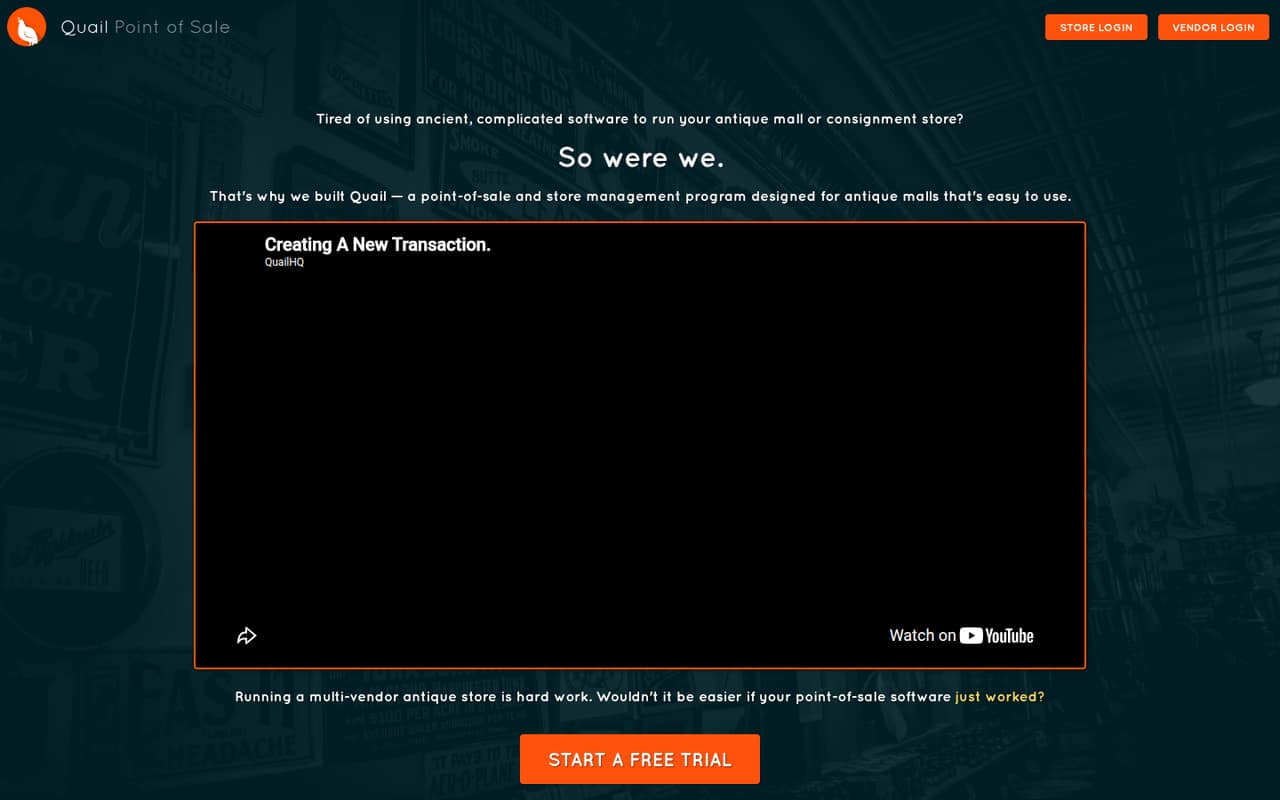
Quail is point-of-sale and store management software for antique malls, vendor stores, and consignment shops. It covers checkout, vendor fees, sales reports, layaway, and weekly vendor summaries, with hourly cloud backups and clerk access controls.
The Basic plan costs $40 per month for up to 30 vendors and includes unlimited clerks. There’s no free plan, but the pricing page lists a 30-day trial. Setup requirements and integrations aren’t published, so ask the vendor about those before you commit.
Good fit if
- Antique malls with vendor booths
- Consignment shops tracking vendor sales
- Small teams sharing store checkout
Skip it if
- Retailers needing a free plan
- Teams seeking published integrations
- Stores outside antique or consignment retail
ScoresHow it rates
What works
- Basic includes up to 30 vendors for $40 monthly
- Unlimited clerks are included on every listed plan
- Supports cash, checks, and card split payments
- Tracks booth rent and per-item consignment fees
- Includes hourly cloud backups and weekly vendor emails
What doesn't
- No free plan
- Annual billing prices aren’t published
- Setup time and onboarding details aren’t published
- Integration details aren’t published
- Basic is capped at 30 vendors
01Who Quail is for
Quail is aimed at antique malls, vendor malls, and consignment shops that need store checkout tied to vendor activity. It suits a small staff: the Basic plan includes unlimited clerks, so a one-person shop and a team of 10 can use the same tier if they have no more than 30 vendors.
The software brings sales checkout, vendor fees, sales reports, layaway tracking, and vendor summaries into one system. Staff can pause transactions and split payments across cash, checks, or cards. Stores can charge monthly booth rent, per-item consignment fees, or both, and vendors can receive weekly sales summaries by email. For a small shop that currently tracks those tasks in separate places, this is a focused option. It is less relevant if you need a general-purpose retail system or a free tool.
02Quail free plan and trial
Quail does not have a free plan. The pricing page lists a 30-day trial, but it doesn’t say which plan features or vendor limits are available during the trial. Ask the vendor whether the trial gives your team access to the full Basic plan and whether you can bring in existing store or vendor data.
The cheapest listed way to keep using Quail after the trial is Basic at $40 per month. It covers up to 30 vendors, unlimited booths, and unlimited clerks, along with hourly data backups and weekly vendor summary emails. There’s no separate per-clerk charge listed, so the key fit question is your vendor count rather than your staff count.
03What a small team pays for Quail
Basic costs $40 per month for up to 30 vendors. Because the price is per store plan, not per seat, one clerk costs $40 per month; three clerks work out to $13.33 per person, and five to $8 per person. Those are monthly equivalents, not separate seat prices. At the listed monthly rate, the annualized spend is $480; the pricing page does not publish an annual billing price or discount.
Basic includes unlimited clerks and booths, hourly data backups, and weekly vendor summary emails. There are no add-ons listed. If the store grows beyond 30 vendors, Regular costs $70 monthly for up to 60 vendors. Full costs $135 monthly and allows unlimited vendors. The pricing page lists flat monthly subscriptions, so confirm billing terms and any other charges with the vendor before signing up.
04Getting started with Quail
Quail’s checkout and store tasks are clearly aimed at vendor-based retail: sales, vendor fees, layaway, reports, vendor summaries, and clerk access controls. But the vendor doesn’t publish a setup timeline, onboarding steps, training materials, or a learning-curve estimate. We can’t responsibly put a number on how long it will take your team to get running.
The vendor also doesn’t publish an integration list. Before choosing Quail, ask whether it connects to the payment processor, accounting software, or other systems your store already relies on. It’s also worth asking how to import vendor records and sales data, and what clerks need to learn before their first shift. The listed 30-day trial gives you a chance to confirm those details with the vendor before moving to a paid plan.
05When small teams outgrow Quail
The clearest reason to move up is adding vendors. Basic stops at 30, so a store that exceeds that limit would need Regular at $70 per month, which covers up to 60 vendors, or Full at $135 per month for unlimited vendors. Those plans also include unlimited clerks, so adding employees alone doesn’t require a higher tier based on the published limits.
The pricing page lists the same core inclusions—unlimited booths and clerks, hourly backups, and weekly vendor summaries—across all three plans. It doesn’t describe feature differences between tiers, so ask the vendor whether anything besides vendor capacity changes. If your store needs an integration or workflow that Quail doesn’t support, the published plan details won’t answer that; confirm your requirements before committing or expanding.
Questions people ask
Does Quail have a free plan?
No. Quail’s pricing page lists a 30-day trial, but not a free plan. The trial’s included features and vendor limits aren’t published, so ask the vendor what access it provides. The lowest listed paid plan is Basic at $40 per month for up to 30 vendors.
How much does Quail cost for a small store?
The Basic plan is $40 per month and covers up to 30 vendors, unlimited booths, and unlimited clerks. The pricing page lists monthly subscriptions and doesn’t publish an annual billing price. If you exceed 30 vendors, Regular is $70 monthly for up to 60 vendors.
Does Quail charge per clerk?
The listed plans include unlimited clerks, and the pricing page gives flat monthly plan prices rather than per-seat rates. Basic costs $40 per month whether one clerk or several use it, as long as the store fits its vendor limit. Confirm any other charges with the vendor.
What payments can Quail handle at checkout?
Quail supports pausing transactions and splitting payments across cash, checks, or cards. The product description doesn’t specify which payment processors or card terminals it works with. Ask the vendor to confirm compatibility with your current payment setup before you choose a plan.
When does a store need to upgrade from Basic?
Basic covers up to 30 vendors. The next listed tier, Regular, costs $70 per month and covers up to 60; Full costs $135 per month and allows unlimited vendors. All listed plans include unlimited clerks, so staff count alone isn’t a published reason to upgrade.