
We may earn a commission if you buy through links on this page. It never changes a score or a ranking. How we make money
The bottom line
Good lab-specific workflows, but the paid entry price is a tough fit for budget-conscious teams.
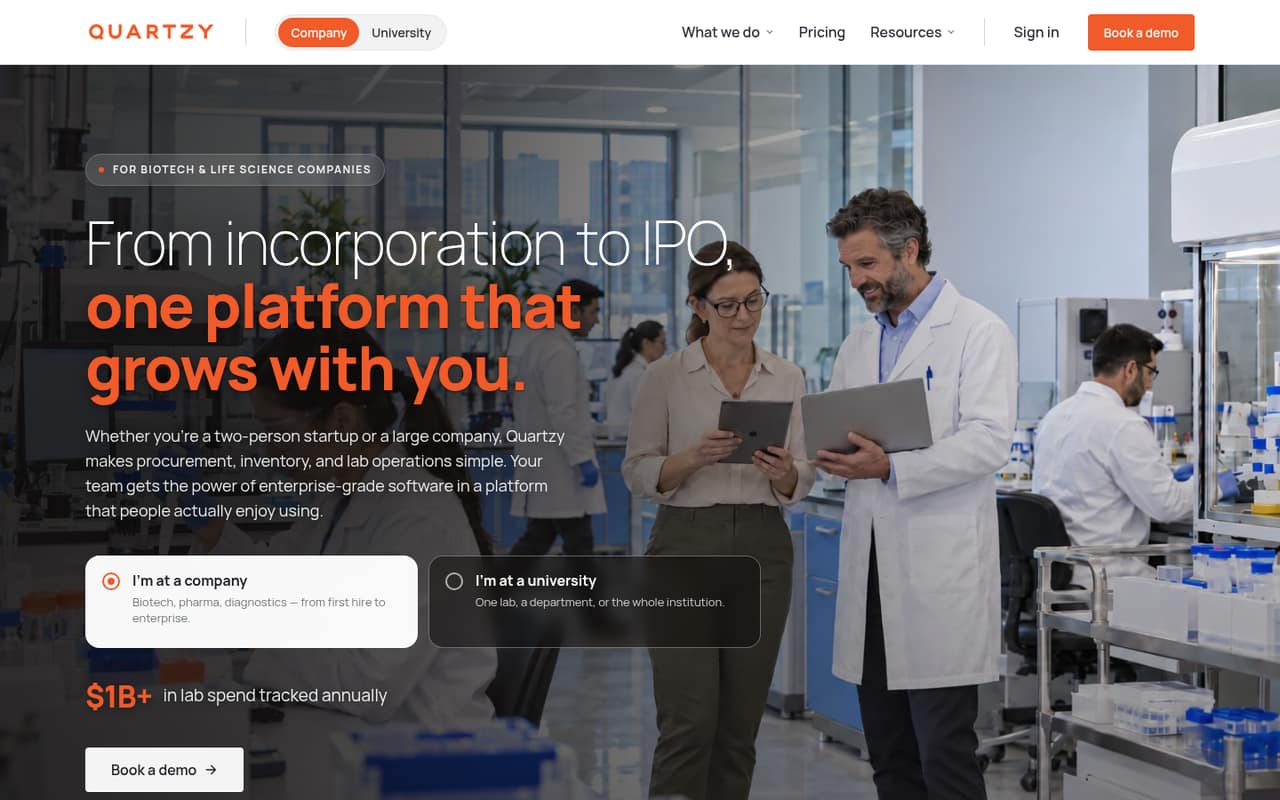
Quartzy connects lab purchasing requests, approvals, orders, receipts, invoices, and inventory tracking. It suits teams that want those jobs in one system rather than a spreadsheet and separate purchasing process.
The pricing page lists no free plan: Academia starts at $50 per month, billed annually, for three included users. That may work for an academic lab with a real need for shared workflows, but Reddit users report frustration with the move from free access to paid plans.
Good fit if
- Academic labs with shared purchasing
- Small biotech procurement teams
- Labs tracking lots and expiration dates
Skip it if
- Labs that need a free system
- Teams with very tight software budgets
- Groups needing unpriced extra seats
ScoresHow it rates
What works
- Connects requests, approvals, orders, receipts, and invoices
- Tracks inventory across locations, lots, and expiration dates
- Shows spend by team, project, and grant
- Academia includes three users
- Supports accounting, ELN, SSO, PunchOut, and API connections
What doesn't
- No free plan is listed
- Academia and Industry require annual billing
- Monthly billing prices are not listed
- Extra seat prices are not published
- Some users objected to the paid-plan change
01Who Quartzy is for
Quartzy is for biotech, pharma, diagnostics, and university labs that need to manage purchasing and inventory in one place. The pricing page lists Academia with three users included and Industry with five, so those plans fit a small lab better than a solo buyer or a large group. Teams of up to 10 should check the cost of additional seats before settling on a plan.
The job it handles is specific: staff can request supplies, route approvals, track orders through receipt and invoice, and keep inventory records across locations. The product also tracks lots and expiration dates and shows spend by team, project, and grant. Its homepage says it serves teams from startups to public companies. For a small team, the key question is whether those shared records save enough administrative work to justify a paid subscription.
02Quartzy free plan and trial
The pricing page lists no free plan, and a free trial is not listed. That makes Quartzy a paid tool for a new team comparing options. The cheapest listed entry is Academia at $50 per month when billed annually, with three users included. Industry starts at $250 per month, also billed annually, and includes five users.
Reddit users describe the change from free access to paid plans as a difficult adjustment for some academic labs. One user said their lab had used Quartzy for more than nine years and called the change a major inconvenience. If your lab cannot budget for a subscription, plan around a spreadsheet or ask Quartzy whether any current offer applies to your organization; the pricing page lists no free tier to fall back on.
03What a small team pays for Quartzy
The pricing page lists Academia at $50 per month, billed annually: $600 per year for three included users. That works out to $16.67 per included seat per month if all three seats are used. A one-person academic lab still pays the listed $50 monthly equivalent, or $600 annually; the unused seats do not lower the plan price.
Industry is $250 per month, billed annually, or $3,000 per year for five included users. That is $50 per included seat per month when all five seats are used. A three-person company team would still be looking at the Industry plan’s $250 monthly equivalent, not a three-seat price. Monthly billing is not listed, and the pricing page does not publish additional-seat prices.
SDS Automation, Procure-to-Pay Automation, BioPASS Procurement Services, PunchOuts, and other integrations or analytics may cost extra. Quartzy does not publish those add-on prices, so ask for a quote before budgeting.
04Getting started with Quartzy
Quartzy brings several lab workflows together, so a team will need to decide how it wants to handle requests, approvals, purchasing, receiving, and inventory records. The vendor does not publish a setup-time estimate for the Academia or Industry plans. For a small group, agree on who can request and approve items, what inventory details to record, and how existing purchasing steps fit before inviting the whole lab.
The listed connections include accounting, ELN, SSO, PunchOut, collaboration, and API integrations. A small team may not need all of them on day one; confirm which ones are included in its plan and whether any carry an extra charge. Quartzy’s Enterprise plan lists a custom implementation plan, but that is not listed as an Academia or Industry feature. In one Reddit thread, a user described finding Quartzy’s inventory history useful for checking who ordered and received an item.
05When small teams outgrow Quartzy
The first pressure point is price. Academia includes three users and Industry includes five; additional seats are available, but Quartzy does not publish their price. A lab approaching 10 people should get the added-seat cost in writing and compare it with the Enterprise plan, which has custom pricing and unlimited users. Enterprise also lists PunchOut and ERP integrations, custom SAML or OIDC, and a custom implementation plan.
Teams may also outgrow Quartzy if they need a free option or cannot justify paying for a purchasing system their institution does not use to place orders. Reddit users describe moving away after the paid change, and one commenter said their lab planned to return to a spreadsheet. Others said they valued Quartzy’s order and inventory history. The choice depends on whether those records and linked workflows are worth the subscription to your lab.
From the threadsWhat users say
Reddit sentiment is mixed but leans negative on the move to paid plans, especially among academic labs with limited budgets. Some users still describe the inventory history and purchasing workflow as useful.
If I was looking for something, I could search the inventory system, see when an item was last ordered, who received it
this is going to be a major inconvenience -- we've been using Quartzy for over 9 years now for order management!
Going back to a Google Sheet will take a bit of organization, but a minimum of $1000 a year for a lab with the academic discount is way too much for this to be worth it
You can change a quartzy request to be a non quartzy request with the same sku by using the change vendor option
Questions people ask
How does Quartzy work?
Quartzy brings lab purchasing and inventory workflows together. Teams can manage requests, approvals, purchase orders, receipts, and invoices, while tracking inventory across locations, including lots and expiration dates. Its listed features also include spend visibility by team, project, and grant.
How much does Quartzy cost per month?
The pricing page lists Academia at $50 per month and Industry at $250 per month, both billed annually. Academia includes three users and Industry includes five. Enterprise pricing is custom. Monthly billing and additional-seat prices are not listed.
Is Quartzy paid?
The pricing page lists paid plans and no free plan. Academia starts at $50 per month, billed annually, for three included users. Industry starts at $250 per month, billed annually, for five. A free trial is not listed.
What is Quartzy?
Quartzy is procurement, inventory, and lab operations software for biotech, pharma, diagnostics, and university labs. It combines purchasing workflows, inventory tracking, and spend visibility, with integrations available for systems such as accounting software, ELNs, and SSO.
Can a small lab use Quartzy?
Yes. The listed Academia plan includes three users, while Industry includes five. Both are billed annually, so check the annual commitment and any extra-seat or add-on costs before signing up. Quartzy does not list a free plan.