We may earn a commission if you buy through links on this page. It never changes a score or a ranking. How we make money
The bottom line
Useful data coverage for custom tools, but no free plan and no published prices make budgeting tough.
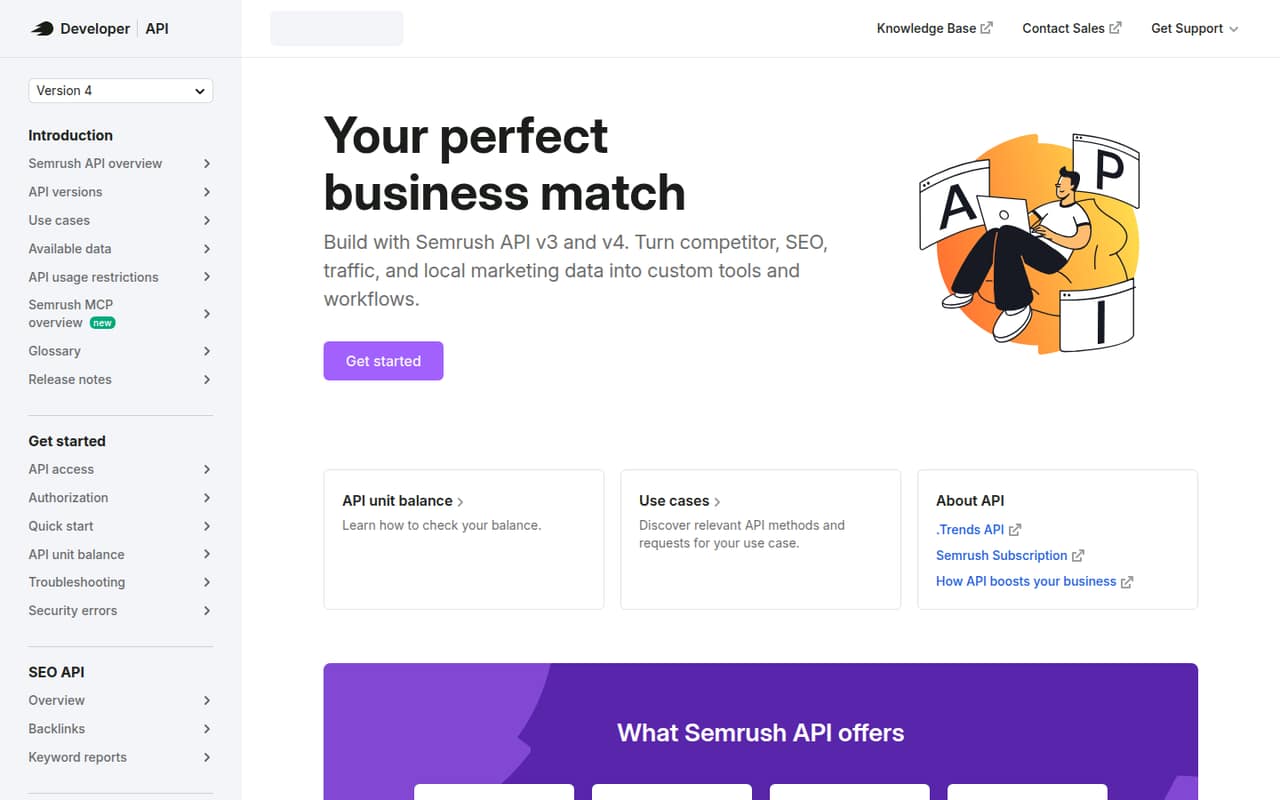
Semrush API gives developers access to SEO, traffic, competitor, local marketing, rank tracking and enterprise visibility data. That range can suit a small team building custom reports or workflows, but it is not a ready-made tool for nontechnical users.
There is no free plan, and Standard API calls use units with none included. Prices for API access and unit packages are not published, so a team should confirm its full subscription and usage cost before committing.
Good fit if
- Teams building custom SEO tools
- Agencies automating client reporting
- Local marketing workflow developers
Skip it if
- Teams needing free API access
- Nontechnical teams seeking plug-and-play
- Buyers requiring predictable published prices
ScoresHow it rates
What works
- Covers SEO, traffic, competitor and local data
- Includes project management API operations
- Map Rank Tracker API needs no specific subscription
- Trends API Basic lists 10,000 monthly requests
- Local API does not consume API units
What doesn't
- No free plan is listed
- Standard API includes zero units
- API and unit prices are not published
- Several APIs require other Semrush subscriptions
- Custom implementation requires developer resources
01Who Semrush API is for
Semrush API fits small teams of one to ten people that have a developer and a specific reason to move Semrush data into their own tools. It provides access to keyword, domain, backlink and competitive search data, plus traffic trends, projects, local listings and reviews, rank tracking, and enterprise brand visibility data.
That breadth is useful for an agency automating client reports or a product team building an SEO workflow. The API can create, retrieve, update and delete projects, while the local options cover listings, reviews and Google Business Profile data. But this is a toolkit for custom workflows, not a finished reporting app. A small team should have someone who can connect the required API and handle the resulting data. Budget matters, too: prices are not published, and Standard API calls consume units without any included allowance. If the team only needs occasional checks, compare the expected usage with the required subscription before choosing it.
02Semrush API free plan and trial
Semrush API does not have a free plan listed, and the pricing information does not list a free trial. Standard API includes zero API units; calls consume units based on each response. Live keyword data costs 10 units per line, while historical keyword data costs 50 units per line.
The cheapest route into Standard API is not a standalone free tier: it requires an eligible Semrush subscription, plus paid API units. The vendor sells Standard API units in packages of 2 million, 5 million, 10 million or 20 million, but does not publish their prices. Other API options have different requirements: for example, Map Rank Tracker API is available to Semrush account users without a specific subscription, while Local API requires Local Pro or Local Business. Check the relevant API’s access conditions and total cost before building around it.
03What a small team pays for Semrush API
The pricing page lists no monthly or annual price for Standard API, Trends API Basic, Trends API Premium, Local API, Map Rank Tracker API or Enterprise API v4. It also does not list per-seat pricing, so we cannot give a reliable cost for one person, three people or five people—or a monthly-versus-annual comparison. The API pricing is based on access requirements and, for Standard API, usage units rather than a published seat rate.
Standard API requires an eligible Semrush subscription and sells units in packages of 2 million, 5 million, 10 million or 20 million; package prices are not published. Trends API Basic is an add-on with 10,000 requests per month, while Premium is available by custom quote and includes 16 additional data types. Local API requires Local Pro or Local Business, whose prices are not listed here. Enterprise API v4 requires a Semrush Enterprise subscription and a custom quote. Ask Semrush for the subscription, API and expected-usage total for your team size before budgeting.
04Getting started with Semrush API
Setup starts with deciding which data you need and choosing the matching API: SEO and project data, Trends, local marketing, rank tracking or enterprise visibility. The documentation covers those areas, including project operations, campaign and keyword status, heatmap and metrics data, and local listings and reviews.
Because Semrush API is for custom tools and workflows, plan for developer work to connect it to your reporting or product setup. The published documentation does not specify a setup time or list ready-made integrations, so we would not assume a no-code connection is available. For Standard API, track usage from the start: calls consume units per response, with different costs for live and historical keyword data. For Trends API Basic, account for its 10,000 monthly requests and limit of 10 requests per second per account. Confirm access requirements for each API before implementation.
05When small teams outgrow Semrush API
The first pressure point is likely cost visibility. Standard API has no included units, unit package prices are not published, and some options require a separate Semrush subscription or a custom quote. That makes it harder for a growing team to forecast spend as clients, data needs or request volumes increase. Trends API Basic lists 10,000 requests per month; the published pricing details do not give a higher self-serve tier price.
Reddit users report that API costs can become a reason to review alternatives. In one thread, a small agency running around 800,000 calls a month said renewal math had stopped working. Another discussion came from a team facing budget cuts to its enterprise subscription and looking for lower-cost raw data. These are individual reports, not a general price comparison, but they point to the same practical trigger: recheck the total cost when volume rises or the required subscription changes. Get a quote and compare it with the cost of rebuilding workflows elsewhere.
From the threadsWhat users say
Reddit discussion is cost-sensitive and mixed, with users raising pricing pressure and asking about alternatives. Comments also recommend other API services, but the conversations do not provide a broad verdict on Semrush API quality.
This is incredibly well timed. We hit a similar wall with Semrush pricing while running a high volume SEO setup with thousands of data rich pages. The API math just stopped making sense
Hey! Our team just got hit with major budget cuts and our enterprise subscription is on the chopping block next month
Yeaah, on pay-as-you-go APIs 15k calls will run you under $30-$50
If you just need basic rank tracking and keyword volume via API, Zenserp or SerpApi work great. Super clean URL examples in their docs and reliable uptime
Questions people ask
Does Semrush API have a free plan?
No free plan is listed, and the pricing information does not list a free trial. Standard API includes zero units, and its calls consume units per response. It also requires an eligible Semrush subscription. Map Rank Tracker API is available to Semrush account users without a specific subscription, but that is not the same as a free plan.
How does Standard API charge for keyword data?
Standard API calls consume units per response. The listed rates are 10 units per line for live keyword data and 50 units per line for historical keyword data. Semrush sells units in packages of 2 million, 5 million, 10 million or 20 million, but does not publish package prices.
Do I need a Semrush subscription to use the API?
Requirements differ by API. Standard API requires an eligible Semrush subscription, Local API requires Local Pro or Local Business, and Enterprise API v4 requires a Semrush Enterprise subscription. Map Rank Tracker API is available to Semrush account users without a specific subscription. Check the requirements for the API you plan to use.
Can Semrush API provide local and rank-tracking data?
Yes. Local API covers Listing Management, Review Management and Google Business Profile Tool data. Map Rank Tracker API provides campaign, keyword status, heatmap and metrics data. Local API requires Local Pro or Local Business; Map Rank Tracker API does not require a specific subscription.
How much does Semrush API cost for a small team?
Semrush does not publish monthly or annual prices for the listed APIs or Standard API unit packages, and the pricing is not presented as a per-seat rate. Some APIs require a separate Semrush subscription; others are add-ons or custom quotes. Ask Semrush for a quote based on your team’s API needs and expected usage.
Sources
- Semrush API homepage
- Semrush API pricing, compiled via web search from ryandoser.com, cloro.dev, justpricing.com, semrush.com, seoinformatica.com
- Reddit: I tested 5 Semrush API alternatives over 6 weeks! Here's my honest writeup of what actually held up:
- Reddit: What are the best Semrush API alternatives right now?
- Reddit: Semrush API vs Ahrefs API
- Reddit: SEMrush API