
We may earn a commission if you buy through links on this page. It never changes a score or a ranking. How we make money
The bottom line
A useful SERP API for small projects, with a limited free plan and usage-based pricing.
Small teams that need Google results inside a product or reporting workflow may find serpstack a practical fit. Its free plan covers 100 searches a month for non-commercial use; commercial access starts with Basic at $29.99 monthly, or $26.99 per month on annual billing.
The trade-off is that this is an API, not a ready-made SEO workspace. You’ll need a technical path to connect it, and the Reddit discussion raises general concerns about location and ad-data reliability for services in this category—not a clear verdict on serpstack itself.
Good fit if
- Developers building SERP features
- Small commercial projects
- Teams with modest search volume
Skip it if
- Nontechnical teams wanting a dashboard
- Commercial users needing only free access
- Teams requiring a published custom SLA
ScoresHow it rates
What works
- Free plan includes 100 searches monthly
- Basic includes 5,000 searches monthly
- Commercial use starts on Basic
- Supports JSON and CSV on paid plans
- Targets locations, languages, and devices
What doesn't
- Free plan is non-commercial and JSON-only
- Free plan has no support
- API-first setup takes technical work
- Extra searches cost more after quota
- Enterprise pricing is not published
01Who serpstack is for
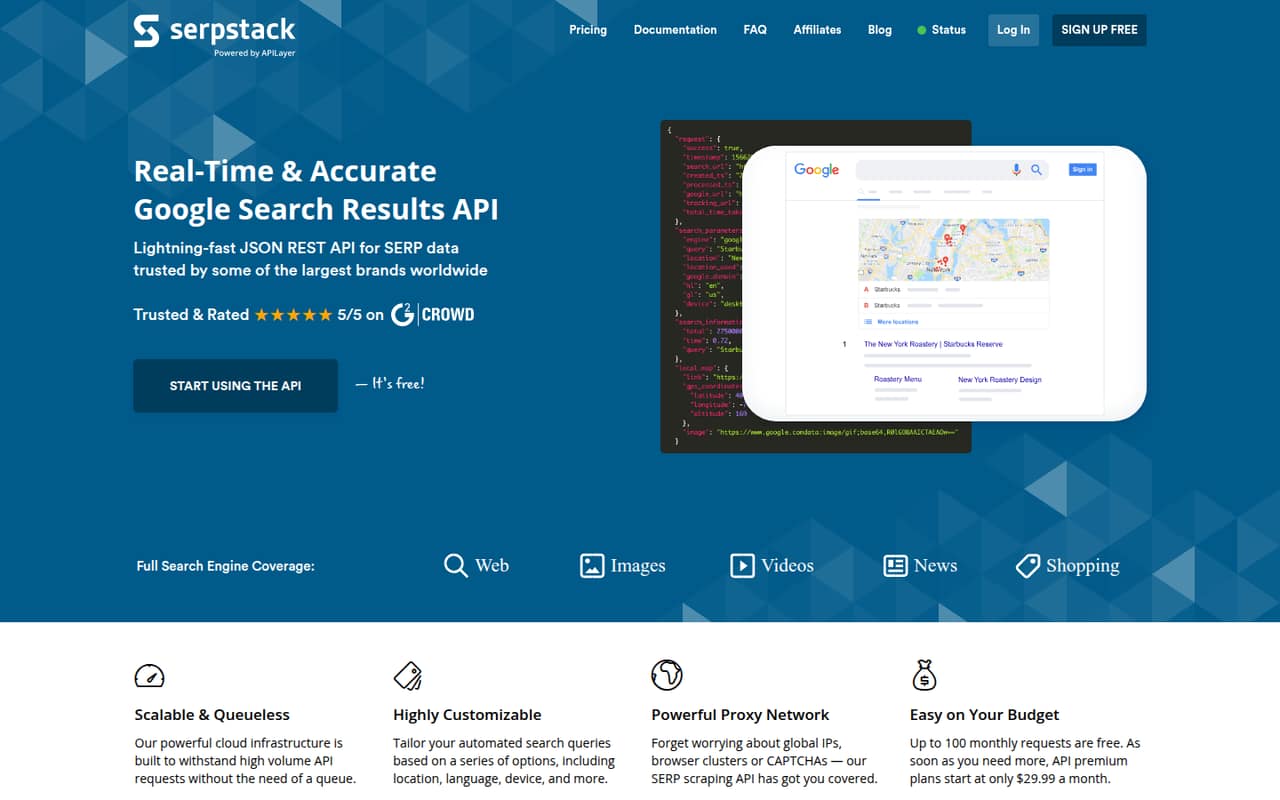
serpstack is for a small team that needs Google search results as data, rather than a full SEO dashboard. The REST API returns SERP data in JSON or CSV, with options for location, language, device, and search-result type. That can suit a developer adding search data to a product, an analyst feeding a reporting workflow, or a small agency automating a specific task.
For a one-to-ten-person team, the main question is whether you can make use of an API. If nobody on the team can connect one to your existing tools, the low starting price may not make the setup worthwhile. The free plan is useful for trying a small, non-commercial project, while Basic is the entry point for commercial use. Its 5,000 monthly searches may fit a modest workload, but teams should estimate shared usage before signing up. serpstack sells search volume, not seats, so several teammates can draw from one plan’s quota.
02serpstack free plan and trial
The pricing page lists a free plan with 100 searches per month, Google Search API access, JSON output, non-commercial use, and no support. That makes it suitable for a small test or personal project, but not a commercial workflow. It also stops at JSON, so CSV export is not included on this tier.
A separate free trial is not listed. For commercial access, the cheapest option is Basic: 5,000 searches per month, JSON and CSV, standard support, and no rate limit, according to the pricing page. It costs $29.99 month to month or $26.99 per month on annual billing. The free plan is a low-risk way to check whether the API suits your needs, but its search allowance and usage terms are narrow.
03What a small team pays for serpstack
Basic is the cheapest commercial plan. The pricing page lists it at $29.99 per month with monthly billing, or $26.99 per month on annual billing. That is $29.99 or $26.99 for one person, respectively. For three people sharing the plan, the equivalent is about $10.00 or $9.00 per person monthly; for five, it is about $6.00 or $5.40. These are just cost allocations: serpstack prices by search volume, not by seat, and the plan includes 5,000 searches a month for the whole team.
Annual billing lists lower monthly-equivalent prices, up to 15% less overall, and requires a request to switch. Basic overages are listed at $0.023992 per extra search after quota. If you need more volume, Business includes 20,000 searches for $99.99 monthly or $87.99 on annual billing. The pricing page lists no Enterprise overage rate.
04Getting started with serpstack
serpstack is a REST API, so getting started means connecting API results to a tool or workflow your team already uses. You can configure queries with options such as location, language, and device, and request supported result types including web, image, video, news, shopping, ads, and questions. The vendor doesn’t publish a setup-time estimate in the pricing details, so we wouldn’t assume this is a no-code setup.
A developer or technically comfortable operator is the sensible person to own the first connection. The product details describe the API and JSON or CSV output, but don’t list named plug-and-play integrations. Plan to confirm the response format and the query options you need before building around it. The free tier offers a way to check a small non-commercial use case, but it comes with no support; paid plans list standard support.
05When small teams outgrow serpstack
The first clear limit is search volume. Basic includes 5,000 searches a month, and extra searches are billed at $0.023992 each. A team that regularly exceeds that allowance can compare Business, with 20,000 searches monthly, or Business Pro, with 50,000. Those plans cost more, so estimate demand before treating overages as a routine part of the budget. Enterprise offers volume searches and a custom SLA, but its price is not published.
A different growth problem is the API-first approach: a team that wants a ready-to-use SEO workspace or named plug-and-play connections may need another kind of tool. Reliability also deserves a check for location- or ad-heavy work. In one Reddit thread about SERP APIs, a commenter said handling locations and getting ad data reliably had been problematic for services of this type. That is a category-level concern, not a specific report about serpstack. The same thread discusses a benchmark comparison but gives no clear user verdict on serpstack.
From the threadsWhat users say
The Reddit material offers little direct evidence about serpstack itself. It shows interest in free tiers and comparisons between SERP APIs, alongside a general concern about location and ad-data reliability for services in this category.
We have an API to scrape and parse search engine results. Made a quick benchmark to compare to us to the competition
Based on my experience handling locations and getting ad data reliably have both been problematic for these types of services
A free tier for pet projects :)
We are going to have free tier soon. :)
Questions people ask
Does serpstack have a free plan?
Yes. The pricing page lists 100 searches per month, Google Search API access, JSON output, non-commercial use, and no support. It’s a small allowance for a personal or test project, not a commercial workflow. Paid Basic adds commercial use, CSV, standard support, and 5,000 searches per month.
How much does serpstack cost for commercial use?
Basic is the lowest commercial plan. The pricing page lists it at $29.99 per month with monthly billing or $26.99 per month on annual billing. Annual billing requires a request to switch. Basic includes 5,000 searches per month, JSON and CSV, standard support, and no rate limit.
Does serpstack charge per user?
The listed plans are based on monthly search volume, not seat count. Basic includes 5,000 searches per month for $29.99 monthly or $26.99 per month on annual billing. A team can divide that cost across its users for budgeting, but the plan’s search allowance is shared.
What data can serpstack return?
serpstack returns Google search results through a REST API in JSON or CSV, depending on the plan. The product supports location and language options, mobile, tablet, and desktop devices, and search types including web, image, video, news, shopping, ads, and questions.
What happens when a serpstack plan exceeds its quota?
The pricing page says overage fees apply after the plan quota. Basic lists an extra-search rate of $0.023992; Business lists $0.019998; and Business Pro lists $0.0159992. The Enterprise overage rate is not published, so ask the vendor to confirm it if you’re considering that plan.