
We may earn a commission if you buy through links on this page. It never changes a score or a ranking. How we make money
The bottom line
Worth considering for identity workflows, but the $20 minimum is a hurdle for tiny teams.
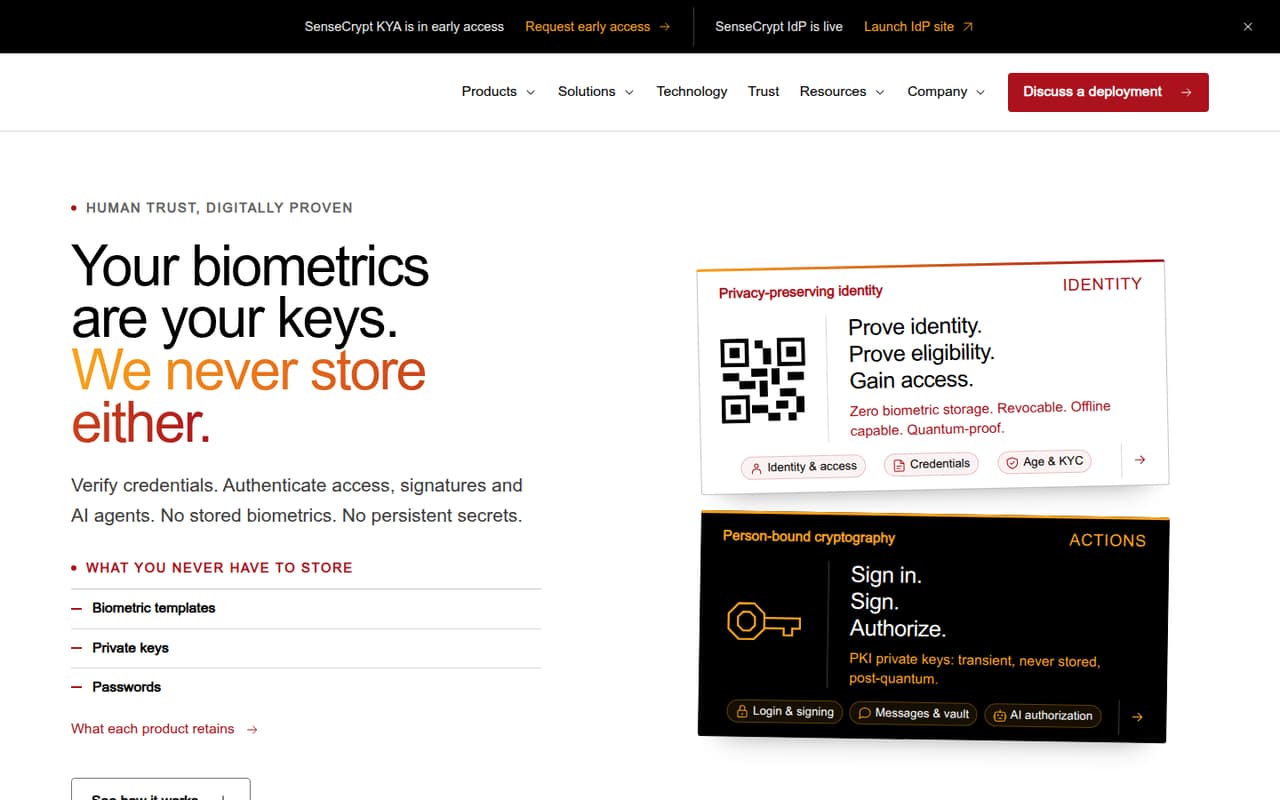
Seventh Sense’s SenseCrypt is an identity platform for credential checks, face sign-in and access authorization—not a general-purpose team tool. Its homepage describes privacy-focused features and offerings at different availability stages.
The pricing page lists usage-based Identity Provider pricing at $1 per user monthly, with a $20 minimum invoice. There’s no free plan, and annual pricing isn’t published.
Good fit if
- Small teams building identity workflows
- Passwordless access projects
- Teams authorizing AI agents
Skip it if
- Teams seeking general team software
- Buyers needing a free plan
- Teams wanting published setup guidance
ScoresHow it rates
What works
- Credential checks can work offline with a prepared verifier
- Face sign-in connects to existing identity protocols
- Private keys can be transient
- AI agent permissions can include scope and expiry
- Homepage says biometrics and private keys aren’t stored
What doesn't
- No free plan
- $20 monthly minimum invoice
- Annual pricing isn’t published
- Enterprise pricing requires contacting sales
- Setup steps and integrations aren’t clearly published
01Who Seventh Sense is for
Seventh Sense is for teams that need to connect a digital action to a real person: checking credentials, enabling face-based sign-in or recording who authorized an AI agent. It’s an identity platform, not an everyday productivity tool, so a small team should have a specific access or verification problem before adding it to the budget.
The Identity Provider plan may suit a 1–10-person team building passwordless identity workflows. The pricing page lists $1 per user monthly, but also a $20 minimum invoice, so a tiny team shouldn’t expect a $1 bill. The homepage describes features including offline credential verification with a prepared supported verifier, transient private keys and agent authorization. Availability varies across the product range: the homepage labels offerings as launched, available, early access or design partnership. Teams should confirm that the feature they need is ready for their use case.
02Seventh Sense free plan and trial
There’s no free plan. The pricing page lists a 30-day trial, but doesn’t spell out which features the trial includes, whether payment details are needed or what happens when it ends. Ask Seventh Sense to confirm those terms and whether the trial includes the workflow you’re evaluating.
The cheapest listed paid option is SenseCrypt IdP, Standard / Usage-Based, at $1 per user per month. That rate comes with a $20 minimum monthly invoice, so it isn’t a practical $1 entry point for a one-person team. The plan includes three tenants and three custom domains; customer identities are metered by monthly active user. Enterprise pricing for Simple Webcam deployments isn’t published, and the vendor directs buyers to contact sales.
03What a small team pays for Seventh Sense
The pricing page lists SenseCrypt IdP at $1 per user per month, with monthly billing. A one-person team’s per-seat math is $1, but the listed 20-seat minimum means the minimum invoice is $20 per month. For three people, the $3 seat calculation is also below the $20 minimum; for five, the $5 calculation is too. Budget at least $20 monthly for either small team, and confirm with sales how the 20-seat minimum applies to your account. Annual pricing isn’t published.
The plan includes three tenants and three custom domains. After those allowances, the pricing page lists additional tenants at $10 per month each and additional custom domains at $10 per month each. A managed key service signing key costs $20 per key per month. Those add-ons can quickly matter if your setup needs more environments, domains or managed signing keys. Enterprise pricing for on-premises Simple Webcam authentication isn’t published; the vendor asks buyers to contact sales.
04Getting started with Seventh Sense
Plan for a technical evaluation rather than assuming a plug-and-play setup. The homepage describes workflows involving identity protocols, credential verification, access and authorization, but it doesn’t spell out a step-by-step onboarding process or a learning curve. It also doesn’t publish an integration list in the product description, so a small team should confirm compatibility before committing.
For day one, define the exact job: verifying a credential, connecting face checks to an existing identity protocol, or recording an AI agent’s authorizer and permissions. If offline verification matters, ask which verifiers are supported and what must be prepared in advance. Also confirm which products are launched or generally available for your use case; the homepage shows that availability varies. Ask the vendor for implementation requirements, supported integrations and what assistance comes with the plan.
05When small teams outgrow Seventh Sense
The first pressure point is likely price and account complexity, not a published user cap. A team with fewer than 20 seats still faces the listed $20 monthly minimum, and the price can rise as the team adds paid tenants, custom domains or managed signing keys. At $10 per extra tenant or domain monthly and $20 per managed key monthly, those additions deserve a budget check before rollout.
A growing team may also need capabilities whose availability or pricing needs confirmation. The homepage lists products at different stages, including early access and design partnership, while the Enterprise option for on-premises Simple Webcam authentication has no published price. If your use case depends on a specific feature, deployment model or integration, ask the vendor to confirm its status and cost in writing. Teams that only need a basic, low-cost tool may find the minimum invoice hard to justify; teams with broader identity requirements should compare the full add-on and enterprise costs first.
Questions people ask
Does Seventh Sense have a free plan?
No. The pricing page lists no free plan and does list a 30-day trial. It doesn’t publish the trial’s feature scope or post-trial terms, so ask Seventh Sense whether the trial includes the product and workflow you want to evaluate.
How much does Seventh Sense cost for a small team?
SenseCrypt IdP is listed at $1 per user per month, with a $20 minimum monthly invoice. That means a one-, three- or five-person team should budget at least $20 monthly, rather than multiplying seats by $1 and expecting a smaller bill. Annual pricing isn’t published.
What does SenseCrypt IdP include?
The pricing page lists three tenants and three custom domains, with customer identities metered by monthly active user. The homepage describes identity features such as credential verification and face sign-in. Confirm with the vendor which features are included in your specific plan and available for your intended use.
Does Seventh Sense store biometric data or private keys?
The Seventh Sense homepage says biometric templates, private keys and passwords are not stored. It also describes transient PKI keys that are generated for an operation and discarded afterward, while public keys are stored. Ask the vendor how those statements apply to your chosen product and deployment.
Is Seventh Sense’s Enterprise pricing published?
No. The pricing page lists Enterprise for on-premises Simple Webcam authentication but doesn’t publish a price; it directs buyers to contact sales. Ask for a quote that covers deployment, required services and any ongoing fees, and confirm which features are available for your project.