
We may earn a commission if you buy through links on this page. It never changes a score or a ranking. How we make money
The bottom line
Useful for cross-border invoice compliance; buyer costs and setup effort need a vendor quote.
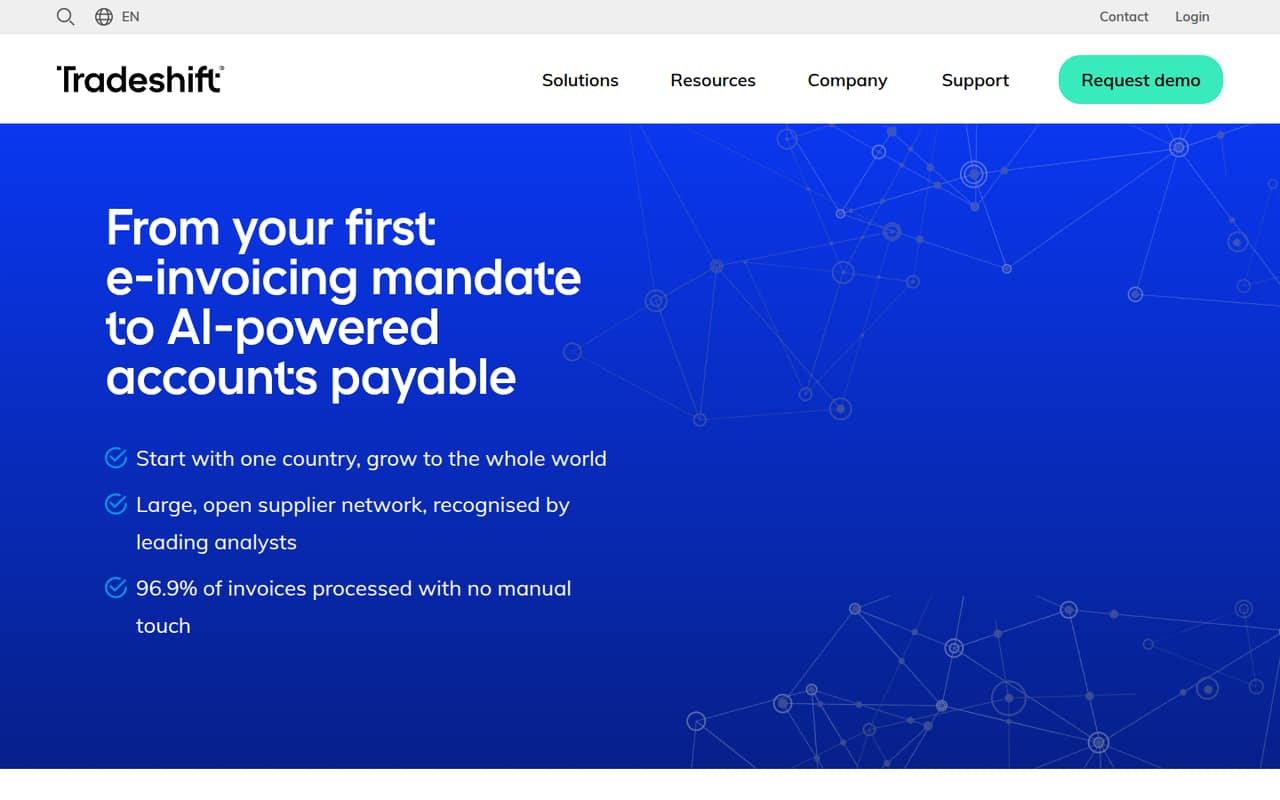
Tradeshift combines e-invoicing compliance and accounts payable automation, including invoice capture, matching, approvals and supplier collaboration. It makes most sense when a business handles invoices across countries and ERP systems; it may be more than a small team needs for basic billing.
Suppliers can use a free tier for up to 30 invoices and credit notes per quarter. Buyer pricing is custom, with no published seat costs, so a 3- or 5-person team cannot estimate its bill from the public price list. Ask for a quote that includes implementation and any ERP maintenance.
Good fit if
- Teams handling invoices across countries
- Buyers with complex procurement needs
- Suppliers sending up to 30 invoices quarterly
Skip it if
- Teams seeking published per-seat pricing
- Businesses with simple invoicing needs
- Buyers who need predictable monthly costs
ScoresHow it rates
What works
- Supports e-invoicing compliance in more than 70 countries
- Clearance support in 20 countries
- Captures e-invoices, PDFs, OCR and PO-flip submissions
- Supplier can transact from its first invoice without signing up
- Supplier free tier covers up to 30 quarterly transactions
What doesn't
- Buyer pricing is custom and not published
- Buyer seat and usage limits are not published
- Monthly and annual prices are not published
- ERP integration maintenance adds $149 per quarter
- Specific ERP connectors and setup effort need confirmation
01Who Tradeshift is for
Tradeshift is aimed at businesses that need to manage invoices across countries and ERP systems. For a small team of 1–10, the case is strongest when cross-border compliance, invoice approvals and supplier coordination are regular work—not just occasional admin. The platform covers invoice capture from e-invoicing, PDFs, OCR and PO-flip submissions, then supports validation, matching and approval workflows.
It also offers supplier collaboration, reporting dashboards and AI agents that can flag issues. The pricing page separates large buyers with complex procurement needs from suppliers paying by transaction, so decide which side of the platform you need before comparing costs. Buyers should budget time to get a custom quote: seat and usage limits are not published. Suppliers with low transaction volumes have a simpler entry point, with up to 30 invoices and credit notes per quarter at no charge.
02Tradeshift free plan and trial
The free offer is for suppliers, not a general free buyer plan. Tier 1 – FREE covers 0–30 invoices and credit notes per quarter at $0 per transaction, billed quarterly in arrears. The pricing page lists no free trial. Suppliers can begin transacting with their first invoice without signing up to the platform, according to Tradeshift’s product description.
Above 30 quarterly transactions, Tier 2 charges $0.80 per transaction and includes the first 30 free. That makes the free tier useful for a supplier with light volume, but it does not establish what a buyer pays to use the accounts payable platform. Buyer pricing is a custom quote, with seat and usage limits not published. Ask Tradeshift for the buyer price and any minimum commitment before planning around the free supplier tier.
03What a small team pays for Tradeshift
The pricing page does not list a per-seat price for buyers. Enterprise Buyer Platform pricing is custom, and seat and usage limits are not published, so the cost for one person or a team of three or five cannot be calculated. Monthly and annual buyer prices are also not published. Get a quote based on your invoice volume, countries and ERP setup rather than assuming the supplier rates apply.
Supplier costs are transaction-based, not seat-based. A supplier with up to 30 quarterly invoices and credit notes pays $0. Tier 2 covers 31–300 transactions at $0.80 each, with the first 30 free; for example, 31 transactions would cost $0.80 under that rate. Tier 3 charges $0.60 per transaction for 301–3,000, and Tier 4 charges $0.30 for 3,001–15,000; each includes the first 30 free. Tiers are billed quarterly in arrears. ERP integration maintenance is listed at $149 per quarter. Ask whether that add-on applies to your setup.
04Getting started with Tradeshift
Tradeshift’s product description covers invoice capture, validation, matching, approval workflows and supplier collaboration, but it does not give a setup timeline. We would not assume this is a quick self-serve rollout for a buyer: confirm what configuration, onboarding and internal work your use case requires before signing. The supplier side has a lighter first step, since suppliers can transact from their first invoice without signing up to the platform.
The platform is described as working across ERP systems, but no specific connector list or integration setup steps are stated in the available product details. Ask Tradeshift to confirm support for your exact ERP, whether integration maintenance is needed, and whether the listed $149-per-quarter maintenance add-on applies. Also check who sets up business rules, multi-way matching and approval routes. Those details will shape the effort for a small team more than the number of seats alone.
05When small teams outgrow Tradeshift
For a buyer, the main hurdle may come before outgrowing the tool: custom pricing and unpublished seat and usage limits make it hard to predict how costs change as a team grows. Ask for the limits and the price at higher volumes in writing. The $149-per-quarter ERP integration maintenance add-on is another cost to include if your setup needs it.
Supplier pricing rises with transaction volume. Tier 1 stops at 30 quarterly invoices and credit notes; Tier 2 reaches 300, Tier 3 reaches 3,000, and Tier 4 reaches 15,000 before Tier 5 switches to custom pricing. Those tiers are not seat plans, so adding staff does not directly show how the bill changes. A team may need to revisit its choice when its invoice volume crosses a tier, or when it needs buyer pricing that is clearer and easier to forecast. Confirm the next-tier rate and any custom terms before volume grows.
Questions people ask
How much does Tradeshift cost?
Buyer pricing is custom; the pricing page does not publish seat or usage limits or monthly and annual buyer rates. Supplier Tier 1 is free for up to 30 invoices and credit notes per quarter. Higher supplier tiers charge per transaction, and ERP integration maintenance is listed at $149 per quarter.
What does the Tradeshift free plan include?
Tier 1 – FREE is for suppliers and covers 0–30 invoices and credit notes per quarter at $0 per transaction. It is billed quarterly in arrears. It is not a published free buyer plan, so a business wanting accounts payable automation should request buyer pricing directly.
What is Tradeshift used for?
Tradeshift provides e-invoicing compliance and accounts payable automation for businesses operating across countries and ERP systems. Its listed functions include invoice capture, data validation, matching, approval workflows, supplier collaboration, compliance and reporting.
Can suppliers use Tradeshift without signing up?
Tradeshift says suppliers can start transacting with their first invoice without signing up to the platform. The free supplier tier covers up to 30 invoices and credit notes per quarter. Confirm with Tradeshift whether any particular buyer relationship or transaction requires additional steps.
Does Tradeshift charge for ERP integration maintenance?
The pricing page lists ERP integration maintenance at $149 per quarter. It does not establish whether every customer needs this add-on, so ask Tradeshift whether it applies to your ERP and what maintenance it covers before accepting a quote.