
We may earn a commission if you buy through links on this page. It never changes a score or a ranking. How we make money
The bottom line
A broad market-data toolkit with a useful free tier and paid plans from $79/month.
Twelve Data offers APIs and WebSocket feeds for stocks, forex, crypto, ETFs, commodities, mutual funds, and more. Its free Basic plan can suit a prototype, but it limits users to three markets and 800 daily requests.
Paid plans start at $79/month for Grow, with more API credits, 27 markets, and unlimited daily usage. We’d shortlist it for a small developer team that needs several asset classes; check the markets and data you need before committing.
Good fit if
- Developers building market-data products
- Small teams covering several asset classes
- Prototypes that can start on Basic
Skip it if
- Teams needing guaranteed exchange coverage
- Buyers who need published seat pricing
- Futures-focused projects without coverage checks
ScoresHow it rates
What works
- Free Basic plan includes 800 daily requests
- Data spans stocks, forex, crypto, and more
- APIs share logic across endpoints, per the homepage
- WebSocket feeds are available
- Google Sheets and Excel add-ins are listed
What doesn't
- Basic covers only three markets
- Paid plans start at $79 monthly
- Annual prices are not published
- Seat and account-sharing terms are not published
- Reddit users report gaps in some market coverage
01Who Twelve Data is for
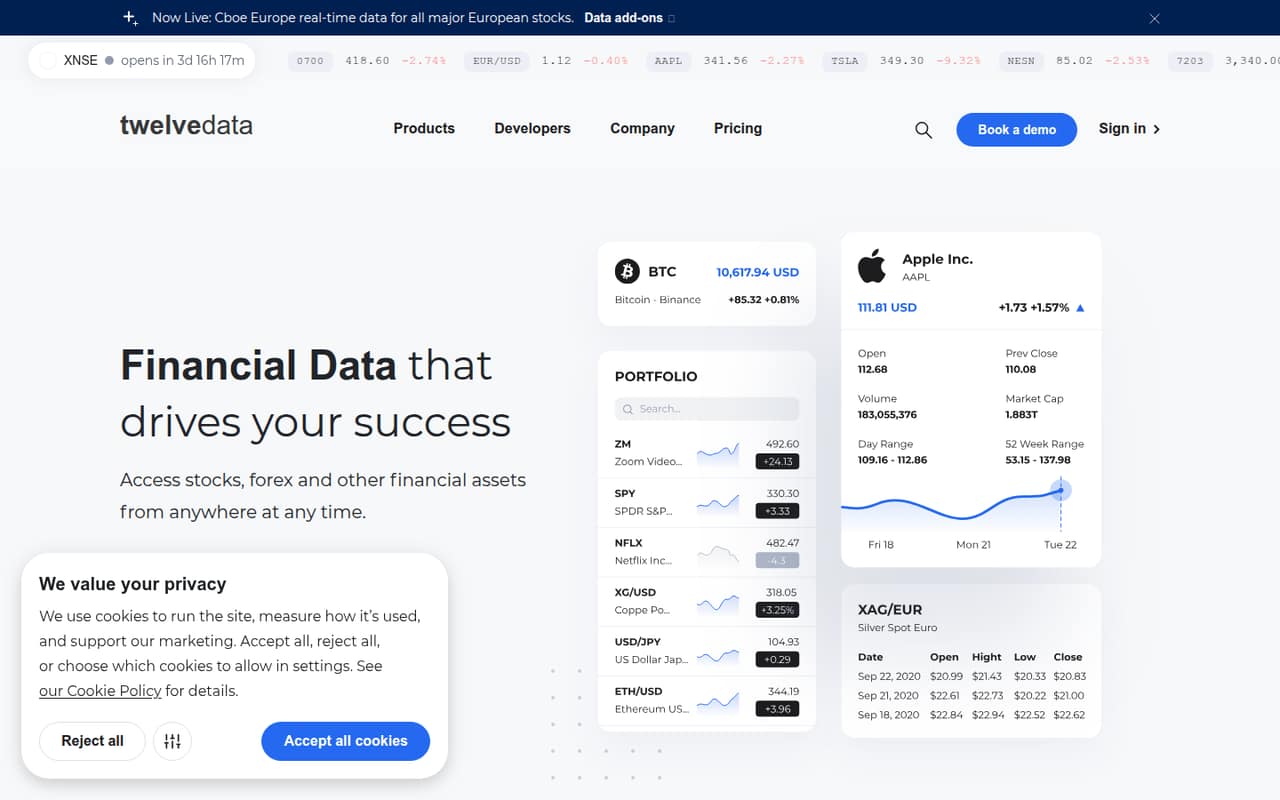
Twelve Data fits a small development team building a trading tool, fintech product, or research workflow that needs market data through APIs or WebSocket feeds. The service covers stocks, forex, crypto, ETFs, commodities, mutual funds, and other assets, according to its homepage. It also lists fundamentals, SDKs, and add-ins for Google Sheets and Excel.
For a founder or a team of one to five, Basic is a sensible place to check whether the required markets and request allowance are enough. If the project needs more markets or daily usage without a stated cap, Grow costs $79 per month. That is a meaningful subscription for a side project, so confirm the specific symbols, exchanges, and data needs first. Twelve Data is less suited to buyers who want seat-based pricing or guaranteed coverage details upfront: the vendor does not publish seat pricing in the plan information.
02Twelve Data free plan and trial
Basic is the free plan. The pricing page lists 8 API credits (800 a day), 8 trial WS credits, three markets, and 800 daily requests. That gives a developer a no-cost way to explore the API, but the three-market limit can be restrictive if a product needs broad international coverage. The vendor does not publish a free-trial duration; Basic itself is free.
For more headroom, Grow is the cheapest paid plan at $79 per month. It lists 377 API credits, 8 trial WS credits, 27 markets, and unlimited daily usage. The difference matters: unlimited daily usage does not remove the listed API-credit allowance. Check how credits apply to the endpoints and data you plan to use before choosing a plan.
03What a small team pays for Twelve Data
Grow is $79 per month for one plan account; the vendor does not publish per-seat pricing or say whether multiple team members can share access. If a team of three or five splits that account cost, the arithmetic is $26.33 or $15.80 per person monthly, respectively—not a confirmed seat price or license allowance.
Pro costs $229 per month, equivalent to $76.33 each for three people or $45.80 each for five if split. It lists 1,597 API credits, 1,500 WS credits, and 76 markets. Ultra is $999 monthly and includes 10,946 API credits, 10,000 WS credits, 85 markets, and a 99.95% SLA.
The pricing page says annual billing saves 17%, but annual prices are not published. Add-ons may raise the bill: listed starting prices include ASX at $120/year, Cboe Canada at $180/year, and Cboe Europe at $300/year. Confirm exchange needs and access terms with the vendor.
04Getting started with Twelve Data
Twelve Data is built around APIs, WebSocket feeds, SDKs, fundamentals, and spreadsheet add-ins, so a developer-led setup is the natural fit. For a first project, decide which markets and data you need, then match that scope to Basic’s three markets or a paid plan’s larger allowance. The homepage says its APIs use shared logic across endpoints, which may help teams working with more than one type of data.
The homepage lists SDKs for popular programming languages but does not name them all. It also lists add-ins for Google Sheets and Excel, useful options for teams that want to explore data in a spreadsheet. The vendor does not publish a setup-time estimate in the available product details. We’d treat API integration as engineering work rather than assume a plug-and-play setup, and confirm documentation, language support, and endpoint behavior before assigning a launch date.
05When small teams outgrow Twelve Data
The first pressure point is coverage: Basic includes three markets, Grow 27, Pro 76, and Ultra 85. A team may need to move up as it adds markets or consumes more credits, even when its daily usage is unlimited on Grow and above. WebSocket requirements can also change the bill; the listed WS credits differ by plan, and the vendor does not publish seat-based pricing.
Market fit needs checking, too. In one Reddit thread, a buyer looking for Canadian stocks said the free plan seemed mostly US-focused. A commenter said the free plan did not cover many TSX tickers, while another commenter later described Twelve Data as a better paid choice for their needs. These are individual reports, not a definitive coverage map. Before scaling, verify symbols, exchange access, and historical depth with the vendor. If your required data is missing or add-ons make the plan uneconomic, compare providers before rebuilding around another API.
From the threadsWhat users say
The Reddit discussion is mixed and limited: some users question free-plan coverage, while others say paid Twelve Data suits their OHLC needs. The comments do not establish a broad consensus on reliability or support.
the free tier is mostly USA
it didn't cover a whole lot of tickers on TSX for the free plan
Twelve Data is actually my better choice for a paid subscription
the grow on twelve data with I think 100 something api is pretty good price compares to fmp
Questions people ask
What does Twelve Data do?
Twelve Data provides financial market data through APIs and WebSocket feeds. Its homepage lists stocks, forex, crypto, ETFs, commodities, mutual funds, fundamentals, SDKs, and spreadsheet add-ins for Google Sheets and Excel. Teams can use the products in trading systems, fintech products, and research workflows.
Does Twelve Data have a free plan?
Yes. Basic costs $0 and lists 8 API credits (800 a day), 8 trial WS credits, three markets, and 800 daily requests. The vendor does not publish a free-trial duration. For more markets and unlimited daily usage, the next listed plan is Grow at $79 per month.
How much does Twelve Data cost?
Basic is free. Paid monthly plans with published prices are Grow at $79, Pro at $229, and Ultra at $999. Venture and Enterprise do not have published prices in the plan information. Annual billing offers a stated 17% saving, but the vendor does not publish annual prices.
Does Twelve Data include real-time data?
Twelve Data lists real-time WebSocket feeds among its products, and its plans include varying amounts of WS credits. The plan details do not specify the timing or availability for every market and endpoint. Confirm the feed and exchange requirements you need with the vendor before buying.
Can a small team share one Twelve Data plan?
The pricing information lists monthly plan prices but does not publish seat counts, per-seat charges, or account-sharing terms. Treat the plan price as an account cost, not a confirmed team license. Ask Twelve Data whether your intended number of users can access the same account.