
We may earn a commission if you buy through links on this page. It never changes a score or a ranking. How we make money
The bottom line
A pay-as-you-go verification tool; estimate usage before you budget.
Twilio Verify helps teams verify users and look up identity information to protect accounts and fight fraud. Official server-side SDKs can help with implementation, but this is a developer tool rather than a ready-made sign-in system.
The pricing page lists a $0.05 starting price per verification, usage-based billing, and volume discounts. A trial is available, but its terms and any ongoing free allowance are not spelled out. Small teams should budget by verification volume, not seat count.
Good fit if
- Teams adding account verification
- Developers comfortable with server-side code
- Variable usage and pay-as-you-go budgets
Skip it if
- Teams wanting a no-code setup
- Buyers needing predictable seat pricing
- Teams needing guaranteed delivery worldwide
ScoresHow it rates
What works
- Starts at $0.05 per verification
- Usage-based billing rather than seat pricing
- Volume discounts as usage grows
- Free trial listed, no card required
- Official server-side SDKs are available
What doesn't
- Trial terms and free usage limits are unclear
- Total cost depends on verification volume
- Monthly and annual billing options are not specified
- Fallback behavior may need extra work
- One Reddit user reports uneven delivery by country
01Who Twilio Verify is for
Twilio Verify fits a small team that needs to confirm users during account creation or sign-in and has a developer who can wire verification into its app. Twilio describes it as part of its user authentication offering, with verification and identity lookup tools intended to help fight fraud and keep accounts secure.
For a team of one to ten, the budget question is less about seats and more about how many verifications customers trigger. The pricing page lists a starting rate of $0.05 per verification, with usage-based pricing and volume discounts as usage grows. That can suit a team with variable demand, but it does not give a fixed monthly bill to plan around.
This is a developer-facing service, not a turnkey identity suite. Official server-side SDKs are available, so teams comfortable integrating an API are a better fit than teams looking for a no-code setup.
02Twilio Verify free plan and trial
Twilio's pricing information marks a free plan as available, and the pricing page lists a free trial with no credit card required. But the public pricing details do not describe an ongoing free verification allowance, the trial's duration, or how many verifications it includes. We would not budget on a specific amount of free usage without confirming those terms with Twilio.
The listed paid starting point is $0.05 per verification, with usage-based pricing. That is the cheapest published way to estimate paid use, but the actual bill depends on how many verifications your app sends. Before launch, ask Twilio what the trial covers, when billing begins, and whether your intended verification channels have different rates.
03What a small team pays for Twilio Verify
The pricing page lists Pay as you go at a starting price of $0.05 per verification. That is a usage price, not a per-seat rate: one person, a team of three, and a team of five all face the same listed starting rate per verification. For example, 100 verifications would start at $5 before any applicable differences in pricing; the number of employees does not determine that total.
Twilio does not publish a standard monthly or annual billing option for Verify in the listed pricing details. Since no typical usage per person is given, we can't turn the starting rate into a reliable monthly total for a one-, three-, or five-person team. The page lists volume discounts as usage grows but does not give thresholds or discount amounts.
No Verify add-ons are listed in the pricing information. Ask Twilio whether your chosen channels or destinations affect your rate. Also account for repeat attempts: one Reddit user says delayed codes in some countries led users to request another code, increasing what the team paid.
04Getting started with Twilio Verify
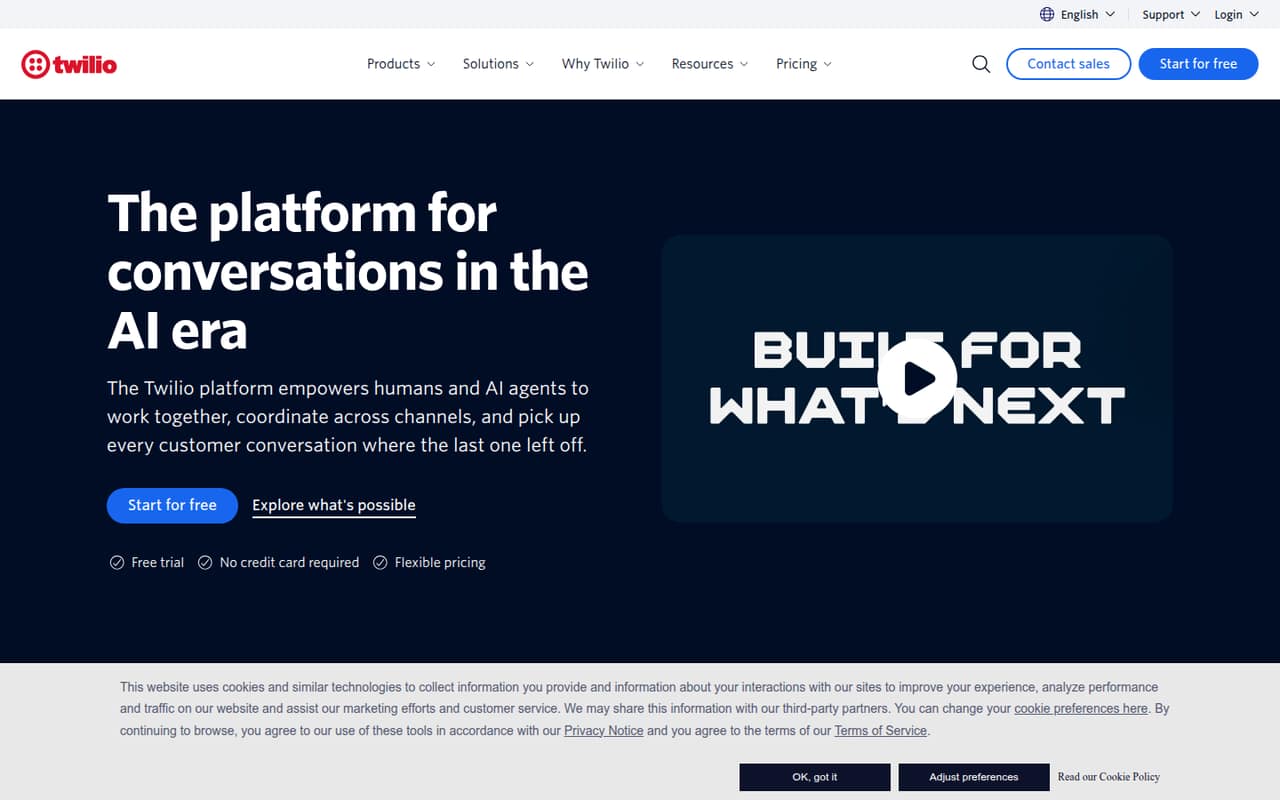
Expect a developer-led setup. Twilio's homepage offers official server-side SDKs, and a Reddit tutorial post describes sample projects for PHP, Python, Node.js, .NET, and Go. That gives a small team code-oriented starting points, but the available information does not establish how much implementation work each app will need.
At minimum, your team will need to connect Verify to the server-side part of its account or sign-in flow and decide how the app handles a code that is delayed or cannot be delivered. Details about prebuilt integrations are not published in the information available here, so ask Twilio whether your identity provider or framework has a supported integration.
One Reddit poster said Twilio was easy to get running and had few complaints about the API. That is one user's experience, not a promise of a quick setup for every team.
05When small teams outgrow Twilio Verify
A growing team may outgrow Verify when it needs a more predictable monthly budget, clearer channel-specific costs, or delivery behavior it can rely on across many countries. The listed price is usage-based, and Twilio does not publish a monthly or annual option or discount thresholds in the pricing details. Those gaps make it harder to forecast costs as volume rises; ask Twilio for a quote based on your expected traffic.
Reddit feedback points to operational issues to plan for, not proof of a universal problem. One poster described slow arrivals in some countries and users requesting another code, which they said meant paying for multiple attempts. Another thread about WhatsApp-to-SMS fallback reports that the fallback was not automatic in the poster's case; commenters suggested contacting the Verify team or implementing a fallback trigger.
If your team needs dependable international delivery or complex fallback rules, compare alternatives and test the required flows before committing.
From the threadsWhat users say
Reddit feedback is mixed: one user praises the API experience, while other posters raise concerns about delayed codes and fallback behavior. These are individual reports, not a measure of overall customer satisfaction.
Twilio was easy to get running and I don’t have many complaints about the API itself
In some countries the first OTP arrives quickly, while in others users request a second code before the first one shows up
Have you consulted the Verify team to enable fallback?
You can also hard-code a fallback trigger based on the error codes returned
Questions people ask
How much does Twilio Verify cost?
The pricing page lists a starting price of $0.05 per verification, with usage-based pricing and volume discounts as usage grows. It does not publish a typical monthly total or the discount thresholds. Your cost depends on how many verifications you send.
Does Twilio Verify have a free plan?
Twilio's pricing information marks a free plan as available and lists a free trial with no credit card required. The published details do not specify an ongoing free verification allowance, trial duration, or number of included verifications. Confirm those terms with Twilio before budgeting.
Does Twilio Verify charge per user or per seat?
The listed price is per verification, not per user or seat. A team of one or five does not have a different published starting rate based on headcount. Estimate the number of verifications your app will send to forecast the bill.
Can Twilio Verify automatically switch from WhatsApp to SMS?
A Reddit thread describes a case where WhatsApp verification stayed pending without an SMS fallback. Commenters suggested asking the Verify team about enabling fallback or implementing a trigger based on returned error codes. Confirm the current behavior and requirements with Twilio.
Does Twilio Verify offer server-side SDKs?
Twilio's homepage offers official server-side SDKs. A Reddit tutorial post describes sample projects in PHP, Python, Node.js, .NET, and Go. Check Twilio's current docs for the SDK and implementation guidance that match your app.