
We may earn a commission if you buy through links on this page. It never changes a score or a ranking. How we make money
The bottom line
Good SERP data options, but small teams need to budget for usage and API setup.
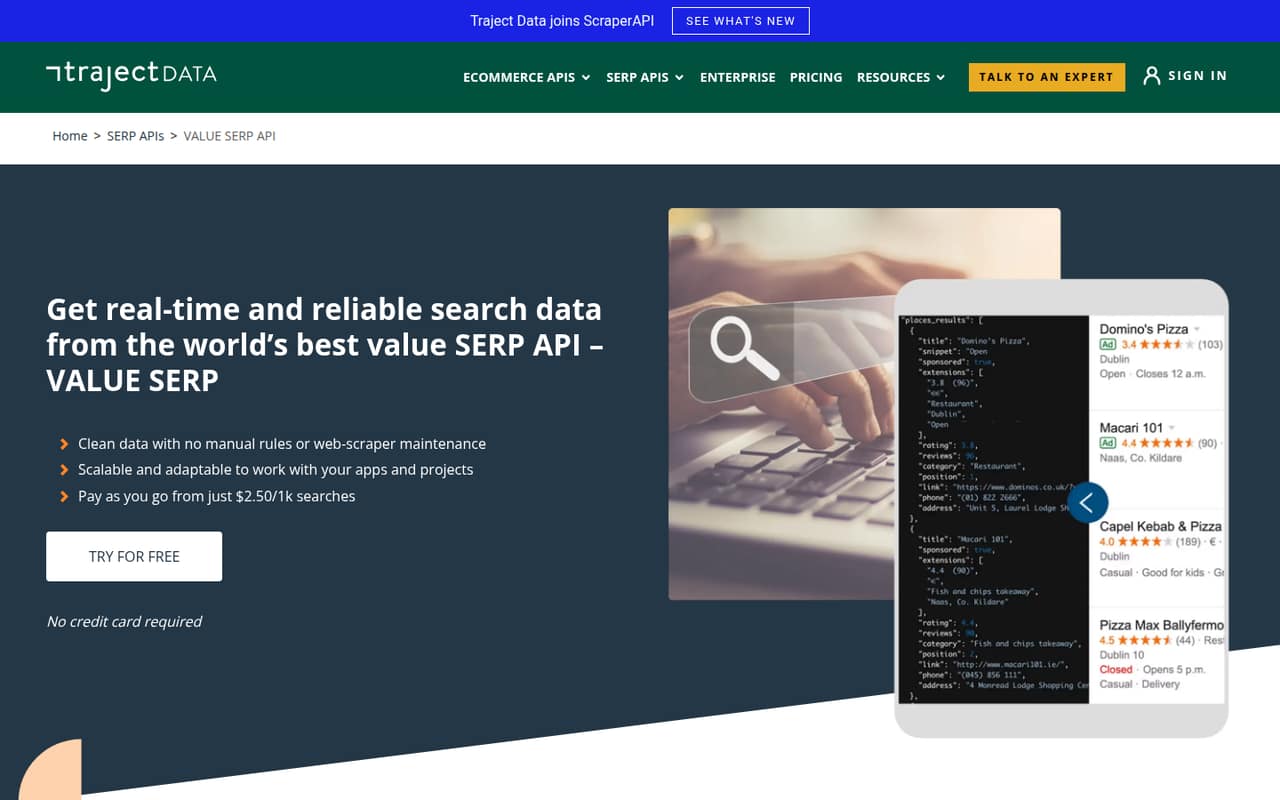
ValueSERP returns live Google search results in JSON, HTML, or CSV, with location and device targeting. Scheduled batches and cloud storage delivery add useful options for teams collecting data regularly.
There’s no free plan or trial listed. The smallest monthly plan is $50 with annual billing, and the service charges by usage rather than by seat. It makes most sense when a developer can connect the API and your team knows what data it needs.
Good fit if
- Developer-led SEO teams
- Recurring SERP data collection
- Teams needing location targeting
Skip it if
- Teams needing a free tier
- Nontechnical users seeking a visual tool
- Teams wanting per-seat pricing
ScoresHow it rates
What works
- Returns results in JSON, HTML, or CSV
- Supports location and device targeting
- Schedules up to 15,000 requests
- Offers several cloud storage destinations
- Higher-volume plans lower per-credit pricing
What doesn't
- No free plan or trial is listed
- Monthly billing prices are not published
- Setup requires working with an API
- Credit-to-request conversion is not published
- No add-ons are listed
01Who ValueSERP is for
ValueSERP is for a small, developer-led team that needs Google search results as data, not a dashboard for manual research. A one-to-ten-person SEO, marketing, or data team could use it to collect live SERPs, target locations and device types, and send results into an existing workflow.
The API makes GET HTTP requests and returns results in JSON, HTML, or CSV. That’s a fit when someone on the team can make API requests and handle the returned data. Scheduled batches can run on demand or on a recurring basis, and results can go to S3-compatible storage, Google Cloud Storage, Azure Blob Storage, or Alibaba Cloud OSS.
The budget starts at $50 per month with annual billing for 25,000 credits. Since the listed plans are usage-based rather than seat-based, one account can serve a few teammates; the deciding factor is whether the included usage matches the team’s work.
02ValueSERP free plan and trial
ValueSERP has no free plan, and the pricing information lists no free trial. The cheapest predictable entry is the 25,000 Credits plan: $50 per month with annual billing, including 25,000 credits per month, a 250 requests-per-minute limit, and up to 10,000 batches. The pricing page lists this as $1.60 per 1,000 credits.
If you don’t want a monthly plan, pay as you go starts at $2.50 per 1,000 requests. That rate is stated per request, while plans quote credits, so don’t assume the units convert one-to-one. Ask ValueSERP how your expected searches map to credits before choosing a plan. Monthly billing prices for the credit plans are not published.
03What a small team pays for ValueSERP
ValueSERP’s smallest plan is $50 per month when billed annually, or $600 for a year at that listed rate. It includes 25,000 credits each month. There’s no per-seat price in the listed plans: one person and a team of three or five pay the same account price if their usage is the same. As a budget split, that’s $50 per person monthly for one, about $16.67 for three, or $10 for five; these are averages, not seat charges. The team totals remain $600 per year.
The page labels annual billing 10% off, but it doesn’t show a monthly-billing price for comparison. Larger options are $240 per month billed annually for 200,000 credits and $1,000 per month billed annually for 1,000,000 credits. Their listed rates are $1.20 and $1.00 per 1,000 credits, respectively. Pay as you go starts at $2.50 per 1,000 requests. No add-ons are listed.
04Getting started with ValueSERP
ValueSERP is an API, so setup means making GET HTTP requests and deciding how your team will use the returned JSON, HTML, or CSV. A developer or someone comfortable connecting APIs will have an easier start than a marketer looking for a point-and-click interface. The vendor does not publish a setup-time estimate in the pricing information, so allow time to check the request flow and your data handling needs.
For day one, decide which locations and device types you need, then choose whether results should be read by your own application or delivered to cloud storage. The listed destinations include S3-compatible storage, Google Cloud Storage, Azure Blob Storage, and Alibaba Cloud OSS. Before committing, ask the vendor about authentication, error handling, and how credit usage maps to your expected requests; those details affect implementation and budget.
05When small teams outgrow ValueSERP
A team can outgrow the 25,000-credit plan when its monthly collection needs exceed that allowance or it hits the 250 requests-per-minute limit. The next listed plan raises the allowance to 200,000 credits and the limit to 1,000 requests per minute for $240 per month billed annually. The 1,000,000-credit plan raises the limit to 1,500 requests per minute and costs $1,000 per month billed annually.
Before upgrading, check the credit-to-request conversion with ValueSERP; the prices use different units for credits and pay-as-you-go requests. Batch needs also deserve a check: the plans list up to 10,000 batches, while the product description says scheduled batches can cover up to 15,000 requests. Ask how those limits apply to your workload. If the team needs a visual workflow or per-seat pricing instead of an API, the listed plans may not fit its way of working.
Questions people ask
Does ValueSERP have a free plan?
No free plan or free trial is listed. The cheapest predictable plan is 25,000 Credits at $50 per month with annual billing. Pay as you go starts at $2.50 per 1,000 requests, but ask ValueSERP how your expected requests translate into credits before estimating total cost.
How much does ValueSERP cost for a small team?
The smallest credit plan is $50 per month billed annually, or $600 for a year at that rate. It is priced by usage, not by seat, so one, three, or five teammates share the same plan price if their usage stays within its allowance. Monthly billing prices are not published.
What formats does ValueSERP return?
ValueSERP returns Google search results in JSON, HTML, or CSV. The API also supports location and device targeting. Choose the format that fits the system receiving the results, and check with the vendor if you need details about fields or formatting.
Can ValueSERP send results to cloud storage?
Yes. The product description lists S3-compatible storage, Google Cloud Storage, Azure Blob Storage, and Alibaba Cloud OSS as destinations for batch results. Confirm the setup requirements and any destination-specific details with ValueSERP before building your workflow.
How many requests can ValueSERP schedule?
The product description says scheduled batches can cover up to 15,000 requests for recurring or on-demand runs. The credit plans also list up to 10,000 batches. Those are separate limits as stated, so ask ValueSERP how each applies to your account and workload.