
We may earn a commission if you buy through links on this page. It never changes a score or a ranking. How we make money
The bottom line
Good sales-focused TV ad tools, but a $50/day entry point is a real budget commitment.
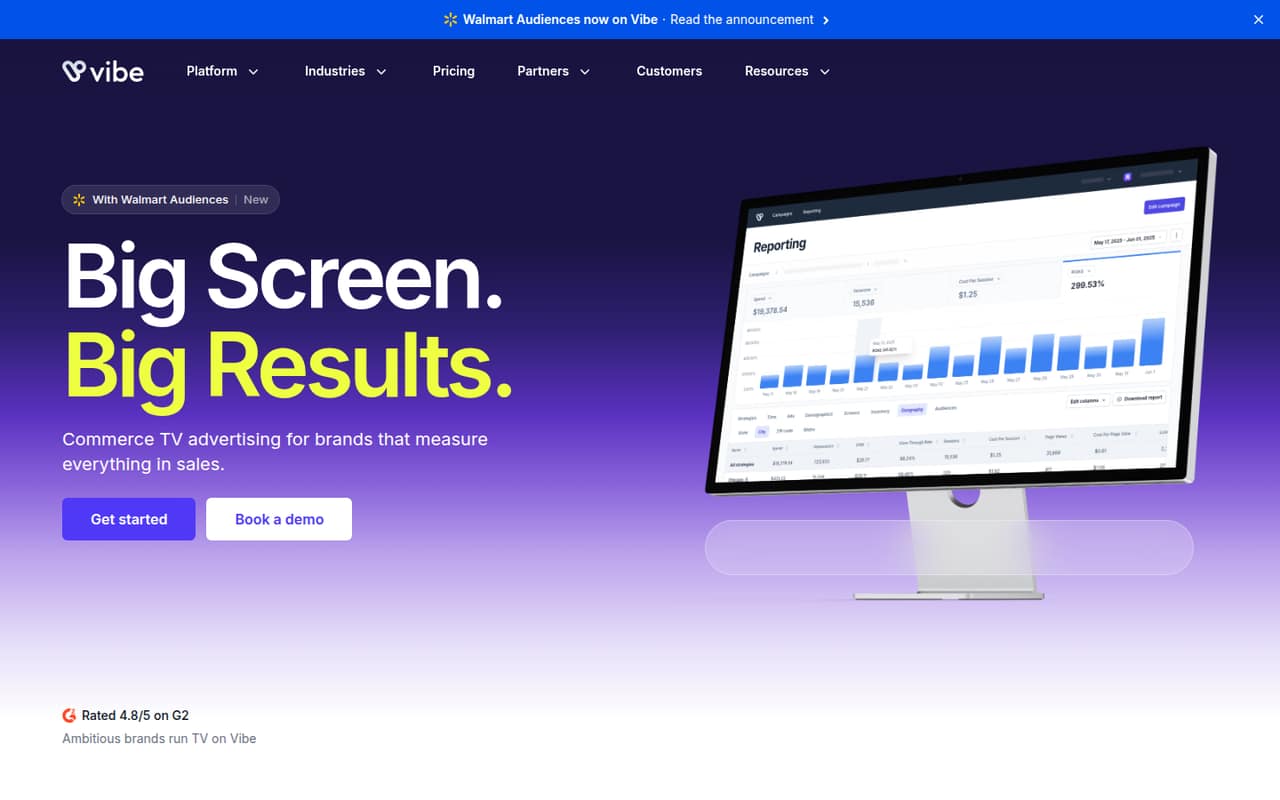
Vibe is for brands buying streaming and connected TV ads, not teams looking for a free marketing tool. It offers Walmart shopper audiences, sales measurement, creative testing, and access to 500+ premium streaming channels. The pricing page lists a starting spend of $50 per day, with no commitment and 24/7 support.
There’s no free plan or trial listed, and Vibe doesn’t price by seat. That makes it easier to estimate the starting campaign spend for a small team, but the vendor doesn’t publish a monthly or annual subscription price or a typical campaign total. Ask for a spend estimate and onboarding details before committing.
Good fit if
- Brands measuring TV-driven sales
- Advertisers targeting Walmart shoppers
- Teams testing streaming TV creative
Skip it if
- Teams needing a free ad platform
- Businesses with tiny ad budgets
- Teams seeking per-seat software pricing
ScoresHow it rates
What works
- Targets shoppers with Walmart purchase data
- Measures campaigns through to revenue
- Offers incrementality testing
- Lists 500+ premium streaming channels
- Includes 24/7 support
What doesn't
- No free plan is listed
- Starting spend is $50 per day
- No monthly or annual subscription price is listed
- Typical campaign costs are not published
- Setup effort and onboarding details are unclear
01Who Vibe is for
Vibe fits brands that buy streaming and connected TV ads and need to tie those campaigns to sales. In plain terms, it helps advertisers reach audiences on streaming services, then measure whether their TV campaigns drove revenue. Its Walmart Audiences feature uses Walmart purchase data and customer lists for targeting, while its measurement tools include incrementality testing.
For a small team of one to ten, the key question is budget, not seat count. Vibe lists a starting price of $50 per day, so it suits a team able to fund an ongoing ad campaign rather than a business looking for inexpensive marketing software. The platform also offers AI campaign optimization, creative A/B testing, and integrations with CRM, CDP, warehouse, and measurement tools. Those features may matter to a lean team that wants to connect advertising and sales data, but the vendor doesn’t publish a typical campaign budget or a setup estimate. Get a campaign quote before deciding whether it fits your budget.
02Vibe free plan and trial
Vibe doesn’t list a free plan or a free trial. The pricing page lists one way in: TV advertising, starting at $50 per day, with no commitment. The listed price is for advertising, not a free software tier that a small team can use before it starts spending.
That makes the choice fairly direct. If you need to explore the product without funding a campaign, ask Vibe whether it can provide a demo or a trial; neither is listed in the pricing information. If you’re ready to advertise, the lowest published entry point is $50 for a day. The vendor doesn’t publish a monthly or annual subscription price, so ask for a campaign estimate that spells out expected spend and any additional charges.
03What a small team pays for Vibe
The listed TV advertising price starts at $50 per day, with a CPM of $15–$35 and no commitment. Vibe doesn’t price this plan per seat, so a team of one, three, or five people has the same published starting campaign spend: $50 per day. Staff count doesn’t change the stated entry price.
This is campaign spend, not a monthly or annual software subscription. The pricing page doesn’t list monthly or annual billing, and it doesn’t publish a typical campaign total. We wouldn’t turn the daily starting price into a monthly or yearly estimate without a published billing period. Ask Vibe how many campaign days and impressions your budget would buy, and whether your planned audience or channels affect the quote. No add-ons are listed in the pricing information, but the vendor doesn’t publish whether services such as onboarding or creative production cost extra. For a small team, get those details in writing before setting a budget.
04Getting started with Vibe
Vibe doesn’t publish a setup-time estimate in the pricing information, so we can’t say whether a small team can launch in a day or needs a longer onboarding process. The practical first step is to ask the vendor what campaign materials, audience details, and data access it needs before launch.
The platform lists CRM, CDP, warehouse, and measurement-tool integrations. That gives teams options for connecting customer and sales data, but the vendor doesn’t publish setup steps or a list of supported products in the information available here. If Walmart Audiences is central to your campaign, confirm how you can use purchase data or customer lists. Also ask who handles campaign optimization and creative testing. Vibe lists 24/7 support, which can help when questions arise, but support availability doesn’t tell you how much hands-on setup a new advertiser should expect.
05When small teams outgrow Vibe
Vibe doesn’t publish seat limits or subscription tiers, so a growing team won’t hit a listed per-user ceiling or a documented upgrade point. The pricing page also lists no add-ons. The more useful limit for a small advertiser is budget: the stated entry point is $50 per day, and the vendor doesn’t publish a typical campaign total.
A team may need to reassess Vibe when it can’t fund the daily ad spend it needs, or when it needs a clear monthly or annual commitment to forecast costs. Another reason to review the fit is data compatibility: Vibe lists CRM, CDP, warehouse, and measurement integrations, but doesn’t publish a supported-products list in the pricing information. Ask which tools it supports and whether any integration work costs extra. If your team needs a free tier, per-seat billing, or a published campaign cap, the listed offer doesn’t provide those details; compare alternatives before committing.
Questions people ask
What is Vibe?
Vibe is a streaming and connected TV advertising platform for brands that want to reach shoppers and measure sales. Its listed features include Walmart Audiences, campaign optimization, sales measurement, incrementality testing, creative A/B testing, and access to 500+ premium streaming channels.
Does Vibe offer a free plan or trial?
Vibe’s pricing information lists no free plan or free trial. Its TV advertising starts at $50 per day, with no commitment. Ask the vendor whether it can arrange a demo or trial before you fund a campaign, as neither is listed in the pricing details.
How much does Vibe cost for a small team?
The pricing page lists TV advertising from $50 per day and a CPM of $15–$35. Pricing isn’t per seat, so the stated entry price is the same whether one, three, or five staff manage a campaign. Vibe doesn’t publish a monthly or annual subscription price.
Can Vibe measure whether TV ads drove sales?
Vibe lists sales measurement through to revenue and incrementality testing among its features. Ask the vendor how it measures sales for your campaign, what data it needs, and which measurement tools it supports before signing up.
What audiences and channels does Vibe support?
Vibe lists Walmart Audiences, using Walmart purchase data and customer lists for targeting, plus advertising across 500+ premium streaming channels. Ask the vendor which specific channels and audience options are available for your campaign.