
We may earn a commission if you buy through links on this page. It never changes a score or a ranking. How we make money
The bottom line
Wunderkind connects visitor behavior to marketing channels, but small teams must request a custom quote.
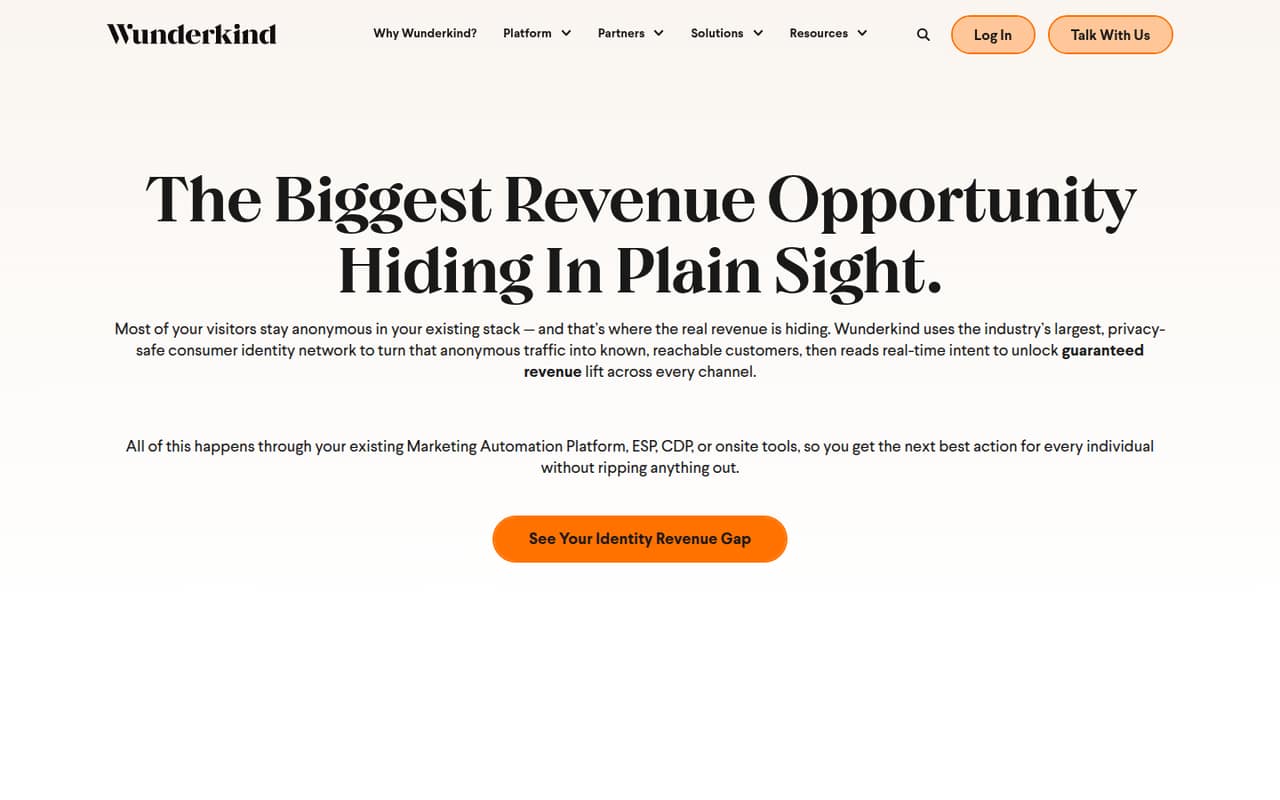
Wunderkind identifies anonymous site visitors, enriches customer profiles with behavior, and uses AI decisioning to personalize marketing across existing channels. It’s aimed at brands with an identity-led marketing program, not teams looking for a simple, self-serve automation tool.
The pricing page lists custom enterprise quotes based on website traffic, contract terms, and activated channels. It lists no free plan, trial, or public usage limits, so a small team can’t estimate the cost for a few seats without contacting the vendor.
Good fit if
- Brands with substantial website traffic
- Teams activating several marketing channels
- Marketers using first-party behavior data
Skip it if
- Teams needing a free starting tier
- Buyers who require published seat prices
- Small teams seeking simple self-service setup
ScoresHow it rates
What works
- Recognizes anonymous visitors and connects profiles
- Enriches profiles with real-time behavior
- Captures browsing, clicks, searches, and cart updates
- Personalizes actions with AI decisioning
- Activates data across email, SMS, onsite, and paid media
What doesn't
- No free plan or trial is listed
- Enterprise pricing requires a custom quote
- Public usage limits are not listed
- One-, three-, and five-person costs are unpublished
- Setup requirements and named integrations are not published
01Who Wunderkind is for
Wunderkind is for brands that want to identify more anonymous site visitors and use their behavior to shape marketing. It connects identity and profile data with existing tools, then uses AI decisioning to personalize next actions across channels such as email, SMS, onsite, and paid media.
For a 1–10-person team, the main question is less about headcount than whether the business has enough website traffic and marketing activity to justify an enterprise product. The pricing page says quotes depend on traffic, contract terms, and activated channels, but doesn’t publish a minimum. That makes it difficult for a small team on a tight budget to know whether it fits before speaking with sales. We’d consider it when identity resolution and coordinated activation are priorities, and ask for a quote tied to the channels and traffic we actually expect to use.
02Wunderkind free plan and trial
The pricing page lists no free plan or free trial. There’s no public starter tier to test identity resolution, profile enrichment, or channel activation before committing. The cheapest listed way in is Wunderkind’s custom-quote Enterprise plan; the vendor doesn’t publish a starting price or public usage limits.
For a small team, ask whether the quote includes implementation, which channels it covers, and what happens if traffic or channel needs change. Also ask whether there is a pilot or another evaluation option, since the pricing page doesn’t list one. Without a published trial or price, you’ll need a conversation with the vendor to find out whether the product fits your budget and use case.
03What a small team pays for Wunderkind
Wunderkind doesn’t publish a monthly or annual rate. The pricing page lists a custom Enterprise quote based on website traffic, contract terms, and activated channels. It does not list a starting price, per-seat rate, or public usage limits.
That means we can’t calculate what one person, three people, or five people would pay, or compare monthly billing with annual billing. The vendor’s pricing is not presented as a per-seat plan, so don’t assume that adding seats is the main cost driver. Ask for a written quote that spells out the contract term, included traffic or usage, and the cost of each channel you want to activate. The pricing page lists no add-ons, so any extra charges for services or capabilities should be confirmed directly with the vendor. For a budget-conscious team, this lack of public pricing makes it hard to compare against tools with published plans before starting a sales conversation.
04Getting started with Wunderkind
Wunderkind is designed to work with a brand’s existing marketing stack: it identifies visitors, enriches profiles, and sends data to email, SMS, onsite, and paid media tools. The product description also says activation requires proper user consent and uses first-party data.
The vendor doesn’t publish a setup timeline, step-by-step onboarding requirements, or a list of named integrations in the pricing material. So we can’t say how much technical work a small team will need to connect its site, customer profiles, and marketing channels. Before signing, ask which of your current tools are supported, who handles the integrations, what consent setup is required, and what your team must maintain. Because the product depends on connecting identity and behavior data across systems, don’t treat setup as a simple switch-on until the vendor confirms the work involved.
05When small teams outgrow Wunderkind
Wunderkind’s listed offer is already Enterprise, so the usual small-team path of starting on a low-cost tier and upgrading later isn’t visible. A team may outgrow the fit if it needs self-serve onboarding, a predictable per-seat budget, or published usage limits before making a commitment. The pricing page doesn’t list those details, so ask how traffic growth, added channels, and contract changes affect the quote.
The product may also be more than a lean team needs if it only wants basic email automation rather than identity resolution and behavior-based activation across several channels. Conversely, as a marketing program grows, ask the vendor how the quote changes when you activate more channels or handle more traffic. Without public limits or rates, there’s no published threshold that tells a team when it must upgrade or move; that decision depends on its quote, requirements, and budget.
Questions people ask
What is Wunderkind?
Wunderkind is an identity and AI marketing product. It identifies anonymous site visitors, adds real-time behavior to customer profiles, and uses AI decisioning to personalize marketing across existing channels such as email, SMS, onsite, and paid media.
How much does Wunderkind cost?
The pricing page lists a custom Enterprise quote, not monthly or annual rates. The vendor says quotes depend on website traffic, contract terms, and activated channels. It doesn’t publish a starting price or per-seat cost, so ask for a quote based on your needs.
Does Wunderkind have a free plan or trial?
The pricing page lists neither a free plan nor a free trial. Its listed option is Enterprise with custom pricing. Ask the vendor whether it offers a pilot or evaluation arrangement, since one isn’t listed on the pricing page.
Which marketing channels can Wunderkind activate?
Wunderkind’s product description names email, SMS, onsite, and paid media as activation channels. It sends identity and behavior data to a brand’s existing tools. Ask the vendor whether your specific platforms are supported and included in your quote.
How does Wunderkind handle privacy and consent?
Wunderkind says it uses first-party data and that activation requires proper user consent. Before implementation, ask the vendor what consent setup your team needs and how that requirement applies to the channels you plan to activate.