
We may earn a commission if you buy through links on this page. It never changes a score or a ranking. How we make money
The bottom line
A broad, pay-per-call API catalog with a $5 signup credit and no monthly fee.
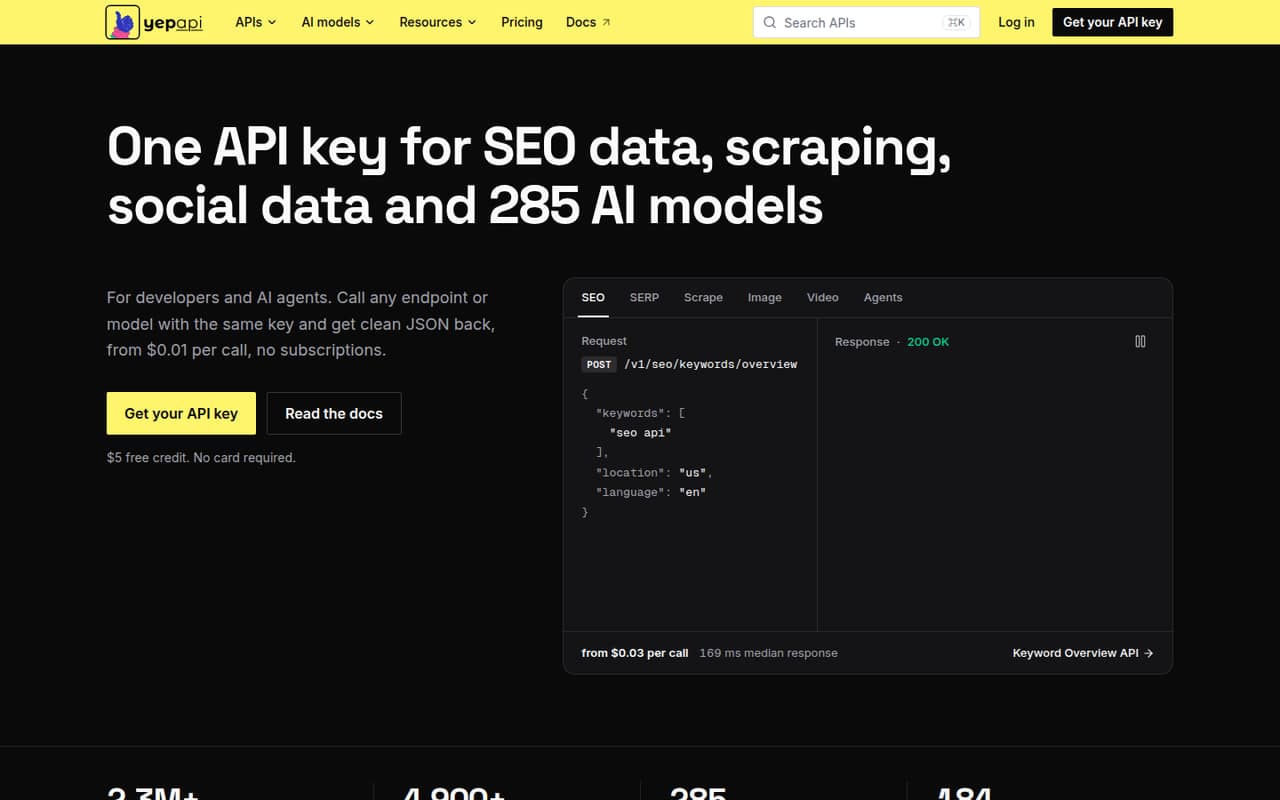
YepAPI combines SEO and SERP data, scraping, social and commerce data, and 285 AI models behind one API key. Calls return JSON, and the pricing page lists pay-per-use billing with no subscription or monthly minimum.
The $5 signup credit makes it easy to try, and Google SERP calls start at $0.01. But there is no free plan, and your ongoing bill depends on endpoint use. It fits teams that can work with APIs and want one metered service; teams needing a predictable fixed bill should compare carefully.
Good fit if
- Small teams building data workflows
- Developers needing varied API endpoints
- Teams avoiding monthly subscriptions
Skip it if
- Nontechnical teams seeking a visual tool
- Buyers needing predictable monthly bills
- Teams requiring published support commitments
ScoresHow it rates
Editor's rating: 9.5/10. Pay-per-call with no subscription or seat count: one key covers SEO data, SERP results, scraping, social media data and 285 AI models, so a small team pays only for what it uses. How editor's ratings work
What works
- One API key covers several data categories
- Includes SEO, scraping, social, commerce, and AI
- $5 signup credit lowers the cost to try
- No monthly fees or minimums
- Failed calls are not charged
What doesn't
- No ongoing free plan
- Most endpoint prices are not stated here
- Total spend depends on call volume
- Setup details and support terms are not published
- No fixed-price team plan
01Who YepAPI is for
YepAPI is for a small developer-led team—one to ten people—that needs data from several services but would rather pay for calls than add a subscription for each tool. It puts SEO and SERP data, web scraping, social and commerce data, and 285 AI models behind one API key. Responses use JSON, which gives a team a consistent format to work with across endpoints.
That breadth may suit a startup building a research workflow, internal tool, or data feature. It is less suited to a team looking for a ready-made SEO dashboard: YepAPI sells API access, so your team needs to connect the calls to its own code or workflow. The pricing page lists Google SERP calls from $0.01 and says there are no monthly minimums. That makes it worth considering on a tight budget, provided someone on the team can build and maintain the integration.
02YepAPI free plan and trial
YepAPI does not list a free plan. The pricing page lists a $5 signup credit, which gives a new account some usage to try before paying out of pocket. That is a credit, not an ongoing allowance: once it is used, calls are billed by usage.
The cheapest published starting point is Google SERP data from $0.01 per call. Other endpoint prices depend on the service and usage unit; ask YepAPI for the current rate before building around an endpoint. The pricing page says there are no monthly fees or minimums, and failed calls are not charged. For a small team, the credit is a low-risk way to check that the API covers a specific task, but it does not establish what regular usage will cost.
03What a small team pays for YepAPI
YepAPI has no per-seat plan, so one person, a team of three, and a team of five face the same pricing structure: pay for usage, not headcount. The pricing page lists Google SERP calls from $0.01 each, with no monthly fee or minimum. At that starting rate, 100 such calls would cost $1, and 1,000 would cost $10; those figures apply only to Google SERP calls at the listed starting price.
The service does not publish a single monthly starting price, and the total for other endpoints depends on their rates and how much you use them. There is no annual billing or subscription to compare. The $5 signup credit is the initial offer, not a recurring discount. No add-ons are listed. Before a team commits, it should price its expected call mix with YepAPI, since a busy workflow can cost more than the Google SERP example suggests.
04Getting started with YepAPI
The basic setup is API-oriented: YepAPI provides one API key, and calls return JSON. A developer will need to choose endpoints, add the key to the application or workflow, and handle the returned data. That is a manageable starting point for a team already comfortable with APIs, but it is not a no-code setup for nontechnical users.
The vendor does not publish setup effort, implementation time, or a list of plug-and-play integrations in the pricing details. The key decision for day one is which data sources the team actually needs; using one API does not remove the work of integrating results into your product or process. Check YepAPI's endpoint documentation and ask the vendor about authentication, examples, and any endpoint-specific requirements before estimating the work. Start with the signup credit to validate a narrow use case before wiring in several services.
05When small teams outgrow YepAPI
The clearest reason to move on is cost uncertainty. YepAPI has no monthly minimum, which is helpful while usage is light, but it also has no fixed subscription price to cap a growing bill. When a workflow makes many calls, the team should compare its actual usage and endpoint mix against alternatives with published monthly pricing.
A second pressure point is operational fit. YepAPI is an API product, so a team that needs a finished dashboard or a nontechnical workflow may outgrow its approach as more colleagues need access. The pricing details list no seat tiers or annual plan, and the vendor does not publish support commitments there. That may matter as a workflow becomes business-critical. The listed lack of rate limits and the policy not to charge failed calls are useful, but they do not replace checking endpoint costs, documentation, and support expectations as the team scales.
Questions people ask
Does YepAPI have a free plan?
No. YepAPI does not list an ongoing free plan. The pricing page lists a $5 signup credit for trying the service, after which API calls are billed by usage. Google SERP data starts at $0.01 per call; check the current price for other endpoints before estimating ongoing costs.
How does YepAPI charge for API calls?
YepAPI uses pay-per-use billing rather than a monthly subscription. The pricing page says there are no monthly fees or minimums, and failed calls are not charged. Endpoint rates vary; Google SERP calls are listed from $0.01. Ask YepAPI to confirm the rates for the endpoints your workflow will use.
What data can I access through YepAPI?
YepAPI describes endpoints for SEO and SERP data, web scraping, social and e-commerce data, and 285 AI models. Its listed SEO data includes keywords, backlinks, domains, Google results, and local listings. Scraping can return markdown, HTML, or screenshots; available data depends on the endpoint.
Does YepAPI support teams of three or five?
YepAPI does not list per-seat pricing. Its pricing is based on usage, so team size alone does not change the bill: a team of three and a team of five pay for the calls they make. The service provides one API key, so confirm with YepAPI how your team should manage access.
Is YepAPI suitable for nontechnical users?
YepAPI is an API service, and its calls return JSON. That makes it a better fit for teams with a developer who can connect endpoints to an application or workflow than for buyers seeking a ready-made dashboard. The vendor does not publish setup effort or a list of plug-and-play integrations in its pricing details.