
We may earn a commission if you buy through links on this page. It never changes a score or a ranking. How we make money
The bottom line
Zip handles procurement across several workflows, but you’ll need a quote to know if it fits your budget.
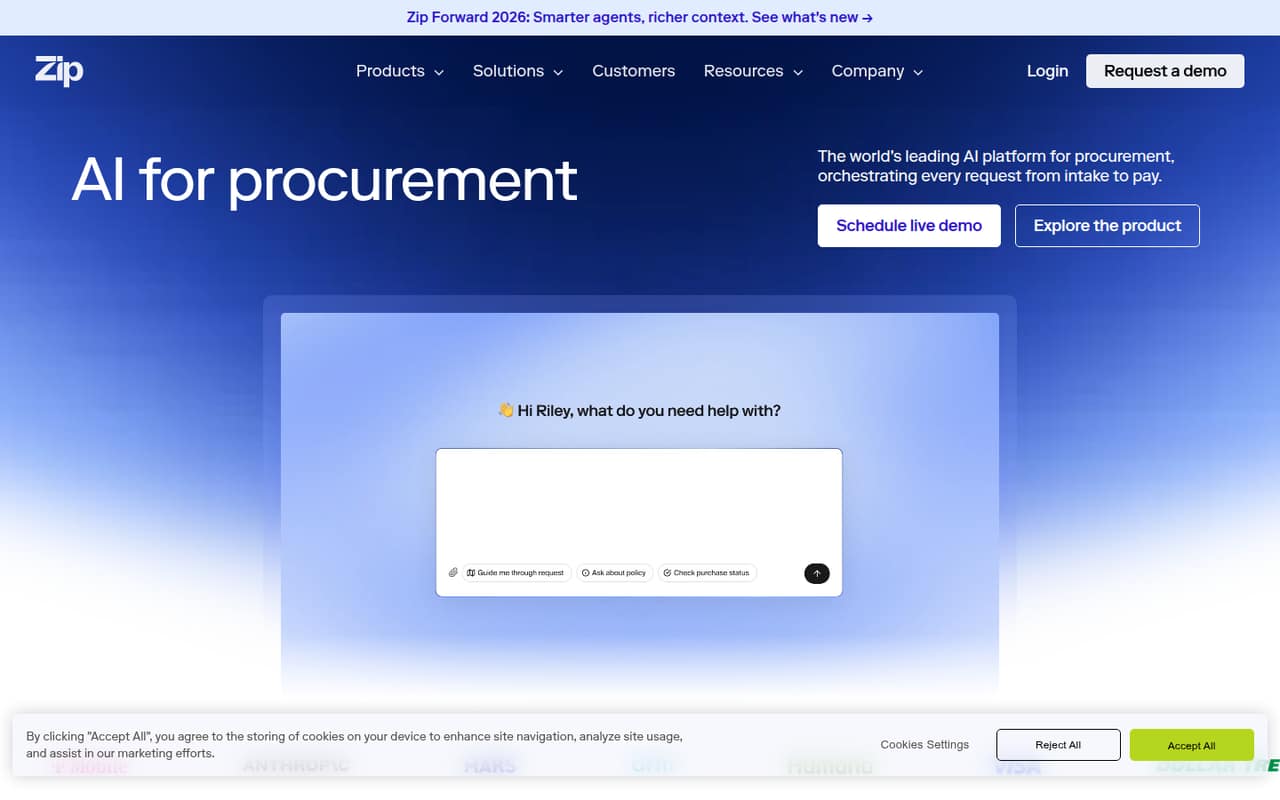
Zip is an AI procurement platform for managing requests from intake to pay. Its products cover purchase orders, invoices, supplier onboarding, sourcing, risk management and contracts, which may suit teams that want these workflows in one system.
For a small team watching every subscription, the main drawback is price opacity: Zip does not publish its starting price, plan details or billing terms. There’s no published free plan or trial to help you assess fit before requesting a quote.
Good fit if
- Teams coordinating many procurement workflows
- Companies needing supplier onboarding
- Buyers seeking intake-to-pay processes
Skip it if
- Teams that need a published price
- Buyers seeking a free procurement tool
- Small teams with simple purchasing needs
ScoresHow it rates
What works
- Covers procurement from intake to pay
- Supports purchase orders and invoice management
- Includes guided supplier onboarding
- Offers AI-supported sourcing workflows
- Includes risk and contract orchestration
What doesn't
- Starting price is not published
- Plan details are not published
- Billing terms are not published
- No free plan is listed
- Free-trial availability is not published
01Who Zip is for
Zip is for teams that want to coordinate procurement requests and related work in one platform. Its products cover intake, purchase orders, invoices, supplier onboarding, sourcing, risk and contracts. That breadth may be useful to a small team if several people handle these processes and requests need to follow shared policies.
For a 1–10-person company, the fit depends less on headcount than on how much procurement work needs coordination. A team with straightforward purchasing may find a platform spanning intake to pay more than it needs. A team managing many requests, suppliers or approval processes may have more reason to assess it. Zip says it uses AI to support procurement and automate workflows, but the vendor does not publish list pricing or plan details. We’d ask for a quote and a demonstration of the workflows the team actually needs before budgeting for it.
02Zip free plan and trial
Zip does not list a free plan, and free-trial availability is not published. That means a small team should not count on a no-cost tier for trying the platform or running a limited procurement workflow. Zip’s products span intake, purchase orders, invoices, supplier onboarding, sourcing, risk and contracts, but the vendor does not publish which features are included in specific plans.
The cheapest way in is not published either. There’s no public entry-level plan price to use as a starting point, so ask Zip for a quote and whether it offers a pilot or evaluation period. Before agreeing to anything, confirm what the quoted package includes, how billing works and whether the features your team needs are available at that price.
03What a small team pays for Zip
Zip does not publish list pricing, plan details or billing terms, so we can’t calculate a reliable cost for one person or a team of three or five. Per-seat pricing is not published, and there’s no public monthly-versus-annual comparison. The starting price is unknown; ask Zip for a quote that covers your team size and intended workflows.
The vendor’s products cover intake, purchase orders and invoices, supplier onboarding, sourcing, risk and contracts. However, the public pricing notes do not say which of these are bundled, sold separately or subject to add-on fees. Add-on prices are not published either. For a small team, request an itemized quote for the exact capabilities you need, including any minimum commitment, billing schedule and fees for adding seats or products later. Until Zip answers those questions, it’s difficult to compare the cost with procurement tools that publish prices.
04Getting started with Zip
Zip describes workflows for procurement requests, purchase orders, invoices, supplier onboarding, sourcing, risk and contracts. But the vendor does not publish setup time, implementation requirements or a learning curve in the available product and pricing details. We can’t say how much work a small team should budget for configuration or training.
Integrations for day-one use are not listed in the material available for this review, so confirm which of your existing systems Zip can connect to before signing. Ask who configures request and approval workflows, what your team needs to provide, and whether onboarding or support is included in the quote. For a team of one to ten, those answers matter: a broad platform can take more coordination to adopt than a simple request form, especially if several procurement processes need to move into it.
05When small teams outgrow Zip
Zip’s listed products span intake, purchase orders, invoices, supplier onboarding, sourcing, risk and contracts. A small team is more likely to question the fit when it needs only a basic purchasing process, or when the cost and implementation effort outweigh the workflows it plans to use. Because Zip does not publish seat limits, plan tiers or prices, we can’t identify a specific headcount or spend level that triggers an upgrade.
Before adopting it, ask how pricing changes as your team adds people or products, and whether the package can cover new workflows without a separate fee. Also confirm any limits on users, requests or approvals. If your team grows into more procurement processes, Zip’s breadth may be relevant; if it needs capabilities beyond the listed areas, ask the vendor whether they’re supported. Without public plan limits, those are questions to settle directly rather than assumptions to make from the website.
Questions people ask
What does Zip do?
Zip is an AI procurement platform for managing processes from intake to pay. Its products cover procurement requests, purchase orders and invoices, supplier onboarding, sourcing, risk management and contracts. It uses guided requests and workflows to support procurement processes, with AI features for areas such as purchase orders, invoices and sourcing.
Does Zip have a free plan or free trial?
Zip does not list a free plan, and free-trial availability is not published. If you want to evaluate it before buying, ask the vendor whether it offers a pilot or trial, what features that includes and whether there is a charge. Don’t assume a no-cost option is available.
How much does Zip cost?
Zip does not publish list pricing, plan details or billing terms. That means there is no public starting price or per-seat figure to use for a one-, three- or five-person team. Request an itemized quote and confirm the billing schedule, any minimum commitment and how costs change as you add users or products.
Can Zip manage purchase orders and invoices?
Yes. Zip lists purchase order and invoice management among its procure-to-pay capabilities, with AI used to automate that work. The vendor does not publish which plans include these features or whether they carry additional fees, so ask for the exact package details when requesting a quote.
Does Zip handle supplier onboarding and contracts?
Zip lists guided supplier onboarding through a supplier portal, as well as contract orchestration to automate contract processes with AI. It also lists sourcing and risk workflows. Ask Zip which capabilities are included in the package you’re considering, since the vendor does not publish plan-by-plan feature details.