
We may earn a commission if you buy through links on this page. It never changes a score or a ranking. How we make money
The bottom line
Good value for teams that can manage connectors and credits; less appealing if support is critical.
Airbyte moves data between systems through a connector library, with self-hosted, managed Cloud, and hybrid options. The free Core edition keeps the entry price low; managed Standard starts at $20/month, with included credits that make actual cost depend on usage.
For a small team, the trade-off is control versus upkeep. Reddit users praise the connector catalog and self-hosting option, but some report hard-to-debug failures and poor support. We’d shortlist it if your team can own pipeline troubleshooting and check connector fit before committing.
Good fit if
- Teams comfortable managing data pipelines
- Small teams testing self-hosted ingestion
- Teams needing custom connectors
Skip it if
- Teams needing guaranteed support
- Buyers wanting a fixed usage bill
- Teams without technical pipeline owners
ScoresHow it rates
What works
- Free self-hosted Core edition
- Managed Standard starts at $20/month
- Connector Builder supports custom connectors
- Cloud, self-hosted, and hybrid deployment options
- Move Core pipelines to Cloud or Hybrid
What doesn't
- Core usage limits are not published
- Standard includes only five credits
- Extra Standard and Plus credits cost $5 each
- Annual Standard and Plus prices are not published
- Reddit users report bugs and poor support
01Who Airbyte is for
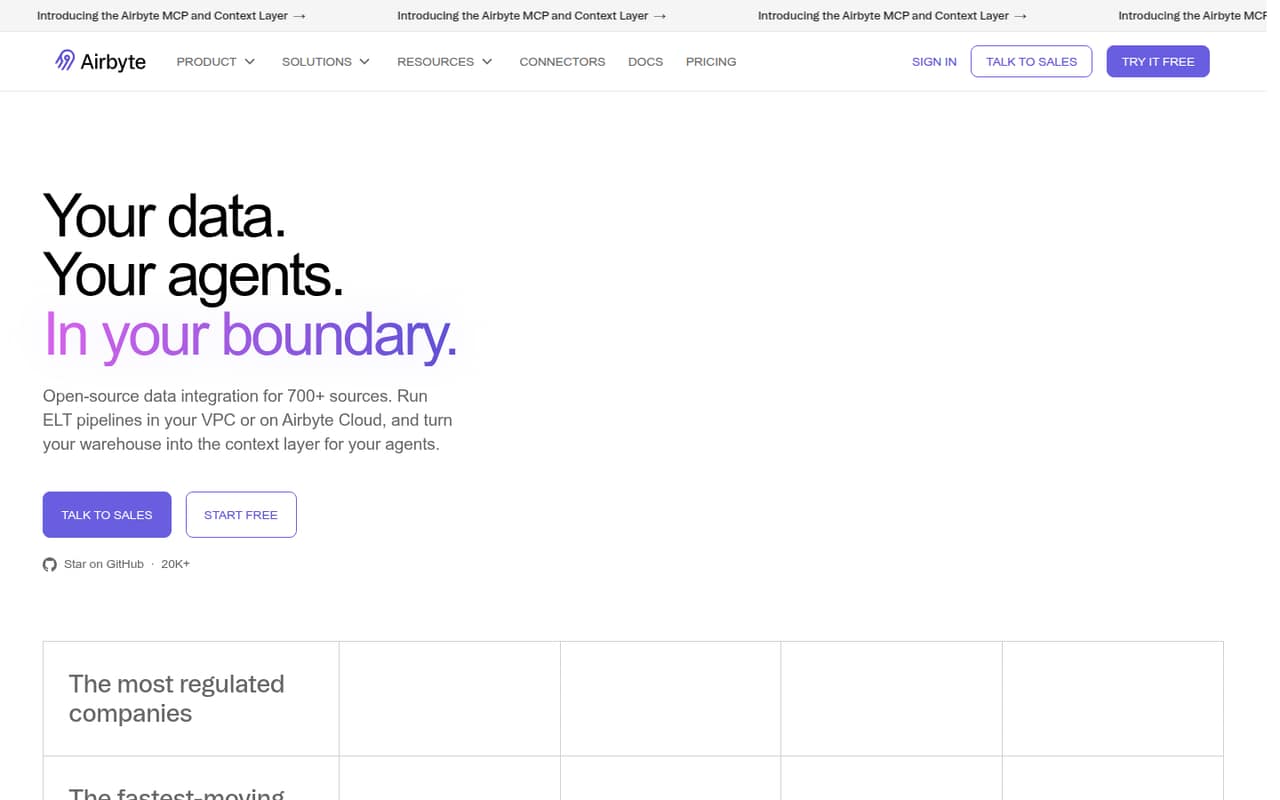
Airbyte is for small teams that need to copy data from business systems into a destination such as a warehouse, and have someone who can own pipeline setup. Its connector library handles replication, while Connector Builder lets teams create and deploy custom connectors. The product also offers an MCP and Context Layer that connects warehouse data to agents with inherited access controls.
A one-to-ten-person team can start with free, self-hosted Airbyte Core if it has the infrastructure and technical time to run it. Teams that would rather use a managed service can start on Standard at $20/month, but that price includes five credits, about 1 GB. Airbyte is a better fit when flexibility and control matter more than a fully hands-off experience. If a broken connector would block a small team with no data engineering backup, we’d compare support expectations carefully before relying on it.
02Airbyte free plan and trial
Airbyte Core is the free option: the pricing page lists it as self-hosted on your infrastructure under the Elastic License 2.0. Usage limits are not published, so teams should confirm whether their intended workload fits and account for the time and infrastructure needed to run it themselves.
For managed Airbyte, Standard starts at $20/month and includes five credits, about 1 GB. The pricing page lists a 14-day trial with 400 credits, about 100 GB, for Standard; Standard and Plus are listed as having a 14-day trial. That trial is a short evaluation, not an ongoing free managed tier. For a team that wants managed service after the trial, the cheapest listed entry is Standard.
03What a small team pays for Airbyte
The cheapest managed plan is Standard at $20/month, including five credits, about 1 GB. Airbyte’s listed prices are not per seat, so the starting plan price is $20/month for one person, three people, or five people if they share that usage allowance. That works out to $20, about $6.67, or $4 per person monthly, respectively. Those are monthly-price calculations, not per-seat rates.
Twelve months at that monthly rate would total $240, $720, or $1,200 for those team sizes, but the pricing page does not publish an annual Standard price or discount. Plus starts at $189/month with 40 credits and a 15-minute minimum sync frequency; divided across three or five people, that is $63 or $37.80 per person monthly. Standard and Plus list additional credits at $5 each. API and custom-source usage costs six credits per million rows, while database and file usage costs four credits per GB. Check expected volume before budgeting.
04Getting started with Airbyte
The setup effort depends on which deployment you choose. Core means running the open-source engine and connectors on your own infrastructure; managed Cloud avoids that hosting responsibility, while Hybrid runs pipelines in your cloud, VPC, or data center with Airbyte managing the control plane. The product overview says Core pipelines can move to Cloud or Hybrid without rebuilding them.
For day one, list each source and destination you need, then check that the relevant connectors support your required data and sync pattern. Airbyte’s connector library is central to the product, and Connector Builder is an option when a connector needs to be built and deployed. We can’t assume every integration is ready for your exact use case from the product description alone, so verify the specific connector before planning a migration. Reddit discussions include users who found Airbyte self-hosting fairly painless, alongside reports of API issues, stuck pipelines, and debugging frustration. A technical owner is sensible even for a small team.
05When small teams outgrow Airbyte
A team can outgrow Core when maintaining its own infrastructure and troubleshooting connectors starts costing more than the free plan saves. Core’s usage limits are not published, so ask Airbyte what applies to your workload before treating it as a long-term budget forecast. Moving to managed Standard shifts the starting cost to $20/month, but five included credits may not cover a larger data load. Plus starts at $189/month, and additional Standard or Plus credits cost $5 each.
Growth can also expose reliability and support concerns. One Reddit thread describes an OAuth error lasting seven days and says support did not acknowledge repeated requests. Other commenters report bugs, stuck runs, and time-consuming debugging; these are individual accounts, not a guarantee of what every team will experience. If your team cannot absorb that troubleshooting, ask the vendor about support coverage and connector-specific reliability before scaling. For larger or custom deployments, Pro and Enterprise Flex require quotes; Enterprise Flex supports VPC, on-premises, or multi-region deployment.
From the threadsWhat users say
Airbyte’s low-cost entry point and connector flexibility appeal to some data teams. Reddit sentiment is mixed to negative, with reports of difficult debugging, bugs, and poor support alongside praise for self-hosting and connector breadth.
Fans appreciate its extensive connector catalog
fairly painless self-hosted version too
It is so much easier to debug
their support is absolutely horrific
Questions people ask
What is Airbyte used for?
Airbyte moves data from sources to destinations using connectors. Teams can use it for data replication, build custom connectors with Connector Builder, and choose self-hosted, managed Cloud, or hybrid deployment. Its MCP and Context Layer connects warehouse data to agents with inherited access controls.
Is Airbyte similar to Airflow?
Airbyte’s stated job is moving data between systems through connectors. The vendor's site describes replication, connector building, and deployment options; it does not describe Airbyte as a workflow orchestrator. If you need both data movement and orchestration, confirm how your planned tools fit together before choosing.
Does Airbyte use CDC?
Airbyte’s product description says it replicates data through connectors, but that does not establish CDC support for every source. Ask Airbyte or check the documentation for the exact source connector and sync mode you need before treating CDC as a requirement the product will meet.
Can we self-host Airbyte?
Yes. Airbyte Core is listed as free and self-hosted on your infrastructure. Hybrid is another option: pipelines run in your cloud, VPC, or data center while Airbyte manages the control plane. Self-hosting means your team should plan for the infrastructure and technical ownership involved.
What is Airbyte’s MCP and Context Layer?
Airbyte describes its MCP and Context Layer as a way to connect a data warehouse to agents while inheriting access controls. Managed Cloud includes MCP and the Context Layer. Ask Airbyte which warehouse connections and access-control behaviors fit your setup.
Sources
- Airbyte homepage
- Airbyte pricing, compiled via web search from airbyte.com, checkthat.ai, datastackindex.com, getorchestra.io, integrate.io
- Reddit: Any alternative to Airbyte?
- Reddit: Replace Airbyte with dlt
- Reddit: Airbyte vs Fivetran for our ELT stack? Any other alternatives?
- Reddit: Airbyte and similar EL tools