
We may earn a commission if you buy through links on this page. It never changes a score or a ranking. How we make money
The bottom line
Strong real-time analytics features; the operational workload may cost a small team more than the software.
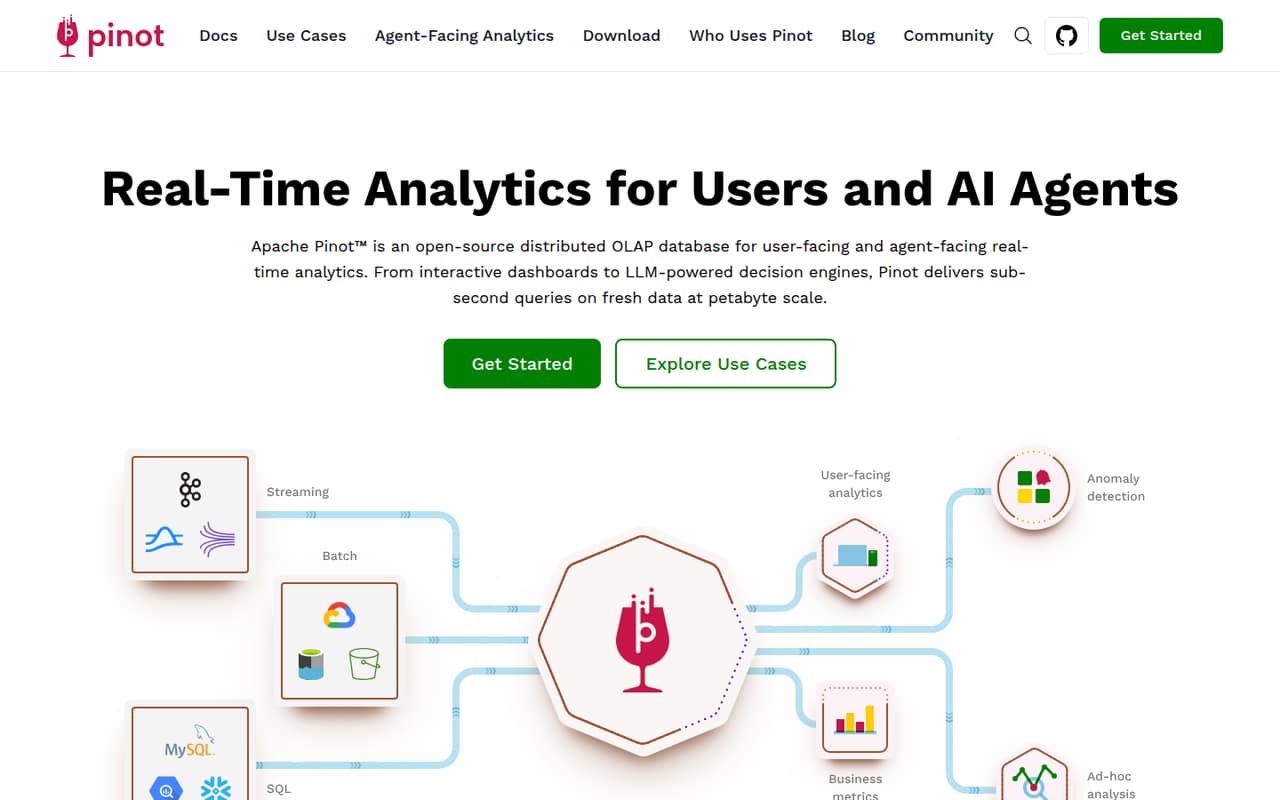
Apache Pinot is an open-source OLAP database for interactive analytics on fresh data. It supports streaming and batch ingestion, SQL, REST access, and upserts, with a free open-source entry point.
For a team of 1–10, the main cost question is operations, not seats: the project doesn't publish subscription rates, and Reddit users describe managing a Pinot cluster as demanding. It makes more sense when user-facing, low-latency analytics is important enough to justify that work.
Good fit if
- Teams building real-time analytics
- Products querying fresh event data
- Engineers comfortable running distributed systems
Skip it if
- Teams seeking a no-ops database
- Small teams without infrastructure capacity
- Buyers needing predictable published pricing
ScoresHow it rates
What works
- Open-source software under Apache License 2.0
- Supports sub-second queries on fresh data
- Ingests from Kafka, Pulsar, and Kinesis
- Handles batch sources including Hadoop and S3
- SQL access, REST API, and upserts
What doesn't
- Monthly and annual rates aren't published
- Seat and usage limits aren't published
- Small teams still need to manage infrastructure
- Reddit users report operational complexity
- No published free-trial terms
01Who Apache Pinot is for
Apache Pinot is for engineering teams building apps or services that need interactive analytics on fresh data. It can ingest streams from Kafka, Pulsar, and AWS Kinesis, as well as batch data from Hadoop, Spark, and AWS S3. Queries use SQL, with access through a query editor and REST API.
For a 1–10-person team, the fit depends less on headcount than on whether someone can take responsibility for the database infrastructure. Pinot is distributed software, and Reddit users describe the work of managing it as a real burden. The open-source license makes the software an option for teams watching subscription spend, but it doesn't make hosting or upkeep free. Choose it when low-latency analytics is central to your product and your team can support the system; skip it if you mainly want a database that runs itself.
02Apache Pinot free plan and trial
Apache Pinot's open-source edition is listed under the Apache License 2.0, making it the free way to start. The project doesn't publish a monthly or annual subscription price, and the pricing information lists no seat or usage limits. It also doesn't publish free-trial terms; the open-source option is the way in rather than a time-limited trial.
Free software doesn't mean a zero-cost deployment. You still need infrastructure and people to run it, and those costs depend on how you operate Pinot. The project doesn't publish those hosting costs or commercial billing terms. For a small team, the sensible first budget is therefore the cost of the software license (free) plus a separate estimate for infrastructure and ongoing operations.
03What a small team pays for Apache Pinot
The project lists an Open Source plan under Apache License 2.0, but it doesn't publish monthly or annual rates. That means we can't give a sourced subscription total for one person or calculate the per-seat cost for a team of three or five. Seat limits and usage limits aren't published either.
The open-source edition is the cheapest way in, but the cost of running it is separate from the software license. The project doesn't publish hosting prices, so a team's full monthly or annual bill depends on its own infrastructure and operations. No add-ons are listed, and commercial billing terms aren't published. Before committing, ask any prospective hosting or commercial provider for a written quote that covers the number of users, usage, support, and infrastructure. Don't treat the free software as a complete estimate of the cost to run Pinot.
04Getting started with Apache Pinot
Pinot's stated features give teams several ways to get data in: streaming sources include Kafka, Pulsar, and AWS Kinesis; batch sources include Hadoop, Spark, and AWS S3. SQL access and a REST API provide ways to query the data. Upserts can resolve repeated records to the latest value at query time.
The harder part is likely operating the system. A Reddit post discussing Pinot's architecture names ZooKeeper, controllers, brokers, and servers, and commenters describe substantial management effort. One commenter said they gave up on a self-hosted setup after two months of firefighting; that's an individual report, not a guarantee of what every team will experience. Plan for engineering time to understand the distributed components and maintain your deployment. The project doesn't publish a setup-time estimate, so allow time for your team to assess its own infrastructure and skills.
05When small teams outgrow Apache Pinot
Pinot doesn't have published seat or usage thresholds that tell a growing team when to upgrade. Instead, the pressure point may be the work of keeping the system healthy as more data and users depend on it. Reddit users describe cluster management, high availability, and schema evolution as demanding, while another commenter says self-hosting led to two months of firefighting. Those are reports from individual users, not universal outcomes.
A small team may outgrow the self-managed approach when maintenance starts taking time away from product work or when it lacks engineers to own the infrastructure. The project doesn't publish commercial rates or upgrade thresholds, so ask a provider for costs and support terms before planning a move. If your needs stay modest and you can run the system, the open-source edition remains an option; if operational effort becomes the problem, compare managed ways to run Pinot or other architectures.
From the threadsWhat users say
Reddit sentiment is mixed but leans cautious for smaller teams: users acknowledge Pinot's performance while warning about the work of managing it. The comments are individual experiences, not a measure of every deployment.
query performance is great
the operational complexity is killing us
Unless you are at Uber scale, Pinot is probably too much work
Pinot is a beast, both in performance and in management
Questions people ask
Is Apache Pinot free?
Apache Pinot's open-source edition is listed under the Apache License 2.0, and the project publishes no monthly or annual subscription rate. That covers the software, not the cost of running it. Hosting expenses and commercial billing terms aren't published, so budget for infrastructure and ask any provider for a quote.
What data sources does Apache Pinot support?
Pinot supports streaming ingestion from Kafka, Pulsar, and AWS Kinesis. Its listed batch sources include Hadoop, Spark, and AWS S3. Which sources a particular deployment can use may depend on how the team configures and operates it, so confirm the requirements for your data pipeline before choosing it.
Can I query Apache Pinot with SQL?
Yes. Pinot provides SQL access, including a SQL query editor and a REST API. The product is designed for interactive analytics on fresh data, with sub-second queries described as a key capability. The actual experience depends on your workload and deployment; no benchmark results are provided here.
Does Apache Pinot support upserts?
Yes. Pinot supports upserts, so repeated records can resolve to the latest value at query time. This is useful when data changes after its first arrival. The project doesn't publish a general usage limit for upserts, so ask about workload-specific requirements when planning your schema and deployment.
How difficult is Apache Pinot to operate?
Expect to account for infrastructure work. Reddit users describe managing Pinot's distributed components as complex, and some report substantial firefighting when self-hosting. Those are individual accounts, not a guarantee for every setup. The project doesn't publish a setup-time estimate, so assess your team's distributed-systems experience before committing.
Sources
- Apache Pinot homepage
- Apache Pinot pricing, compiled via web search from softwr.com, ksolves.com, pingcap.com
- Reddit: Clickhouse and Apache Pinot
- Reddit: Apache Pinot reviews? Is the operational complexity worth it for most teams?
- Reddit: Apache Pinot alternatives? Struggling with operational complexity for user-facing analytics.
- Reddit: Sub-second query on Iceberg data lakes using Apache Pinot's indexes