
We may earn a commission if you buy through links on this page. It never changes a score or a ranking. How we make money
The bottom line
Worth considering for API-heavy teams; less compelling if you just need a simple API gateway.
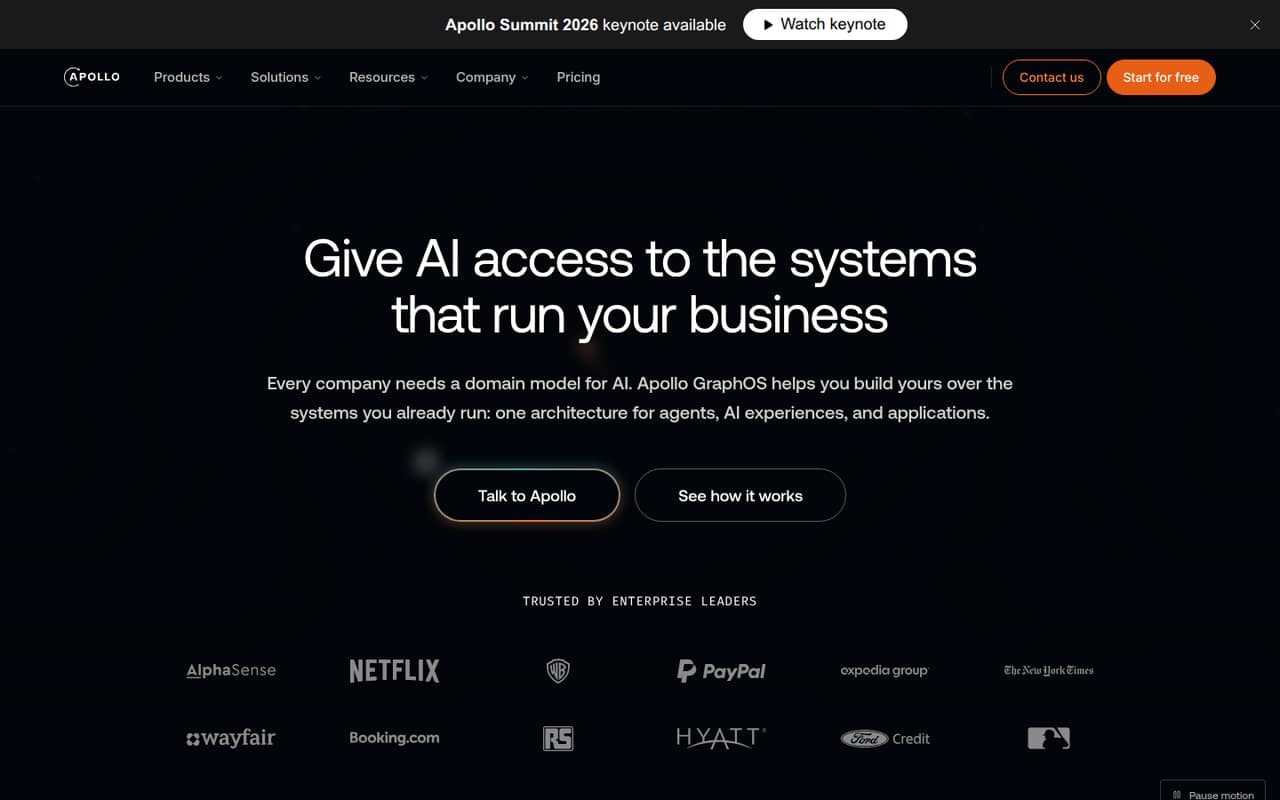
Apollo GraphOS connects APIs and services into a shared domain model, with tools for federation, access policies, agent discovery, identity, and observability. That breadth can help teams coordinate how applications and agents use business data.
The Free plan covers up to three developers, but production teams pay by request volume on Developer. That can be economical at low usage, though add-ons and separately metered features make a fixed monthly budget harder to predict.
Good fit if
- Teams unifying multiple business APIs
- Small production teams with variable traffic
- Organizations building agent-ready APIs
Skip it if
- Teams with only one simple API
- Buyers needing fixed monthly pricing
- Teams without API platform expertise
ScoresHow it rates
What works
- Free plan covers up to three developers
- Connects existing APIs in a shared graph
- Access policies apply across services
- Agent Services helps agents discover APIs
- Developer starts at $5 per million requests
What doesn't
- Developer costs depend on request volume
- Some features are metered separately
- Free Router is limited to 60 requests per minute
- Standard and Enterprise pricing is custom
- Setup effort and time are not published
01Who Apollo GraphOS is for
Apollo GraphOS is for teams that need several APIs or services to work as one business domain model. It connects existing systems in a shared graph, describing what their data and operations mean and how they relate. Applications and agents can then work with that model under shared access policies.
A small production team of one to ten developers can fit the Developer plan, which supports up to ten developers and starts at $5 per million requests per month. That price is usage-based, not a per-seat fee, so headcount alone does not determine the bill. Teams can start with the Free plan if its three-developer cap and traffic limit are enough.
The product makes most sense when API federation, governance, agent discovery, identity tracking, or observability solve real coordination problems. A small team with one straightforward API may be paying for platform capabilities it does not need. Standard and Enterprise are aimed at larger or scaling efforts and require custom pricing.
02Apollo GraphOS free plan and trial
The Free plan costs $0 and covers up to three developers. It includes one-day data retention, community support, and a Router limited to 60 requests per minute. Apollo lists no credit card requirement, which makes it a practical starting point for students, hobbyists, or a small team exploring a graph.
The limit to watch is the Router’s request rate. A team serving production traffic may hit that ceiling, and one-day retention gives it less history than the Developer plan’s seven days. The Free plan also does not include Developer support. Apollo lists a separate free trial as not published, so treat Free as the no-cost option rather than assuming a trial period for paid features. For production beyond the free limits, Developer starts at $5 per million requests per month.
03What a small team pays for Apollo GraphOS
Developer starts at $5 per million requests per month and supports up to ten developers. That means one developer, a team of three, or a team of five all start at the same listed rate if each generates one million monthly requests: $5 before any separately metered features. The bill changes with usage, not seat count, and Apollo lists automatic volume discounts. It does not publish annual billing; Developer is billed monthly.
Apollo also lists a $50 signup usage credit. The plan includes seven-day data retention and Developer support, 8×5 with no SLA. A three-person team can use Free instead if the three-developer limit and 60-request-per-minute Router cap work for its needs.
Budget for possible extras: the Performance add-on and subscription update events each start at $2 per million for the first 250 million monthly requests or events, with lower rates by tier afterward. Federated subscriptions and response caching are metered separately on Developer. Ask Apollo for an estimate using your expected volume and feature mix.
04Getting started with Apollo GraphOS
Apollo GraphOS is a platform for connecting existing APIs and services into a shared domain model, so the first work is likely deciding which systems belong in that model and how their data and operations relate. The product description also includes access policies, identity and auditing, and visibility into traffic. Those are useful capabilities, but they mean a team should plan for more than simply switching on an API endpoint.
Apollo does not publish a setup-time estimate in the pricing details, and the vendor's site does not name a required integration list. Teams should confirm the implementation steps and compatibility for their own APIs with Apollo before budgeting engineering time. Agent Services supports agent discovery through MCP, but that does not establish that every service is ready to connect without additional work.
For a small team, a sensible first step is to scope one domain and its APIs, then clarify who will own access rules and ongoing graph changes. The learning curve will depend on the systems and governance requirements involved; a fixed onboarding effort is not published.
05When small teams outgrow Apollo GraphOS
The Free plan stops being a fit when you need more than three developers, more than one day of data retention, or traffic beyond its Router limit of 60 requests per minute. Developer raises the developer cap to ten and retention to seven days, with a starting price of $5 per million requests per month. The move is not a per-seat jump, but growing usage can raise the bill.
A team can also outgrow Developer’s support terms: it provides 8×5 Developer support with no SLA. Standard offers up to 30 developers, 90-day retention, and 8×5 support with an SLA at custom pricing. Enterprise offers unlimited developers, 18-month retention, and 24×7×365 Business support with an SLA, also at custom pricing.
Before upgrading, check whether performance, subscription update events, federated subscriptions, or response caching will add metered charges. If the team only needs to serve a small number of APIs and does not need a shared model or its governance features, simplifying the architecture may be a better answer than moving to a higher GraphOS plan.
Questions people ask
Is Apollo GraphOS free?
Yes. Apollo lists a Free plan at $0 for up to three developers, with one-day data retention, community support, and a Router limited to 60 requests per minute. It does not require a credit card. Teams needing higher limits can consider Developer, which starts at $5 per million requests per month.
How much does Apollo GraphOS cost for a small team?
Developer starts at $5 per million requests per month and supports up to ten developers. The price is based on usage rather than seats, so a team of three or five does not have a separate listed per-person charge. Add-ons and separately metered features can increase the bill.
Does Apollo GraphOS charge per developer?
The listed Developer price is per million requests per month, not per developer. Developer supports up to ten developers, while Free supports up to three. Standard and Enterprise have developer limits of 30 and unlimited, respectively, and both use custom pricing.
Does Apollo GraphOS offer a free trial?
Apollo lists a Free plan, but a separate free trial is not published. The Free plan has a three-developer limit, one-day data retention, and a Router cap of 60 requests per minute. Ask Apollo whether a trial of paid features is available for your evaluation.
What does Apollo GraphOS connect?
Apollo GraphOS connects existing APIs and services into a shared domain model. Its capabilities include API federation, access policies, agent discovery through MCP, identity and auditing, and observability into traffic to the domain model.