
We may earn a commission if you buy through links on this page. It never changes a score or a ranking. How we make money
The bottom line
Enterprise-focused zero-trust access, with custom pricing and no listed free entry point.
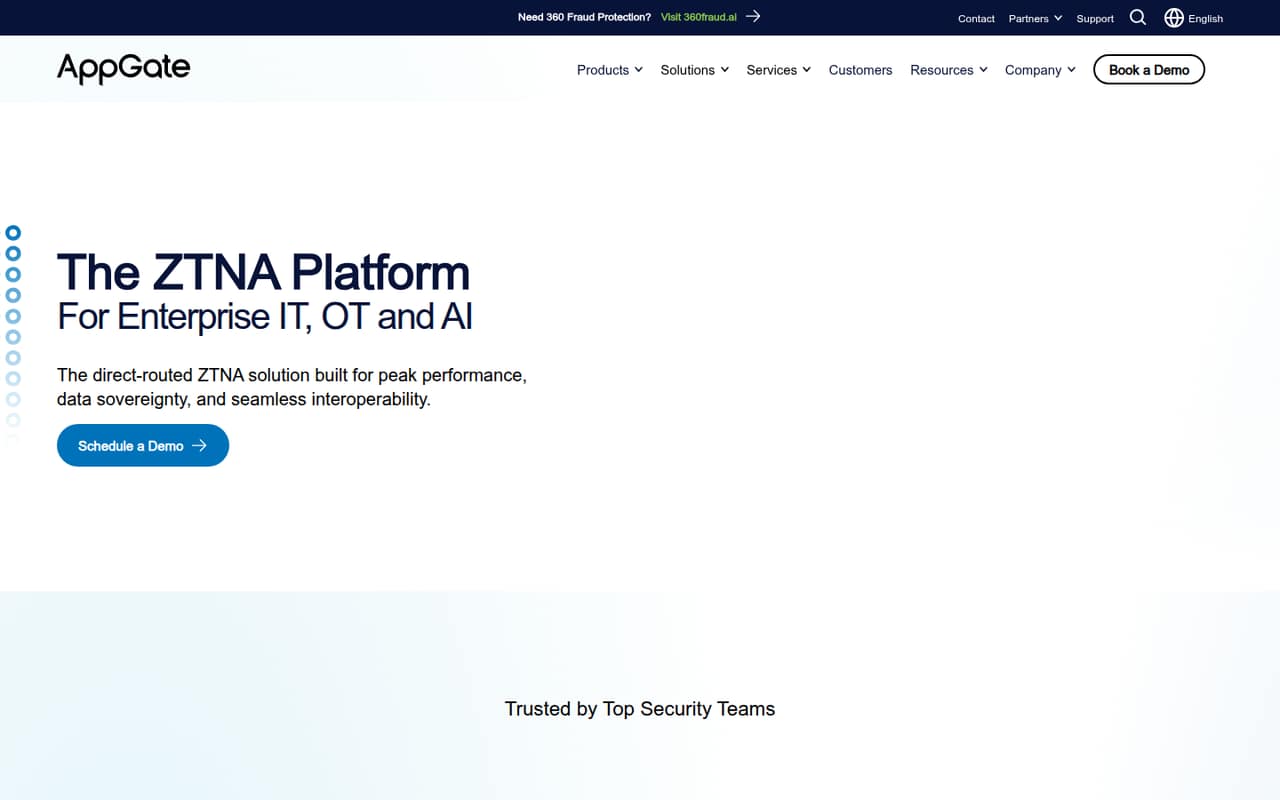
Appgate SDP is a zero-trust network access platform for enterprises and government agencies. It offers direct-routed access, cloaked infrastructure and dynamic access controls, with an API-first design aimed at interoperability.
For a 1–10-person team watching spend, the obstacle is buying clarity: the pricing page lists custom quotes, but no starting rate, seat limits or usage limits. There’s no listed free plan or trial, so get a quote before budgeting.
Good fit if
- Enterprise IT and security teams
- Government agencies
- Teams needing cloaked infrastructure
Skip it if
- Teams needing a free starting plan
- Buyers with a fixed seat budget
- Teams seeking instant self-service setup
ScoresHow it rates
What works
- Direct-routed access avoids cloud detours
- Cloaks infrastructure until trust is validated
- Dynamic access adapts to changing requirements
- API-first design targets interoperability
- Built for IT, OT and AI access
What doesn't
- Pricing is custom-quoted
- Seat and usage limits aren't published
- No free plan is listed
- No free trial is listed
- Reddit users report ISP-related connection trouble
01Who Appgate SDP is for
Appgate SDP is aimed at enterprise IT, OT and AI environments, as well as government agencies. In plain terms, it controls access to private resources based on trust rather than simply putting a user on a broad network. The vendor says it provides direct-routed, point-to-point access, keeps infrastructure hidden until trust is validated and adapts access as networks, devices and requirements change.
For a 1–10-person company, this makes sense only if those access and visibility needs are important enough to justify a custom enterprise purchase. A small team with a modest budget should ask for a quote before spending time on evaluation: the vendor does not publish a starting price or seat limits. Appgate also describes an API-first framework for interoperability and continuous visibility for compliance. Those capabilities may suit a security-focused team, but the vendor’s published positioning is not a simple small-business VPN offer.
02Appgate SDP free plan and trial
The pricing page lists no free plan, and it does not list a free trial. That leaves a small team without a published self-serve way to try the product before committing. The vendor says pricing is available by request, with seat and usage limits not published.
The cheapest way in is therefore a custom quote; there is no public entry-level plan to compare against a small team’s budget. Before booking an evaluation, ask whether the quote includes a trial or proof-of-concept period, how many users it covers and whether any usage limits apply. Those details matter when you’re deciding whether the product is workable for three or five people, not just whether its enterprise features look relevant.
03What a small team pays for Appgate SDP
The pricing page lists a custom quote, not a dollar amount. It does not publish monthly or annual rates, per-seat pricing, seat limits or usage limits. So we can’t calculate what one person, three people or five people would pay, or compare monthly billing with an annual commitment. The vendor’s cheapest published route is to request pricing.
No add-ons are listed in the pricing information. That doesn’t confirm that every capability is included, so ask the vendor to spell out what the quote covers, including seats, usage, support and any optional services. For a budget-conscious team, get a written quote for your actual headcount and expected use before comparing Appgate with tools that publish per-user plans. Without those figures, the cost for even a small team—and the point where adding seats changes the bill—remains unknown.
04Getting started with Appgate SDP
Plan for an IT-led setup, rather than assuming a quick self-serve sign-up. Appgate describes a platform for enterprise environments, and its pricing is custom-quoted; the vendor does not publish a small-team setup checklist or a time-to-launch figure. Its API-first framework is designed for interoperability, but the integrations a team needs on day one are not listed in the pricing details. Ask the vendor which identity, device and network systems your deployment requires.
The docs linked in a Reddit discussion explain Single Packet Authorization (SPA), which is part of the connection flow users there were troubleshooting. A commenter describes SPA exchanges over UDP before a TCP 443 connection is allowed. That suggests network-path details can matter: check that your users’ networks pass the required traffic. Reddit users report trouble connecting on T-Mobile Home Internet, while another says the same setup worked through an iPhone hotspot.
05When small teams outgrow Appgate SDP
Appgate SDP is already positioned for enterprise and government use, so a small team may find the buying process more substantial than its headcount suggests. The vendor does not publish seat or usage limits, and custom pricing means we can’t identify a specific seat count or bill that triggers an upgrade. Ask how pricing changes as you add people, locations or access needs, and what happens if your use grows beyond the initial quote.
Moving away may make sense if you need a public per-seat price, a free entry point or a simpler purchase path. Connection reliability also deserves a real-world check on the networks your team depends on. In one Reddit thread, users report Appgate SDP failing on T-Mobile Home Internet or tethering, with one commenter saying the SPA packets were not reaching the controller on that network. That is an individual network issue, not proof of a general product fault, but it’s worth including in your evaluation.
From the threadsWhat users say
The Reddit discussion is mostly negative, centered on connection failures over T-Mobile networks. One user’s account suggests the issue may involve SPA traffic not passing through, but the reports are limited and don’t establish how common it is.
Appgate sdp just stop working on their TMHI and tethering
My IT team is not seeing these two UDP packets (DNS/DTLS) when I'm on T-Mobiles network
it worked for a week this past week and now appears to be blocked again
All other protocols I use seem to work fine http/https/ssh/dns etc. Just not Appgate
Questions people ask
What is Appgate SDP?
Appgate SDP is a zero-trust network access platform for enterprises and government agencies. The vendor describes it as providing direct-routed access, cloaked infrastructure and dynamic access based on changing networks, devices and requirements. It also describes the product as intended for IT, OT and AI environments.
How does Appgate SDP work?
The vendor says Appgate SDP provides point-to-point access without cloud detours and keeps infrastructure invisible until trust is validated. In a Reddit discussion about troubleshooting, a user describes SPA packets being exchanged before a TCP 443 connection is allowed. The exact setup depends on the deployment, so ask the vendor for the relevant network requirements.
Is Appgate SDP a VPN?
Appgate describes SDP as zero-trust network access, with direct-routed, point-to-point access. That is the vendor’s product category and positioning; the available pricing details do not compare it feature by feature with VPN products. If you’re replacing a VPN, ask Appgate how its access model fits your users, devices and private resources.
How much does Appgate SDP cost?
The pricing page lists custom quotes and does not publish a starting price, monthly or annual rates, per-seat costs, seat limits or usage limits. A small team should request a quote for its actual headcount and expected use, then ask what the quoted amount includes and how costs change as it grows.
Does Appgate SDP have a free plan or trial?
The pricing page does not list a free plan or a free trial. The published route to pricing is a custom quote. Ask the vendor whether an evaluation or proof-of-concept is available, how long it lasts and whether it has any seat or usage restrictions before starting a buying process.