
We may earn a commission if you buy through links on this page. It never changes a score or a ranking. How we make money
The bottom line
Good free CDC for small pipelines; Growth starts at $500/month billed annually.
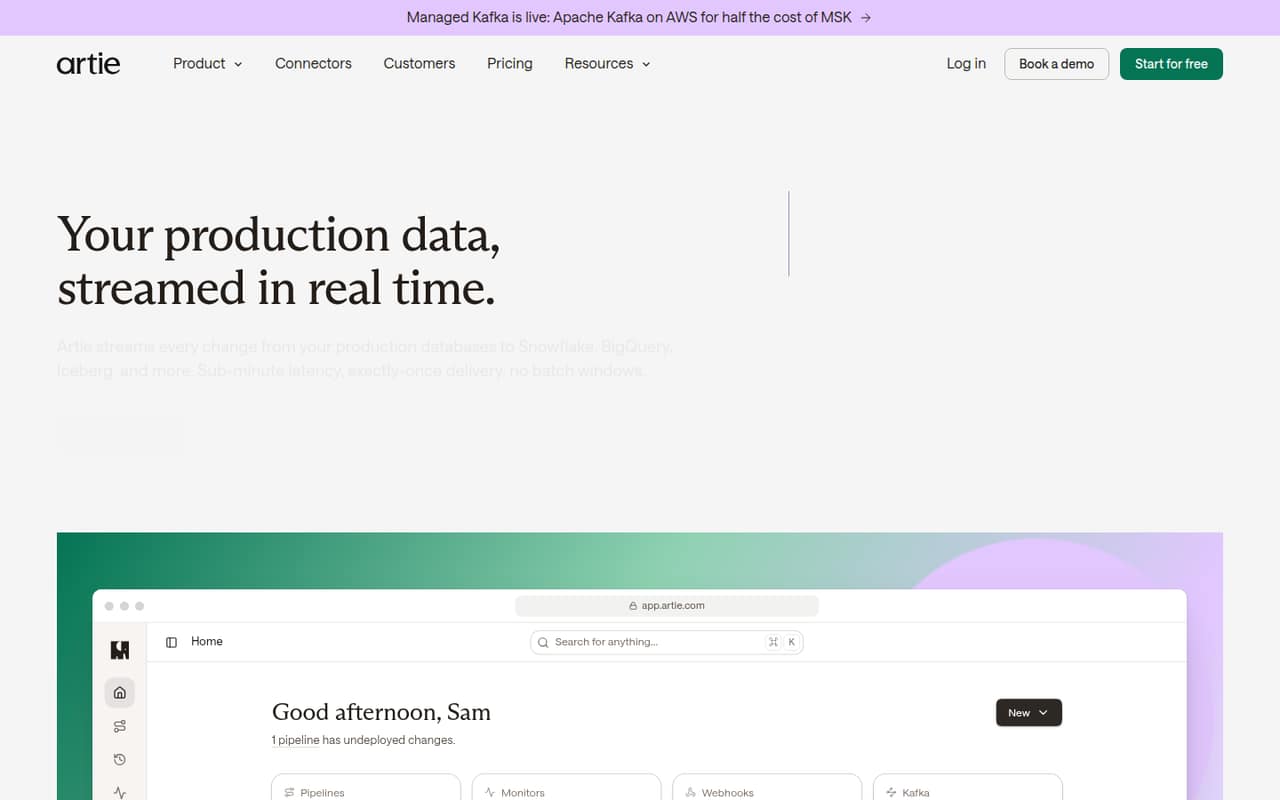
Artie streams database changes to warehouses and lakehouses, with sub-minute delivery, exactly-once processing, and backfills that don't count toward billable rows. Its Free plan covers up to 1 million billable rows and two active pipelines each month.
For more production controls, Growth costs $600 month-to-month or $500/month billed annually. That is a meaningful spend for a small team, and usage beyond committed volume costs extra at rates the vendor does not publish.
Good fit if
- Small teams moving production data
- Teams testing CDC on a budget
- Pipelines needing backfills and schema changes
Skip it if
- Teams needing many free pipelines
- Buyers requiring published connector details
- Teams avoiding usage-based pricing
ScoresHow it rates
What works
- Free plan includes up to 1 million billable rows monthly
- Two active pipelines are included on Free
- Backfills are included and excluded from billable rows
- Changes land within a minute of commit
- Growth includes unlimited pipelines, SSO, and RBAC
What doesn't
- Free plan is limited to two active pipelines
- Growth costs $600 month-to-month
- Extra Growth usage rates are not published
- Growth PrivateLink costs $500 monthly per connection
- Specific connector coverage and setup time are not published
01Who Artie is for
Artie is for small data or engineering teams that need production database changes copied into a warehouse or lakehouse without building and operating the whole pipeline themselves. The product description says it streams inserts, updates, and deletes, with changes landing within a minute of commit and exactly-once processing.
A one-to-ten-person team can start on Free if its workload fits within 1 million billable rows and two active pipelines per month. That is a low-risk way to try CDC for a couple of important data flows, rather than paying for a large platform upfront. Backfills are included and do not count toward billable rows, and schema changes carry over automatically.
Artie also offers managed Kafka on AWS and cloud or bring-your-own-cloud deployment options. The latter is aimed at enterprise customers, so a small team that only needs standard CDC should focus first on the Free plan and confirm its exact source and destination support with Artie.
02Artie free plan and trial
Artie Free costs $0 on an ongoing basis. The pricing page lists up to 1 million billable rows per month and up to two active pipelines, plus backfills that are always included. It also lists SOC 2 Type II and Slack Community support. For a small team validating a couple of data flows, that is a useful starting allowance; it is not an unlimited production tier.
The key ceiling is the combination of monthly rows and active pipelines. If your volume or pipeline count exceeds either limit, the pricing page points to Growth, which has unlimited active pipelines and usage-based billing. Artie also lists a 14-day free trial, but the trial's plan access and limits are not published in the pricing details. Ask Artie what the trial includes before treating it as extra capacity beyond Free.
03What a small team pays for Artie
Artie prices Growth by usage, not by seat. It costs $600 per month month-to-month, or $500 per month when billed annually, which is $6,000 for the year. So one person pays the same plan total: $600 monthly or $6,000 annually. For three people, the equivalent split is $200 each monthly or about $166.67 each per month annually; for five, it is $120 or $100 each. Those per-person figures are just the bill divided across the team, not seat prices.
Free stays at $0 for one, three, or five people if usage remains within its 1-million-row and two-pipeline limits. Growth usage beyond committed volume is billed at a per-unit rate, but that rate is not published. PrivateLink on Growth adds $500 per month per connection. Managed Kafka costs AWS infrastructure charges plus 25% on broker instances. Enterprise pricing is custom; its BYOC offer waives that 25% for Artie CDC.
04Getting started with Artie
Artie is intended to move changes from production databases into analytics destinations, but the product description does not name specific databases, warehouses, or lakehouses. It also does not publish setup steps or an expected onboarding time in the pricing details. Before committing, ask Artie to confirm support for your exact source and destination, any required permissions or network access, and how long a first pipeline typically takes to configure.
The basic job is understandable: select a database-to-analytics flow and stream inserts, updates, and deletes. Artie advertises delivery within a minute of commit, exactly-once processing, and automatic schema evolution. Those capabilities may reduce ongoing pipeline maintenance, but they do not tell us how much initial configuration your environment needs. The pricing page lists Slack Community support on Free, while Growth adds proactive monitoring. A team with strict network requirements should also ask whether its deployment needs Enterprise BYOC.
05When small teams outgrow Artie
The first limits to watch are Free's 1 million billable rows per month and two active pipelines. If you exceed either, Growth removes the active-pipeline cap, but the minimum listed price is $600 month-to-month or $500 per month billed annually. Growth also bills usage beyond committed volume, and the per-unit rate is not published, so get a quote based on expected row volume before budgeting.
A team may also need Growth for its listed production controls: proactive monitoring, SSO, RBAC, or HIPAA with a BAA. PrivateLink costs another $500 per month per connection. If your organization needs BYOC or on-premise deployment, unlimited PrivateLink, 24/7 support, or uptime guarantees, those are Enterprise features with custom pricing. Artie may stop fitting a budget-conscious team when these controls or deployment needs push the total well beyond the Free allowance.
Questions people ask
Is Artie free?
Yes. Artie's ongoing Free plan costs $0 and includes up to 1 million billable rows per month and two active pipelines. Backfills are included and do not count toward billable rows. The plan also lists SOC 2 Type II and Slack Community support. If you need more pipelines or exceed the row allowance, compare Growth pricing.
Does Artie cost money?
It can. Artie has a free plan, while Growth costs $600 per month month-to-month or $500 per month billed annually. Growth usage beyond committed volume is billed separately at a per-unit rate that the vendor does not publish. PrivateLink and managed Kafka can add further costs, so ask for an estimate based on your setup.
How many pipelines can I run on Artie Free?
Artie's Free plan includes up to two active pipelines and up to 1 million billable rows per month. Backfills are included and do not count toward billable rows. Growth lists unlimited active pipelines, but it starts at $600 per month month-to-month or $500 per month when billed annually.
What does Artie Growth include?
The pricing page lists unlimited active pipelines, usage-based billing by billable rows, proactive monitoring, SSO, and RBAC on Growth. It also lists HIPAA, with a BAA required. Growth costs $600 per month month-to-month or $500 per month billed annually. Usage above committed volume is charged at a per-unit rate that is not published.
Does Artie support bring-your-own-cloud deployment?
Yes. Artie lists BYOC and on-premise deployments as Enterprise features, alongside unlimited PrivateLink, 24/7 support, and uptime guarantees. Enterprise pricing is custom. The pricing details do not specify deployment requirements or implementation costs, so ask Artie whether your cloud and network setup is supported and what the full quote includes.