
We may earn a commission if you buy through links on this page. It never changes a score or a ranking. How we make money
The bottom line
Good API breadth for a defined need; no free plan or predictable per-seat bill.
Bandwidth offers programmable voice, messaging, SIP trunking, carrier connectivity, and emergency communications for enterprise use. Its breadth is useful if your product or service needs communications built in, rather than a ready-made team chat app.
There is no free plan, and pricing is usage-based. A small team can see some per-message and per-minute rates, but it cannot estimate a bill from headcount alone. Get a quote for SIP Trunking and forecast expected usage before committing.
Good fit if
- Teams adding communications to software
- Businesses with a clear API use case
- Teams needing carrier connectivity
Skip it if
- Teams looking for free API access
- Buyers who need a flat monthly bill
- Teams wanting a ready-made communications app
ScoresHow it rates
What works
- Voice, messaging, SIP, and emergency communications
- Published rates for several voice and messaging services
- SMS and RCS messaging options
- Direct-to-carrier connectivity
- SIP trunking includes 24/7 network monitoring
What doesn't
- No free plan
- No flat per-seat price
- Monthly and annual rates are not published
- SIP Trunking requires a quote
- Setup effort and timelines are not published
01Who Bandwidth Communications APIs is for
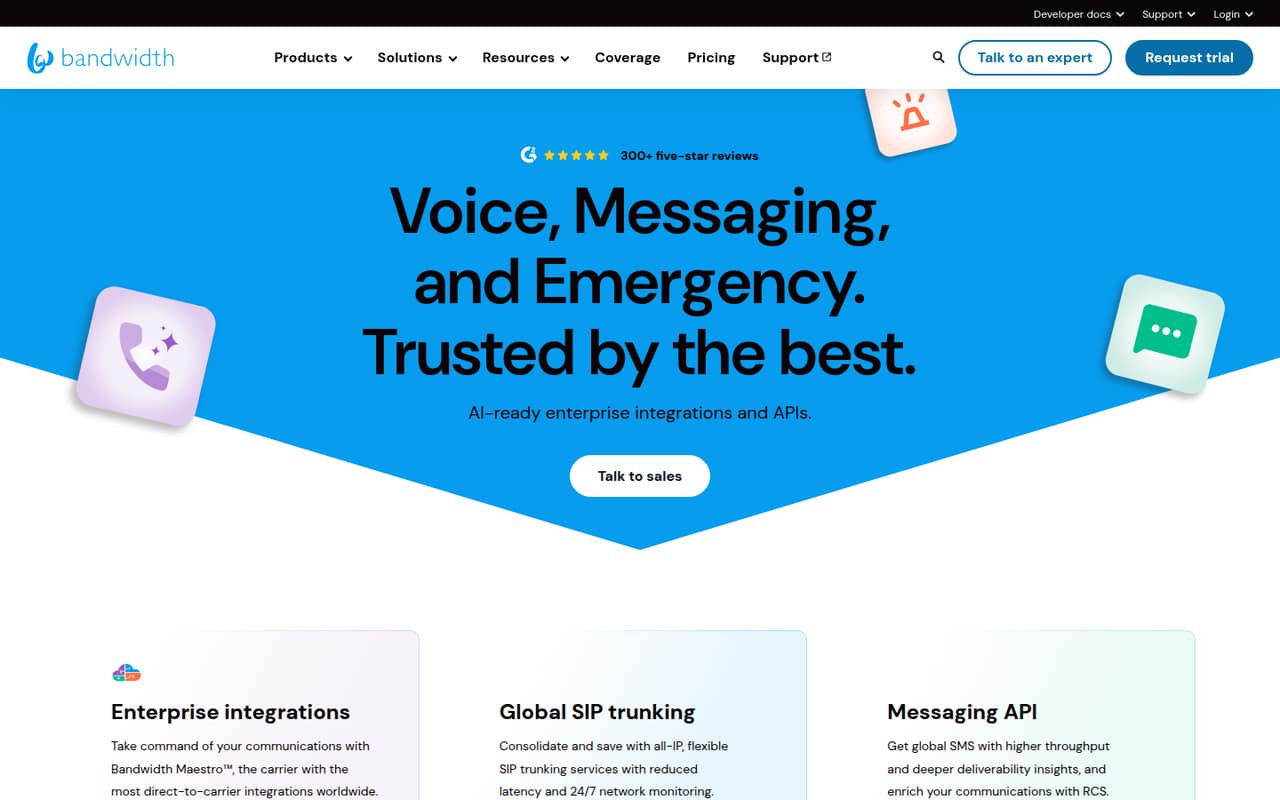
Bandwidth is for teams that need to put voice, messaging, or emergency communications into a product or business service. The homepage lists programmable voice, global SMS and RCS, SIP trunking, and integrations with contact center and communications services. It also describes direct-to-carrier connectivity and PSTN access in about 70 countries.
For a team of one to ten, the fit depends less on headcount than on whether you have a specific communications job and budget for usage charges. A small software company building calls or texts into its product may have a reason to evaluate it; a small office looking for an off-the-shelf calling or chat app may not. These are APIs and network services, not a simple seat-based subscription. Before signing, estimate messages or call minutes, confirm which service matches your use case, and ask Bandwidth for a quote where pricing is custom.
02Bandwidth Communications APIs free plan and trial
Bandwidth does not offer a free plan in its listed pricing, and it does not publish a free-trial offer. That means there is no free tier to use for a small team’s initial build or low-volume production traffic.
The cheapest way in depends on the service. For U.S. messaging, the listed 10DLC rate is $0.004 per SMS and $0.015 per MMS. For voice, local inbound calls are listed at $0.0055 per minute. These are usage rates, not monthly plans, and the cost depends on how much you send or call. If you are evaluating the service, ask Bandwidth about a test environment, any minimum commitments, and the likely bill for your projected usage before you start.
03What a small team pays for Bandwidth Communications APIs
Bandwidth prices these services by usage, not by seat, so there is no published one-person, three-person, or five-person monthly price to calculate. The same applies to monthly versus annual billing: the pricing page lists usage rates, but not annual or monthly subscription rates. Your team size alone will not determine the bill.
For U.S. messaging, the listed 10DLC rate is $0.004 per SMS and $0.015 per MMS; short code is $0.008 per SMS and $0.020 per MMS, while toll-free is $0.007 per SMS and $0.020 per MMS. Voice rates include $0.0100 per minute for local outbound calls and $0.0055 for inbound calls. Transcription, recording, conferencing, and in-app calling have separate listed rates. Authentication costs $0.0500 per two-factor authentication. SIP Trunking has customizable usage-based pricing and requires a quote. Ask Bandwidth to model your expected volume and confirm any other charges.
04Getting started with Bandwidth Communications APIs
Getting started means choosing the communications service you need and connecting it to your product or business systems. Bandwidth’s homepage lists programmable voice, messaging, global SIP trunking, and integrations with contact center and communications services. That gives buyers a sense of the available areas, but it does not spell out a setup timeline or the work required for a specific integration.
For a small team, plan for technical implementation rather than a quick seat-based signup: APIs need to be connected to the service that will use them. Confirm which APIs, network connections, and integrations apply to your use case before budgeting developer time. Bandwidth also describes direct-to-carrier and PSTN connectivity in about 70 countries. Ask the vendor which countries, configuration steps, and support arrangements apply to your rollout. The homepage lists 24/7 network monitoring for SIP trunking; that is not the same as a published implementation plan.
05When small teams outgrow Bandwidth Communications APIs
Bandwidth is more likely to become a mismatch when your team needs a predictable monthly bill or a ready-to-use communications product than when it simply adds seats. The listed plans are usage-based, with no published per-seat price, so higher message or call volume raises usage charges rather than triggering a stated seat upgrade. The vendor does not publish monthly or annual rates for comparison.
A growing team should keep an eye on message and call volumes, especially when using services with separate per-message or per-minute charges. Ask Bandwidth to project the cost at your expected scale and clarify any minimums or commitments before expanding. SIP Trunking is customizable and quote-based, so it may need a fresh pricing discussion as requirements change. If your needs shift toward a flat subscription or a packaged communications app, compare products built around those buying models; Bandwidth’s listed offer is focused on APIs and connectivity.
Questions people ask
Does Bandwidth Communications APIs have a free plan?
No. Bandwidth’s listed pricing has no free plan, and a free trial is not published. The services are usage-based, so ask the vendor whether it can provide a test environment and what any evaluation would cost before building against the APIs.
How much does Bandwidth charge for SMS?
For U.S. messaging, the listed rates are $0.004 per 10DLC SMS, $0.008 per short-code SMS, and $0.007 per toll-free SMS. MMS rates are higher: $0.015 for 10DLC and $0.020 for short code or toll-free. Confirm which route fits your use case.
How is Bandwidth Communications APIs pricing calculated?
Pricing is usage-based rather than per seat. Messaging and voice services have separate rates, while SIP Trunking has customizable usage-based pricing and requires a quote. Bandwidth does not publish monthly or annual subscription rates, so estimate your volume and ask for a cost projection.
What does Bandwidth charge for voice calls?
The listed Voice API rates include $0.0100 per minute for local outbound calls and $0.0055 per minute for inbound calls. Other services, including transcription, recording, and conferencing, have separate charges. Ask Bandwidth to estimate the combined cost for your planned use.
Is Bandwidth Communications APIs suitable for a small team?
It can suit a small team with a defined need to build voice, messaging, or connectivity into a product. The lack of a free plan and flat team price makes it less convenient for teams that need a low-cost, predictable subscription or a ready-made communications app.