
We may earn a commission if you buy through links on this page. It never changes a score or a ranking. How we make money
The bottom line
A feature-rich enterprise incident platform with custom pricing and no published small-team entry cost.
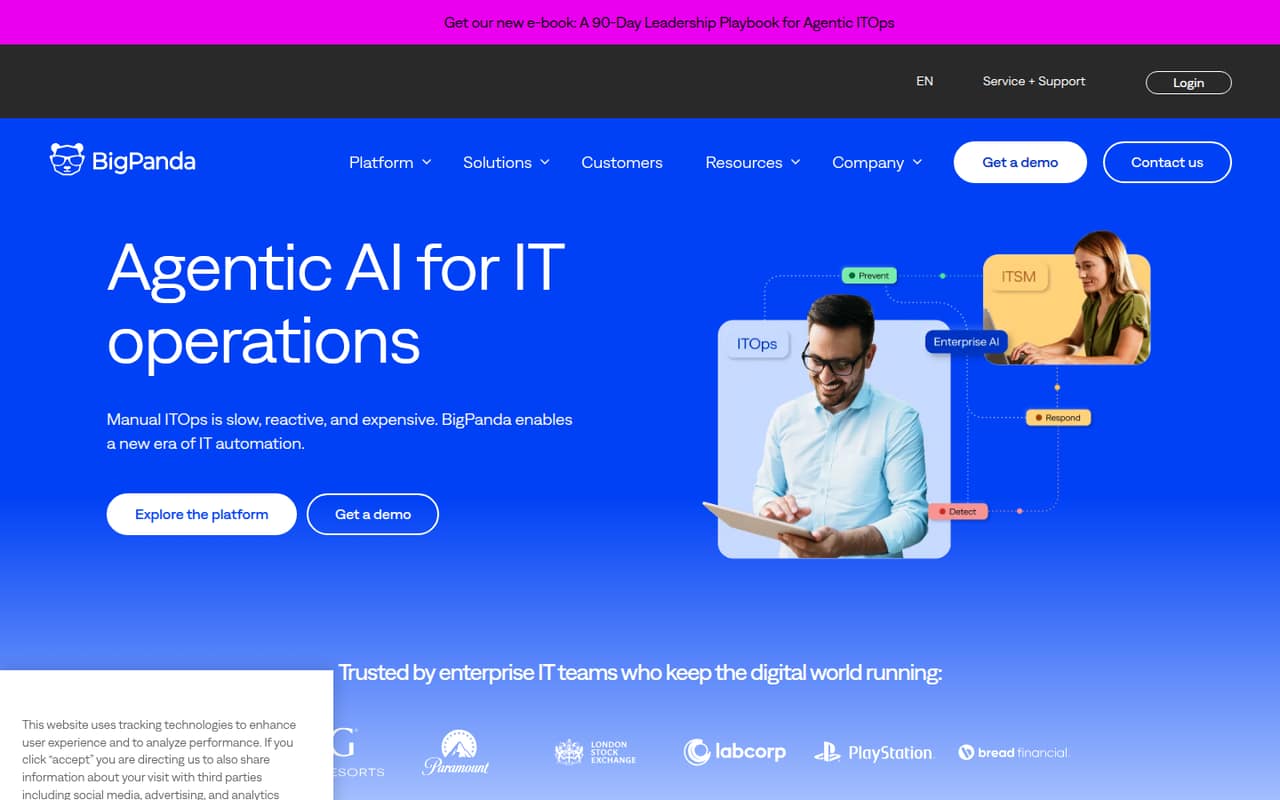
BigPanda uses agentic AI, a knowledge graph, and change risk analysis to help IT teams detect, triage, resolve, and prevent incidents. Its feature set is aimed at enterprise operations, not a simple alerting setup for a tiny team.
The pricing page lists usage starting at 20,000 credits, but requires a custom quote and a one-to-three-year commitment. With no free plan or published price per seat, a small team should get a detailed quote before investing time in evaluation.
Good fit if
- Enterprise IT operations teams
- Teams handling complex incident workflows
- Organizations seeking incident prevention
Skip it if
- Teams needing a free plan
- Budget-first teams of one to ten
- Buyers needing published seat pricing
ScoresHow it rates
What works
- Automates IT event detection and response
- Adds incident context and recommended actions
- Offers AI assistance to L2, L3, and SRE teams
- Knowledge graph unifies tools, tickets, and people
- Change risk analysis aims to prevent incidents
What doesn't
- No free plan is listed
- No free trial is listed
- Monthly and annual prices are not published
- Requires a custom quote
- One-to-three-year commitment is listed
01Who BigPanda is for
BigPanda is built for enterprise IT operations and service management teams that need to handle detection, triage, resolution, and prevention in one platform. It uses agentic AI to automate parts of those workflows, while its knowledge graph brings context from tools, tickets, and people. Change risk analysis is intended to help teams assess changes before they cause incidents.
For a team of one to ten, this is worth considering only if incident operations are complex enough to justify an enterprise-focused platform and a custom buying process. A small team that mainly needs basic alerting may find the commitment and unknown seat costs hard to justify. The pricing page lists usage starting at 20,000 credits, but does not publish seat limits or a per-seat price. Ask BigPanda how credits map to your expected event volume and team size before comparing the quote with your budget.
02BigPanda free plan and trial
BigPanda does not list a free plan or free trial. That means there is no published no-cost option for a small team to try incident detection, triage, or the Incident Assistant before buying.
The cheapest way in is a custom-quoted Tiered Credit Plan. The pricing page lists usage starting at 20,000 credits and a one-to-three-year commitment; it does not publish a starting dollar price. Seat limits are also not published. Before agreeing to a term, ask for a written quote covering the minimum commitment, what the included credits cover, and whether you can test the workflows with your own data. Without those answers, a budget-conscious team cannot estimate the cost of evaluating or running the platform.
03What a small team pays for BigPanda
The pricing page lists a Tiered Credit Plan for enterprise IT teams, with usage starting at 20,000 credits. It requires a custom quote and a one-to-three-year commitment. Monthly and annual prices are not published, and seat limits are not published.
So we cannot give an honest one-person, three-person, or five-person cost, or calculate monthly versus annual per-seat pricing. BigPanda prices this plan around credits rather than a published per-seat rate, and the credit-to-seat relationship is not listed. Ask the vendor to quote your expected usage for one, three, and five users, and request both the total contract cost and any overage terms.
No add-ons are listed in the pricing details. That does not confirm that every feature is included in a quote, so ask whether AI Detection, Incident Assistant, Incident Prevention, and Change Risk Management carry separate charges. For a small team, the unknown total and multiyear term are the main budget risks.
04Getting started with BigPanda
BigPanda’s feature description points to a setup that involves bringing context together from tools, tickets, and people, then using that context for detection and incident workflows. The product also includes change risk analysis. That is a broader project than switching on a standalone alert, so a small team should plan for time to decide which data sources and workflows matter before launch.
A public setup timeline, onboarding effort, and specific integration list are not published in the pricing details. The Reddit discussion available is a question about BigPanda, not a report from someone who has set it up. Before signing, ask BigPanda which of your monitoring, ticketing, and change-management tools it supports, what configuration is required, and who handles implementation. Also ask for a walkthrough using a workflow close to your own; the product description alone does not establish how much day-to-day administration your team will need.
05When small teams outgrow BigPanda
For a small team, the first pressure may come before growth: the custom quote, 20,000-credit starting usage, and one-to-three-year commitment could be more than a lean operation wants to take on. If the team’s event volume or incident workflow grows, ask how credit usage changes and what happens when you exceed the quoted amount. The vendor does not publish seat limits, so get the allowed user count in writing as well.
A team may also need to move on if it wants a free tier, transparent per-seat costs, or a short commitment; none is listed. The only Reddit thread provided is a user asking how BigPanda handles alert correlation, noise reduction, and monitoring integrations. The author says they have not used BigPanda, and the thread has no comments, so it offers no evidence about customer experience, limits, or migration triggers. Ask the vendor for references and an exit plan before committing.
From the threadsWhat users say
Treat sentiment as unknown rather than as evidence of customer satisfaction.
how it handles alert correlation, noise reduction, and integrations with monitoring tools
especially in comparison to PagerDuty?
Can anyone share their experience using BigPanda
I haven’t had hands-on experience with BigPanda yet
Questions people ask
What does BigPanda do?
BigPanda is an agentic AI platform for automating IT operations. Its listed features cover event detection and response, incident triage, AI assistance for L2, L3, and SRE teams, incident prevention, a knowledge graph, and change risk analysis.
How much does BigPanda cost?
BigPanda does not publish monthly or annual prices. Its pricing page lists a Tiered Credit Plan with usage starting at 20,000 credits, a custom quote, and a one-to-three-year commitment. Ask for a quote that spells out total cost, credit usage, and any overage terms.
Does BigPanda have a free plan or trial?
BigPanda does not list a free plan or free trial. Its listed entry point is a custom-quoted Tiered Credit Plan, with usage starting at 20,000 credits and a one-to-three-year commitment. Ask the vendor whether it can provide a time-limited evaluation before you sign.
Who is BigPanda designed for?
BigPanda is described as a platform for enterprise IT operations and service management teams. Its features focus on incident detection, triage, resolution, and prevention. A small team should check whether its workflows and quoted commitment fit the team’s needs before proceeding.
What does the 20,000-credit starting usage mean?
The pricing page lists usage starting at 20,000 credits, but does not publish a per-seat price or explain how that credit amount maps to a specific team’s activity. Ask BigPanda what usage counts against credits, how the minimum applies to your account, and what happens if you exceed it.