
We may earn a commission if you buy through links on this page. It never changes a score or a ranking. How we make money
The bottom line
A broad eCommerce CRM for stores that can justify at least $350 a month.
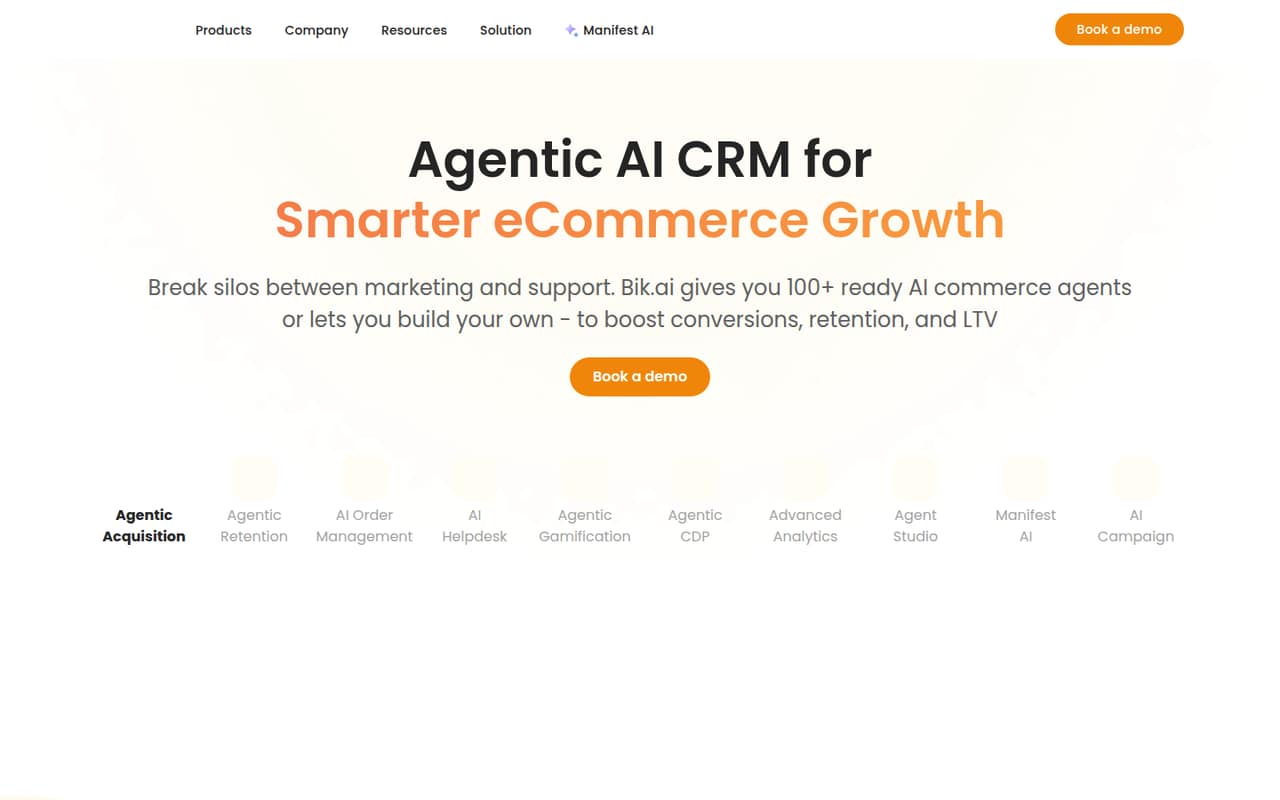
Bik combines eCommerce marketing and customer support, with AI agents, campaigns, customer journeys, a helpdesk, and customer data tools. That breadth may suit a store trying to manage retention and support in one system.
The catch for a small team is the entry price: the pricing page lists Growth at $350 per month, with no free plan or trial listed. That buys up to 10 helpdesk users, but it is a large fixed bill if you only need a few seats.
Good fit if
- eCommerce stores combining marketing and support
- Teams that need AI commerce agents
- Stores with room for a $350 monthly tool
Skip it if
- Teams looking for a free CRM
- Stores needing only basic email marketing
- Small teams with tight monthly budgets
ScoresHow it rates
What works
- Combines marketing and customer support
- Offers more than 100 ready-made AI agents
- Growth includes up to 10 helpdesk users
- Includes web and social customer journeys
- Scale raises automation and AI credit limits
What doesn't
- No free plan is listed
- The cheapest plan costs $350 per month
- Annual billing and discounts are not published
- Setup effort and integrations are not published
- Growth and Scale both cap contacts at 10,000
01Who Bik is for
Bik is for eCommerce stores that want marketing and customer support in one system, rather than a lightweight tool for one or two campaigns. Its feature set covers targeted marketing across social platforms and other customer touchpoints, personalized web and social journeys, AI drip campaigns, and an AI helpdesk. The platform also lists a customer data platform and Customer 360.
The pricing page’s Growth plan costs $350 per month and includes up to 10 helpdesk users, so the practical audience is a team that can use several of those seats and justify the fixed monthly cost. Growth includes up to 10,000 contacts and 20 automations. That may fit a small store with real retention and support workflows; it is harder to justify for a solo operator or a team that only needs basic messaging. Bik also offers more than 100 ready-made AI commerce agents and lets businesses build their own, which adds options but may mean more decisions to make during setup.
02Bik free plan and trial
The pricing page lists no free plan, and it does not list a free trial. That means there is no published free tier to use for testing Bik’s campaigns, helpdesk, or AI agents before committing. Ask Bik whether it can provide a guided demo or trial access before you budget for it; those options are not listed in the pricing details.
The cheapest published way in is Growth at $350 per month. It includes up to 10,000 contacts, 20 automations, 10 helpdesk users, and 2,000 BIK AI credits. Those are the listed plan limits, not a small free allowance that scales into a paid account. If you are evaluating Bik with a small team, confirm which features and AI credit usage you need, and whether Growth covers them, before signing up.
03What a small team pays for Bik
The pricing page lists Growth at $350 per month and Scale at $499 per month. There is no published annual price or discount, so the monthly rate is the only published billing basis. Growth includes 10 helpdesk users, while Scale includes 25; neither plan is priced per seat.
For a rough seat comparison, allocating Growth’s $350 evenly comes to $350 per person for one user, $116.67 each for three, or $70 each for five. Scale’s $499 works out to $499, $166.33, or $99.80 per person for those same team sizes. These are budget-sharing calculations, not actual per-seat rates; the full plan price applies even if you use fewer seats. Growth and Scale both include up to 10,000 contacts, with 20 versus 50 automations and 2,000 versus 5,000 BIK AI credits. The pricing page lists no add-ons. Custom pricing is available for required contact volume, unlimited automations, users as required, and a dedicated CSM, but its price is not published.
04Getting started with Bik
Bik’s listed capabilities span AI agents, marketing campaigns, customer journeys, a helpdesk, a customer data platform, and analytics. A team adopting several of those areas should expect to make choices about its workflows and agent instructions, since businesses can build agents with goals, success criteria, and instructions. The vendor does not publish a setup-time estimate or a step-by-step onboarding process in the available product and pricing details, so we can’t give a reliable hours-or-days estimate.
The vendor also does not publish an integration list in those details. Before committing, ask whether Bik connects to your store, existing marketing tools, and support systems, and whether those connections are included in Growth. It is also worth confirming how contacts and AI credits are counted. The feature list gives a useful outline of what the platform can do, but it does not establish which connections or migration services are available to your team.
05When small teams outgrow Bik
Growth starts with up to 10,000 contacts, 20 automations, 10 helpdesk users, and 2,000 BIK AI credits. A store that needs more automations or AI credits can move to Scale, which lists 50 automations and 5,000 credits for $499 per month. Scale still caps contacts at 10,000, so it is not the listed step up for a store that has outgrown that contact limit.
A larger team may also hit Growth’s 10-user helpdesk limit; Scale raises that to 25. For more contacts or users as required, Bik lists a Custom plan, with unlimited automations and a dedicated CSM, but the price is not published. That makes it harder for a budget-conscious team to forecast its next bill. If you only need one more seat or a modest increase in contacts, ask Bik how it prices custom volume before assuming the upgrade is affordable. The listed plans show no smaller paid tier between Growth and Scale.
Questions people ask
Does Bik have a free plan or free trial?
The pricing page lists no free plan, and no free trial is listed. The cheapest published plan is Growth at $350 per month. Ask Bik whether it can arrange a demo or trial access before you commit, since those options are not listed in the pricing details.
How much does Bik cost for a small team?
Growth costs $350 per month and includes up to 10 helpdesk users. Scale costs $499 per month and includes up to 25. The plans are not priced per seat, so a three-person team still pays the full plan price. Annual billing and discounts are not published.
What does Bik Growth include?
The pricing page lists up to 10,000 contacts, 20 automations, 10 helpdesk users, and 2,000 BIK AI credits in Growth. It costs $350 per month. Ask Bik to clarify how your planned AI usage counts against the credit allowance and which integrations are available for your store.
What is the difference between Bik Growth and Scale?
Growth costs $350 per month and lists 20 automations, 10 helpdesk users, and 2,000 BIK AI credits. Scale costs $499 per month and lists 50 automations, 25 helpdesk users, and 5,000 credits. Both list a limit of up to 10,000 contacts.
Does Bik publish annual pricing or add-on costs?
The pricing page lists monthly prices and says annual billing and discounts are not published. It lists no add-ons. Custom pricing is available for stores needing more contacts or users, unlimited automations, and a dedicated CSM, but the vendor does not publish that plan’s price.