
We may earn a commission if you buy through links on this page. It never changes a score or a ranking. How we make money
The bottom line
An enterprise NDR option, but custom pricing and sparse product detail make small-team fit hard to judge.
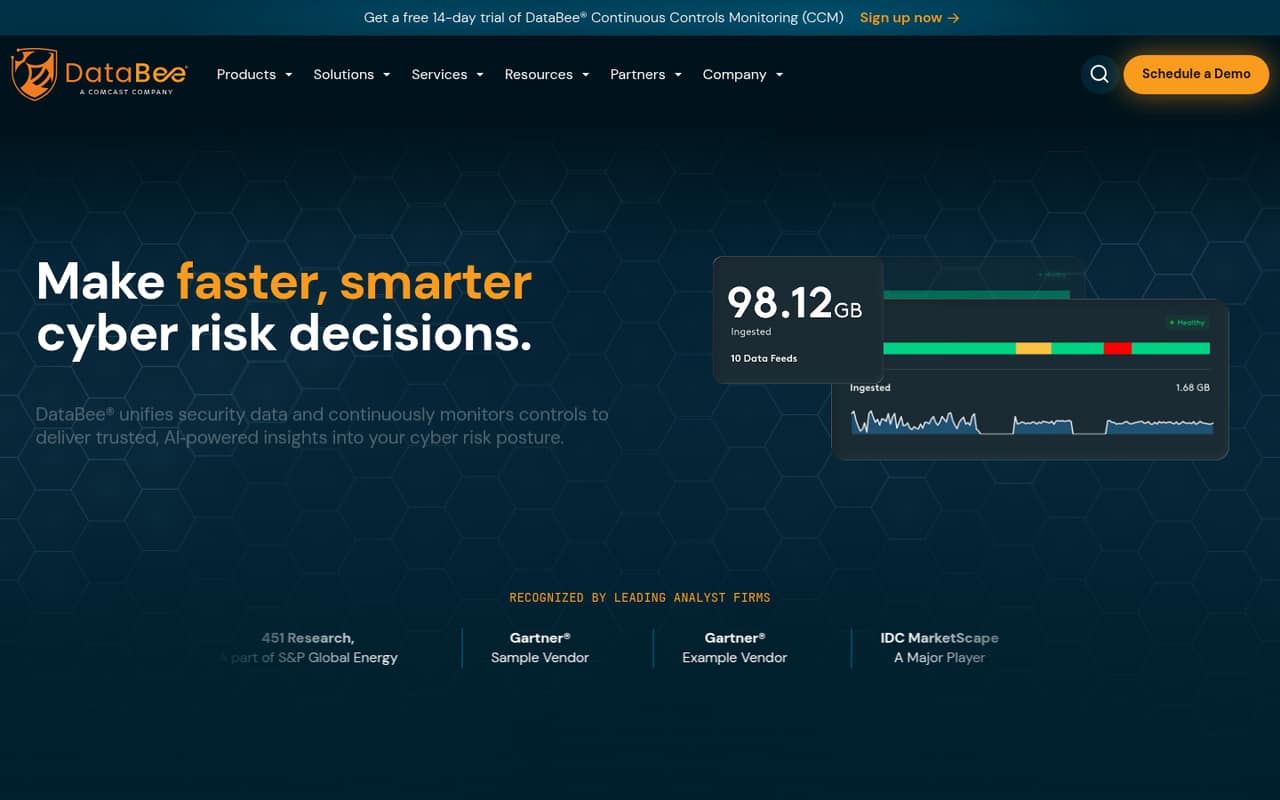
BluVector is listed as DataBee’s network detection and response (NDR) product. DataBee describes its broader platform as unifying security and business data, but its homepage offers little BluVector-specific detail.
There’s no free plan listed, and the available pricing information describes an enterprise custom quote without a published starting price. Small teams should ask for a quote and confirm features, setup needs, and contract terms before shortlisting it.
Good fit if
- Teams evaluating enterprise NDR
- Organizations already assessing DataBee
- Buyers comfortable requesting a custom quote
Skip it if
- Teams needing a free security tool
- Buyers with a fixed per-seat budget
- Teams needing detailed public feature lists
ScoresHow it rates
What works
- Listed as DataBee’s NDR product
- DataBee platform unifies security and business data
- Platform lists several data ingestion options
- Platform describes control coverage and gap monitoring
- Platform says insights use transparent, repeatable logic
What doesn't
- BluVector-specific features are not detailed on the homepage
- No free plan is listed
- Starting price is not published
- Pricing is described as a custom quote
- Monthly and annual billing terms are not published
01Who BluVector is for
BluVector is worth considering if your small team is evaluating network detection and response as an enterprise security purchase. DataBee lists it as an NDR product, but its homepage does not explain BluVector’s specific features. That makes it difficult to tell from public details whether it fits a particular team’s network, alerting, or response needs.
DataBee describes its broader platform as bringing security and business data together to provide cyber risk insights. It also lists control monitoring and risk reporting among the platform’s capabilities. Those are platform-level descriptions, not a detailed BluVector feature list, so ask the vendor which capabilities are included with the NDR product. With enterprise custom pricing and no public starting price, it is a less straightforward fit for a 1–10-person team watching every subscription. Shortlist it if NDR is a defined need and you are prepared to scope requirements directly with the vendor.
02BluVector free plan and trial
The available pricing information lists no free plan for BluVector. It does not publish whether a free trial is available, so ask DataBee whether the team can evaluate the product before committing and what that evaluation includes.
The listed route in is an Enterprise / custom plan for enterprise NDR. There is no published self-serve or lower-cost plan to start with, and no public starting price to compare against a small-team budget. Before requesting a quote, write down the use case, the capabilities you need, and the number of people who would manage or use the product. Ask whether the quote includes onboarding, support, and any required services; those details are not published in the available pricing information.
03What a small team pays for BluVector
The available pricing information labels BluVector’s plan “Enterprise / custom” and says pricing is by custom quote. It does not publish a starting price, per-seat rate, or monthly or annual billing terms. So we can’t calculate a reliable cost for one person, three people, or five people—or compare monthly billing with an annual commitment.
For a 1–10-person team, ask DataBee for a written quote at your actual team size. Confirm whether pricing is based on seats, network coverage, usage, or another measure; the pricing information does not specify a unit. It also does not publish any add-ons, so ask which capabilities and services are included in the quote and whether anything costs extra. Until the vendor gives those numbers, there is no defensible “few seats” total to budget for. Treat the custom quote as the price to evaluate, not a published per-user plan.
04Getting started with BluVector
The vendor does not publish BluVector-specific setup steps or a learning-curve estimate on its homepage. That leaves an important small-team question unanswered: how much time or specialist help is needed to get the NDR product ready for your environment? Ask DataBee to walk through deployment, ongoing administration, and what the team needs to supply.
DataBee’s broader platform lists APIs, S3 buckets, data collectors, HTTP collectors, and Azure buckets as data ingestion options. It also describes data transformation that parses, maps, validates, enriches, and correlates information. These are platform-level capabilities; the homepage does not establish which are part of BluVector or which your setup would require. Ask for the exact BluVector integrations and prerequisites for day one, plus who handles configuration and troubleshooting. Don’t plan implementation effort from the platform overview alone.
05When small teams outgrow BluVector
For a growing team, the first pressure point may be the buying model rather than a stated product limit. BluVector’s available pricing is described as an enterprise custom quote, with no published seat price or monthly and annual terms. If your budget process needs predictable per-person costs, ask the vendor how a larger team changes the quote and whether usage or coverage affects it.
The public homepage also provides little BluVector-specific feature detail, and the available pricing information does not specify capacity limits, included support, or add-on costs. Those are unknowns to resolve before deciding whether the product can support a larger operation—not confirmed product shortcomings. Ask DataBee for the limits and terms that apply to your deployment. If the quote, feature scope, or requirements no longer fit your team, compare other NDR tools using the same needs and cost assumptions.
Questions people ask
What is BluVector?
DataBee lists BluVector as its network detection and response (NDR) product. The company describes its broader platform as unifying security and business data for cyber risk insights, but its homepage does not explain BluVector’s specific features. Ask DataBee for a product-level feature list tied to your use case.
Does BluVector have a free plan or trial?
The available pricing information lists no free plan. It does not publish whether a free trial is available, so ask DataBee about evaluation access, its duration, and what features or support it includes before making a purchase decision.
How much does BluVector cost?
BluVector is listed under an Enterprise / custom plan, and pricing is described as a custom quote. A starting price, per-seat rate, and monthly or annual billing terms are not published. Request a quote for your team size and ask what is included.
What integrations does BluVector support?
DataBee’s broader platform lists APIs, S3 buckets, data collectors, HTTP collectors, and Azure buckets as ingestion options. The homepage does not say which of these apply to BluVector specifically. Ask DataBee for the BluVector integration list and any setup requirements for your environment.
Is BluVector a good fit for a small team?
It may be worth evaluating if your team needs NDR and is prepared to request an enterprise custom quote. Public information does not establish BluVector’s specific features, setup effort, or per-seat cost. Ask for a tailored demo or evaluation and a written quote before deciding whether it fits your budget.