
We may earn a commission if you buy through links on this page. It never changes a score or a ranking. How we make money
The bottom line
A broad financial close platform with custom pricing and too little published detail for easy small-team budgeting.
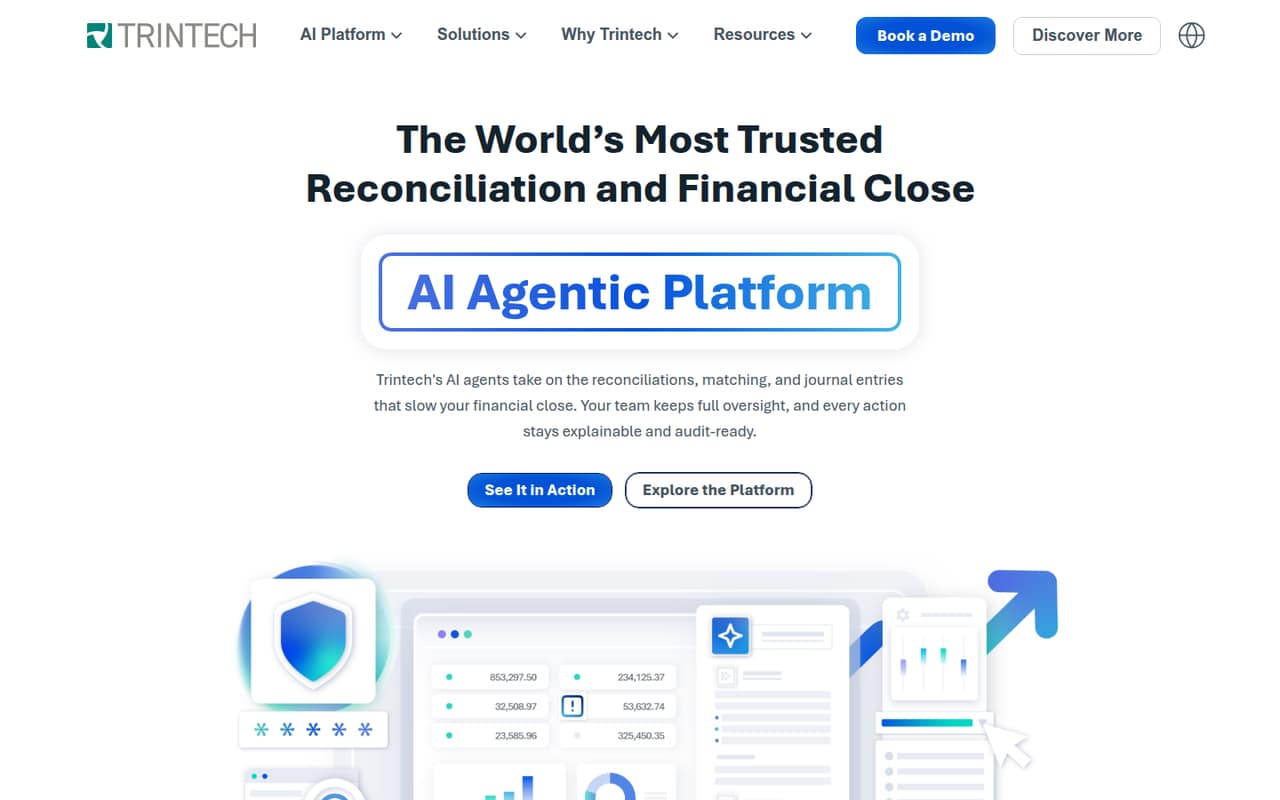
Cadency is part of Trintech’s AI financial close portfolio. The company lists platform capabilities such as reconciliation, close management, journal entries, audit and compliance, and reporting, but doesn’t spell out Cadency’s specific capabilities on its homepage.
There’s no listed free plan, and Trintech doesn’t publish a starting price or trial terms. For a team watching every subscription, get a quote that covers your exact headcount, billing term, setup, and integrations before deciding.
Good fit if
- Teams with complex financial close work
- Finance leaders seeking close automation
- Organizations willing to request a quote
Skip it if
- Teams that need a free plan
- Buyers requiring upfront seat pricing
- Simple bookkeeping for a tiny team
ScoresHow it rates
What works
- Platform includes daily, operational, and account reconciliation
- Transaction matching handled by AI agents
- Journal entry management is listed
- Close management is included in the platform
- Audit, compliance, reporting, and analytics are listed
What doesn't
- No free plan is listed
- Trial terms are not published
- Starting price is not published
- Monthly and annual rates are not published
- Cadency-specific capabilities are not detailed on the homepage
01Who Cadency is for
Cadency is worth a look for finance teams responsible for a busy, repeatable close—not for a small business that only needs basic bookkeeping. Trintech places it in an AI financial close portfolio. The company lists platform capabilities including reconciliation, transaction matching, journal entries, close management, audit and compliance, and reporting and analytics. It says AI agents handle work under human oversight.
For a team of 1–10, the question is whether close work is complex enough to justify a dedicated platform and a custom quote. Trintech doesn’t publish Cadency’s specific capabilities on its homepage, so ask which of those platform functions are included in the Cadency package you’d buy. Budget-conscious teams should also request a total price for their actual users and billing term. If you need a simple, low-cost accounting tool, the published pricing information doesn’t make Cadency an easy fit to assess.
02Cadency free plan and trial
Trintech doesn’t list a free plan for Cadency. Trial terms are not published, so don’t assume you can test the platform before purchasing. The cheapest way in is to request a quote; the pricing page information lists Cadency as quote-based, with no published monthly or annual rate.
That makes the initial buying step less straightforward for a small team: you can’t compare a free tier or calculate a self-serve entry price. Ask Trintech whether it offers a trial or guided evaluation, what access it includes, and whether any evaluation has a fee. Also confirm whether the quote is based on seats, close volume, selected capabilities, or another factor. Get the answers in writing before comparing Cadency with tools that publish their prices.
03What a small team pays for Cadency
The pricing page lists Cadency as quote-based. It does not publish a starting price, a per-seat rate, or monthly and annual billing rates. That means we can’t give you a sourced cost for one person, three people, or five people—or calculate whether annual billing is cheaper.
Ask for written quotes for your actual setup: one user, three users, and five users, if those are viable configurations. Request both monthly and annual totals, and check whether the quote includes every person who needs access. Trintech’s pricing information lists no add-ons, but that isn’t a confirmation that implementation, integrations, or other services are included in a quote. Ask what costs extra and whether there are minimum seats or contract terms.
For a small team keeping close tabs on recurring spend, the lack of published rates is a real budgeting drawback. Don’t compare a headline quote without confirming what’s included and how the price changes as the team grows.
04Getting started with Cadency
Trintech’s homepage doesn’t publish Cadency’s setup steps, implementation timeline, training requirements, or learning curve. It also doesn’t identify the integrations a small team should have ready on day one. We can’t tell from the published details whether setup is light self-service work or a larger finance-operations project.
Before you request a quote, write down the systems your team uses for accounting, payments, and reporting, then ask Trintech which integrations are supported for Cadency and whether any require extra work or cost. Ask who handles configuration, what your team must prepare, and what training is available. A short demonstration using your close process can help establish whether the listed platform capabilities fit your workflow. Treat setup effort as an open buying question, not a guaranteed quick start.
05When small teams outgrow Cadency
For Cadency, the bigger concern may be outgrowing your budget or available buying information rather than hitting a published seat limit. Trintech doesn’t publish seat caps, usage limits, or a price ladder, so we can’t identify a specific threshold where you’d need to upgrade. Ask whether the quote changes with headcount, transaction volume, or the capabilities you select.
A team may also find the platform is more than it needs if its close process is simple and doesn’t call for the listed reconciliation and close-management functions. On the other hand, if close work becomes harder to coordinate, Trintech’s portfolio lists capabilities across matching, reconciliation, journal entries, audit, compliance, and reporting. Confirm which are actually part of your Cadency quote before treating them as a reason to stay. Revisit the fit when the quote, required integrations, or implementation effort no longer makes sense for your team.
Questions people ask
How much does Cadency cost?
Trintech lists Cadency as quote-based. It doesn’t publish a starting price or monthly and annual rates, so the cost for one, three, or five users isn’t available to calculate. Ask for quotes at your expected headcount and confirm what the price includes, what can cost extra, and whether contract terms change the total.
Does Cadency have a free plan or trial?
Trintech doesn’t list a free plan for Cadency. Trial terms are also not published, so ask the vendor whether an evaluation is available and whether it includes access to the capabilities your team needs. Confirm whether there’s a fee and how long the evaluation lasts before making a purchase decision.
What does Cadency do?
Cadency is listed in Trintech’s AI financial close portfolio. Trintech describes platform capabilities including reconciliation, transaction matching, journal entry management, close management, audit and compliance, and reporting and analytics. The homepage doesn’t detail which specific capabilities are included in Cadency, so ask for a package-level feature list.
How difficult is Cadency to set up?
Trintech doesn’t publish Cadency setup steps, implementation timelines, or training requirements on its homepage. Ask who handles configuration, what your team must prepare, and what support is included. Request a walkthrough of your own close process so you can judge the work involved before agreeing to a quote.
Is Cadency a good fit for a small team?
It may fit a small finance team with complex close and reconciliation work, but the quote-based pricing makes the budget harder to assess. There’s no listed free plan or published starting price. Ask for a quote based on your headcount and confirm which Cadency capabilities, integrations, and setup services it includes.