
We may earn a commission if you buy through links on this page. It never changes a score or a ranking. How we make money
The bottom line
CARTO packs serious spatial tools, but unpublished pricing makes budgeting difficult.
A small team only needs CARTO if it has substantial spatial analysis, mapping, or app-development work to do. Its cloud-native tools and low-code workflows cover a lot, but the pricing page lists no dollar starting price.
There’s no free plan; plans include a 30-day trial. A Reddit post describes one user’s enthusiasm after learning CARTO, but that single account isn’t enough to establish broad user sentiment.
Good fit if
- Teams doing regular spatial analysis
- Cloud data platform users
- Analysts building location-based apps
Skip it if
- Teams needing a free GIS plan
- Buyers requiring predictable published pricing
- Occasional map-making on a tight budget
ScoresHow it rates
What works
- Low-code workflows include 100+ analysis components
- Connects spatial work to cloud ecosystems, including BigQuery
- Visualizes billions of data points
- Offers flexible usage and committed tiers
- Includes a 30-day free trial
What doesn't
- No free plan is listed
- Dollar prices are not published
- Committed tiers require upfront annual billing
- Pay As You Go usage is metered
- API access is limited on Pay As You Go
01Who CARTO is for
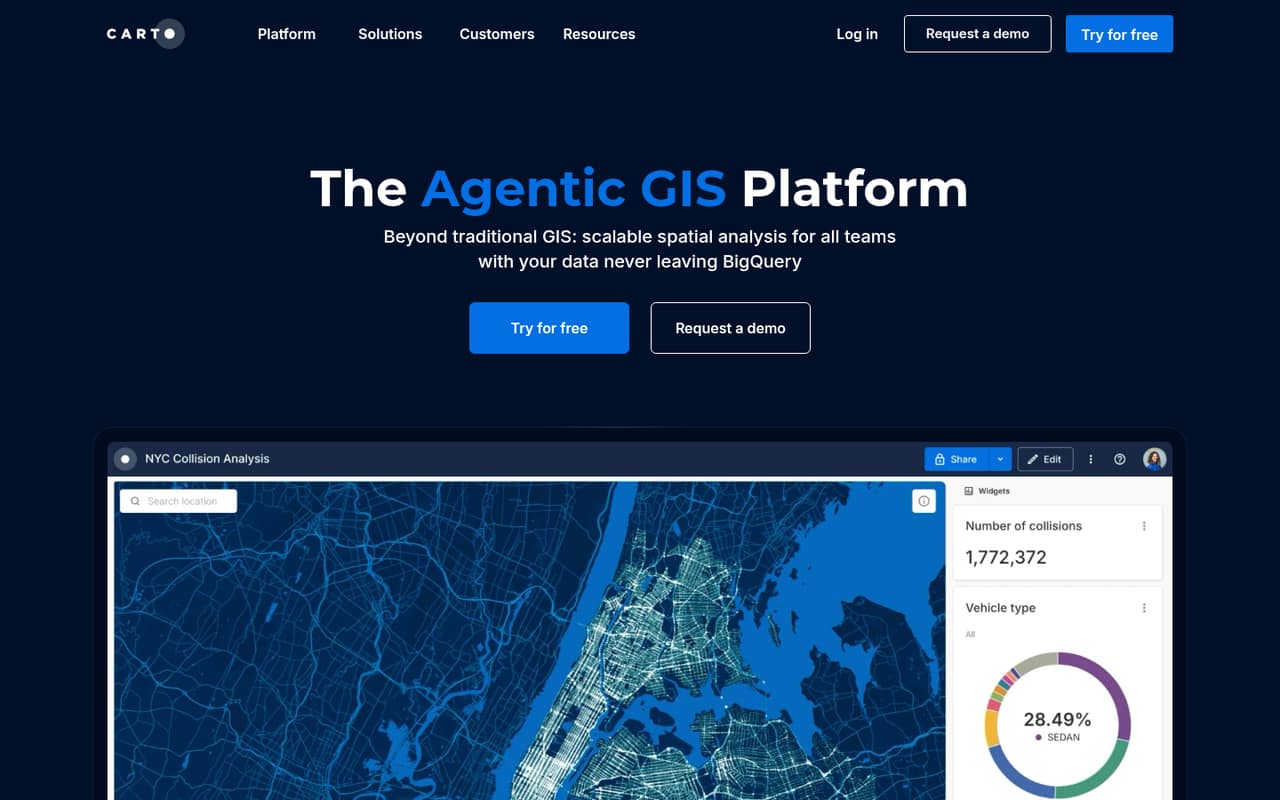
CARTO is for teams that need more than a basic map: think analysts, developers, and decision-makers working with location data for research, operations, or customer insights. The platform combines spatial analysis, visualization, and app development, with cloud data ecosystems such as BigQuery in its intended workflow.
For a team of one to ten, the right question is whether spatial work is important enough to justify an enterprise-oriented platform and an unknown bill. Low-code, drag-and-drop analysis and more than 100 analysis components may suit analysts who want to build workflows without coding every step. Developers can use it to build framework-agnostic apps that run in a data lakehouse. Teams that only make occasional maps, or need a firm low monthly price before evaluating software, may find the fit harder. CARTO is most compelling when multiple people need to explore substantial location data and turn that work into repeatable analysis or applications.
02CARTO free plan and trial
CARTO does not list a free plan. The pricing page lists a 30-day free trial for Pay As You Go and each committed tier: Enterprise, Strategic, and Custom. Trial access is the lowest-commitment way to evaluate the platform, but the published plan details don’t say what usage quota, API access, or tokens the trial includes. Ask CARTO to confirm those details before building a project around trial access.
The cheapest listed option is Pay As You Go (Flexible). It has metered consumption, limited API access and tokens, and no upfront commitment. Its price is not published, so “cheapest” describes the plan structure, not a known dollar cost. After the trial, a small team needs a vendor quote or the pricing terms presented during sign-up to budget accurately.
03What a small team pays for CARTO
The pricing page lists four options: Pay As You Go (Flexible), Enterprise (Committed Tier), Strategic (Committed Tier), and Custom (Committed Tier). It does not publish monthly or annual dollar prices, and no add-on prices are listed. That means we can’t give a reliable cost for one person, three seats, or five seats—or do monthly-versus-annual seat math. CARTO describes some committed tiers as being for a team, not as per-seat plans, so ask how seats and usage affect your quote.
Pay As You Go has metered consumption, limited API access and tokens, and no upfront commitment. Enterprise has a basic annual quota and requires upfront annual billing. Strategic adds an expanded annual quota and unlimited API access and tokens, also with upfront annual billing. Custom is aimed at high-volume usage and requires upfront annual billing. All list a 30-day trial. Before signing, ask CARTO for a written quote covering the expected usage, API needs, team size, annual commitment, and any charges beyond the included quota. Until then, a small team’s real cost is not published.
04Getting started with CARTO
The platform is cloud-native and connects spatial analysis to cloud ecosystems, including BigQuery. For a team already working in a supported cloud data environment, that may fit an existing data workflow; the sources don’t specify the exact connection steps or which setup tasks require an administrator. Confirm your data platform, permissions, and expected usage with CARTO before committing.
CARTO describes its analysis workflows as low-code and drag-and-drop, with more than 100 components, which should make routine spatial analysis more approachable than building every operation from scratch. That does not mean there is no learning curve: the range of analysis tools, data connections, and app-development options suggests teams should plan time to learn the workflow. Visualization uses deck.gl, WebGL, and GPU technology, while app development supports framework-agnostic apps in a data lakehouse. A small team should begin with one data connection and a specific mapping or analysis task, then check whether the trial covers the required access and usage.
05When small teams outgrow CARTO
CARTO’s plan structure gives teams a route from metered usage to committed annual quotas. A team may need to move beyond Pay As You Go if limited API access or tokens are a blocker; Strategic lists unlimited API access and tokens, while Enterprise lists a basic annual quota and Strategic an expanded one. High-volume users may need Custom. The trade-off is that committed plans require upfront annual billing, and CARTO does not publish prices, so upgrades can be hard to forecast.
A team can also outgrow the platform in the other direction: if it only makes occasional maps, it may be paying for a broader spatial analysis and app-development platform than it needs. Ask for the quota thresholds and overage terms before usage grows. One Reddit post comes from a user who says they learned CARTO and became interested in it, but it also raises affordability as a concern in its title. That’s a reminder to check the quote against your budget, not evidence of a typical bill.
From the threadsWhat users say
The Reddit material offers a glimpse of one user who became enthusiastic after learning CARTO, alongside an affordability concern signaled in the post title. That’s a narrow sample, so it can’t tell us how users generally feel.
I caught the CARTO bug when I taught myself to use it
policy advocacy, research, and mapping helped me make the transition from academic to policy
my company has access to GIS
Unaffordable if you don't have an extra 15k/year?
Questions people ask
Does CARTO have a free plan?
CARTO does not list a free plan. The pricing page lists a 30-day free trial across Pay As You Go and the committed tiers. It does not publish the trial’s usage quota or exact API and token access, so confirm those terms with CARTO before starting a project.
How much does CARTO cost for a small team?
CARTO does not publish dollar prices for its plans, so a one-, three-, or five-person cost cannot be calculated from the listed pricing. Pay As You Go is metered; committed tiers require upfront annual billing. Ask CARTO for a written quote based on your team, usage, and API needs.
What is included in CARTO Pay As You Go?
The pricing page lists metered consumption, limited API access and tokens, no upfront commitment, and a 30-day trial for Pay As You Go (Flexible). Its price and usage rates are not published. Ask CARTO how your expected data volume and API use affect the bill.
Does CARTO work with BigQuery?
CARTO is described as connecting spatial analysis to cloud ecosystems, including BigQuery. Its cloud-native GIS approach is designed to work with cloud data environments. Confirm the specific connection, permissions, and setup steps you need with CARTO before relying on it for a production workflow.
What’s the difference between CARTO Enterprise and Strategic?
Enterprise lists a basic annual quota for a team. Strategic lists an expanded annual quota and unlimited API access and tokens. Both require upfront annual billing and include a 30-day trial. CARTO does not publish their prices, so ask for a quote and the precise quota terms.