
We may earn a commission if you buy through links on this page. It never changes a score or a ranking. How we make money
The bottom line
Good streaming depth for small teams, with no free plan and seat costs to confirm.
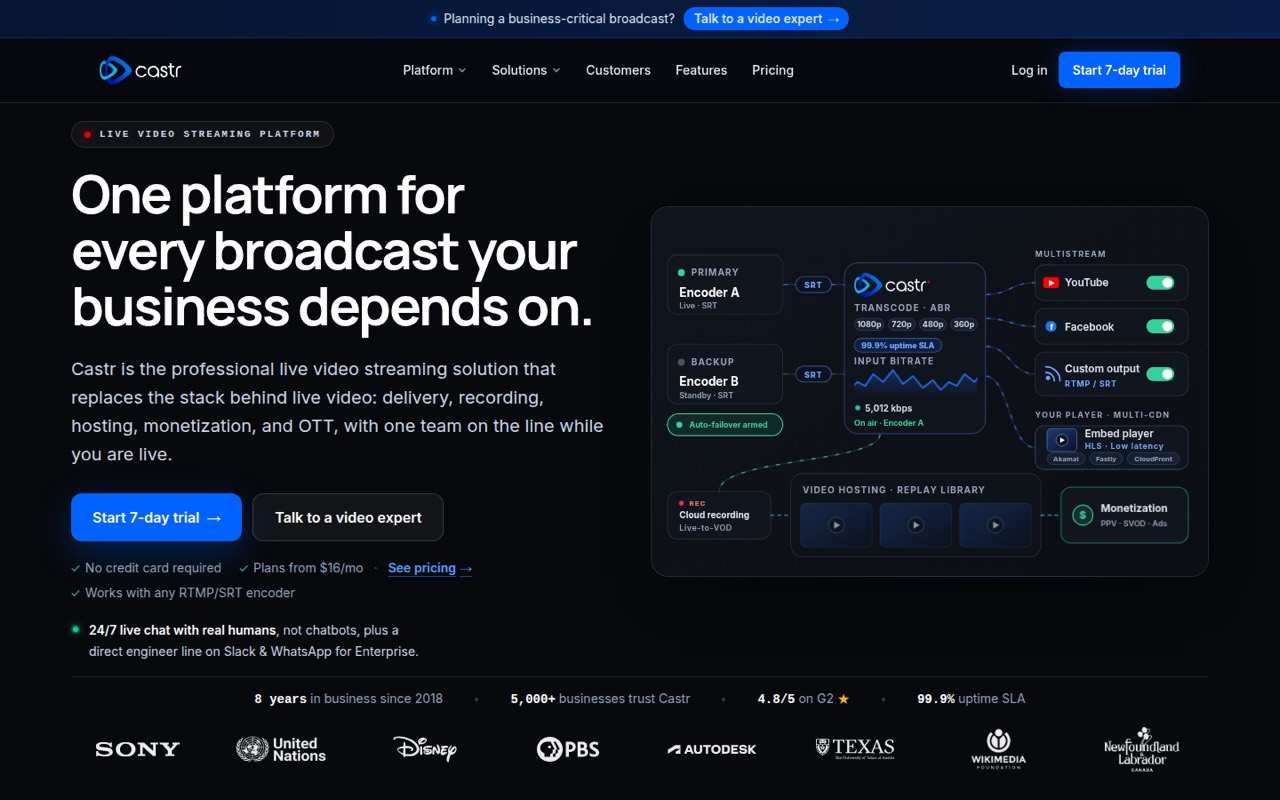
Castr combines live streaming, multistreaming, recording, video hosting, scheduled playout and monetization. It’s a fit for teams that need more than a simple feed to one destination, but the range of tools may be more than a small team needs.
There’s no free plan. Starter costs $19.99 monthly or $16.67 per month with annual billing. The pricing page lists 24/7 support on every plan, but Starter’s included team-member count isn’t published.
Good fit if
- Small teams streaming to several destinations
- Churches and event broadcasters
- Teams building a branded OTT service
Skip it if
- Teams needing a free ongoing plan
- Simple broadcasts to one destination
- Teams needing clear seat pricing
ScoresHow it rates
What works
- One platform for streaming, hosting and playout
- Multistreaming to 30+ platforms and custom destinations
- 24/7 support listed on every plan
- Starter includes recording and a paywall
- Annual billing includes two months free
What doesn't
- No free plan
- Starter team-member limit isn’t published
- Additional-seat pricing isn’t published
- Add-on prices aren’t published
- SRT setup can involve network and firewall work
01Who Castr is for
Castr suits a small team that regularly broadcasts events, worship services, classes or other live programming to multiple destinations. It can send one feed to 30+ platforms and custom RTMP or SRT destinations, while also offering recording, video hosting, scheduled playout and monetization. That is useful when a team wants more than a basic stream-to-one-platform setup.
For one or two channels, the pricing page positions Starter as the entry plan: $19.99 month to month or $16.67 per month with annual billing. That may work for a budget-conscious team, but confirm how many team members it supports; the plan’s seat limit isn’t published. Teams needing API access and three team members have Premium at $199.99 monthly or $166.67 per month billed annually. If all you need is to send a feed to one destination, Castr may be more platform than your team needs.
02Castr free plan and trial
Castr does not offer a free plan. The pricing page lists a seven-day free trial, but the trial’s feature access, usage limits and payment requirements aren’t published. Check those details with Castr before relying on the trial for a live event.
The cheapest paid option is Starter at $19.99 per month, or $16.67 per month with annual billing. Starter includes two monthly or three annual streams, six destinations, 200 GB of monthly bandwidth or 2.4 TB upfront bandwidth, 100 GB of video storage, paywall features and cloud recording. Those are plan limits, not a permanent free allowance. A team that only needs occasional streaming should compare the trial terms with its schedule and confirm the Starter seat limit before paying.
03What a small team pays for Castr
Starter is $19.99 month to month or $16.67 per month when billed annually. That is the plan price, not a published per-seat rate. If divided among three people, it works out to $6.66 or about $5.56 per person monthly; among five, it’s about $4.00 or $3.33. But Castr doesn’t publish Starter’s team-member limit, so those figures are only arithmetic, not confirmation that those team sizes are included.
Premium explicitly includes three team members and costs $199.99 monthly or $166.67 per month billed annually: about $66.66 or $55.56 per person. The included member count for Standard, Ultra and Events isn’t listed. Castr doesn’t publish the price for extra seats, DRM, sub-second streaming or native mobile and TV apps. Annual billing is paid yearly and provides bandwidth upfront; monthly plans are month to month. Ask Castr for a five-person quote and any add-on costs before committing.
04Getting started with Castr
A straightforward RTMP broadcast may be simpler to set up than a workflow involving SRT, cloud switching, overlays or scheduled playout. Castr lists these features, but its setup time and learning curve aren’t published. The integrations your team needs on day one depend on where you stream: Starter includes six destinations, while higher plans list more. Castr also supports custom RTMP or SRT destinations.
One Reddit discussion about sending SRT through Castr points to the practical network details: commenters mention ports, firewall rules, public IPs and buffering. One commenter says RTMP direct to YouTube may be enough for a straightforward setup, while another explains that SRT can handle variable networks but doesn’t fix a bad connection. Treat SRT as an option that may add setup work, not as a default requirement. Confirm your encoder, destination and network requirements with Castr before an important broadcast.
05When small teams outgrow Castr
You may need to upgrade when Starter’s six destinations, 200 GB monthly bandwidth or 100 GB video storage no longer cover your broadcasts and library. Standard raises those limits to 10 destinations, 500 GB monthly bandwidth and 200 GB storage. Premium adds 20 destinations, 3 TB monthly bandwidth, 2 TB storage, API access and three listed team members. Ultra adds 30 destinations, 5 TB monthly bandwidth, failover ingest and low-latency playback.
Seat planning is less clear: Starter’s member limit and extra-seat prices aren’t published, while Premium lists three team members. A five-person team should ask for a quote rather than assume the price scales by seat. The available Reddit discussion is about setup choices, not a broad review of Castr’s reliability. Commenters describe SRT as useful in some network conditions but more involved, and note that a direct RTMP feed may be enough for a simpler stream. If your needs are basic, a lower-cost, simpler workflow may be the better fit.
From the threadsWhat users say
The available Reddit discussion focuses on how to route a stream and whether SRT is worth the added network setup. It offers practical, mixed advice rather than a broad verdict on Castr itself.
Why not just use RTMP direct to YouTube? Thousands of streamers do that daily
SRT can be more resilient and handle more variable networks than RTMP
But it’s not magic, it won’t make a bad connection suddenly good
SRT basically requires a handshake between devices, which means the two devices need to talk back and forth, thru your firewall
Questions people ask
What is Castr streaming?
Castr is a live video streaming platform for delivery, hosting, monetization and OTT. It combines live streaming and multistreaming with recording, video hosting, scheduled playout and branded OTT options. The pricing page lists plans from Starter to Enterprise.
Is the Castr app legit?
Castr lists live streaming, video hosting, multistreaming and OTT services, with 24/7 support on every plan. A seven-day free trial is listed, but there’s no free plan. Before subscribing, confirm the trial terms, seat limits and any add-on prices with Castr.
Is Castr safe?
Castr lists access controls for hosted video and DRM as an add-on on every plan. The price for DRM isn’t published. The available details don’t establish broader security practices, so ask Castr about the safeguards and controls your organization needs before storing or broadcasting sensitive content.
Does Castr support SRT?
Castr lists SRT/RTMP pull links on Standard and supports custom SRT destinations. The Reddit discussion highlights that SRT can require attention to ports, firewall rules and network setup. Confirm the exact workflow and plan requirements with Castr before building around it.
Can Castr stream to multiple platforms at once?
Yes. Castr says it can send one live feed to 30+ platforms and custom RTMP or SRT destinations. The listed destination limits vary by plan: Starter includes six, Standard 10, Premium 20, and Ultra and Events 30.