
We may earn a commission if you buy through links on this page. It never changes a score or a ranking. How we make money
The bottom line
A capable people-data platform, but custom pricing leaves small teams guessing.
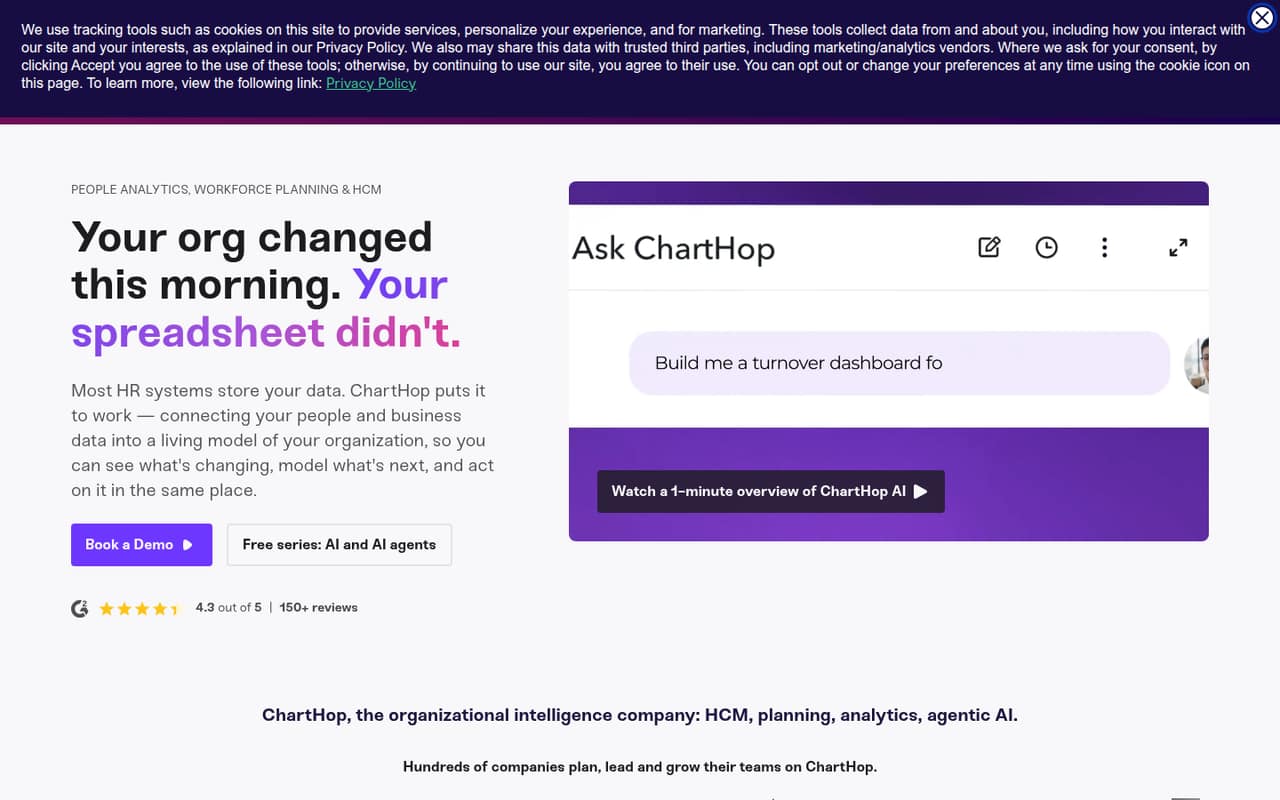
ChartHop brings HRIS, headcount planning, compensation, performance, engagement, goals and AI tools into one organizational model. That range can suit a team trying to connect people and cost data across workflows.
For a 1–10 person team watching every subscription, the catch is cost: ChartHop Core is custom-priced by headcount, and the vendor does not publish a starting price. We’d ask for a quote that covers the specific modules and seat count we need before investing in setup.
Good fit if
- Teams connecting HR and cost data
- People teams planning headcount
- Buyers wanting several HR workflows
Skip it if
- Teams needing a known monthly price
- Very small teams wanting a free tier
- Buyers needing one simple HR tool
ScoresHow it rates
What works
- Combines HR and planning workflows
- Uses a shared organizational data model
- Supports headcount and compensation planning
- AI tools can answer questions and build workflows
- Can connect existing HR systems
What doesn't
- Starting price is not published
- Costs scale with team headcount
- Contractors count toward headcount
- Modules are selected in a custom quote
- One Reddit user reported data integrity problems
01Who ChartHop is for
ChartHop is for teams that want HR records, workforce plans and people analytics tied to the same organizational model. It covers HRIS, headcount planning, compensation, performance, engagement and goals, with AI tools for asking questions or building workflows. That breadth is most useful when a people team needs several of those jobs connected, rather than a basic employee directory.
For a team of 1–10, the budget fit is harder to judge. ChartHop Core is custom-priced according to total headcount, and the vendor lists contractors as part of that count. The price for even one person is not published, so a small team should request a quote before treating it as a practical option. In one Reddit thread, a company looking at ChartHop for compensation found it wonderful but said it was twice the price of other options. That is one buyer’s experience, not a standard price comparison.
02ChartHop free plan and trial
ChartHop’s current pricing information lists no free plan, and trial availability is not published. A commenter on r/humanresources said they believed ChartHop had a free version, but that comment doesn’t establish what is available now. We’d confirm directly with the vendor rather than plan a small-team budget around a possible free tier.
The cheapest listed way in is ChartHop Core, which has custom pricing based on total team size. The quote builder lets buyers select modules, so ask whether the quote can cover only the features you need. HRIS, Workforce Planning / Headcount Planning, Compensation, Performance, Engagement, Goals and ChartHop AI Pro are listed as add-ons. There is no published entry price to compare with a free plan or a low-cost starter subscription.
03What a small team pays for ChartHop
ChartHop Core is custom-priced by total headcount; the pricing information says contractors count, too. The vendor does not publish a per-person rate or a starting price. That means we can’t calculate a reliable cost for one person, three people or five people, or compare monthly and annual totals. Annual billing is stated in the subscription terms, but the prices for either billing period are not published.
Ask for a written quote covering your exact headcount and billing term. Also check which modules are included: the quote builder selects modules, while HRIS, Workforce Planning / Headcount Planning, Compensation, Performance, Engagement, Goals and ChartHop AI Pro are listed as add-ons. Overage costs are not published, so ask whether any apply and how they’re calculated. This is a real budget hurdle for a small team: without the seat rate or a minimum, you can’t know whether ChartHop fits until the vendor responds.
04Getting started with ChartHop
ChartHop is designed to connect people, cost and business data from existing systems, or manage HR data in its HRIS. That can give a team a shared model for planning and other workflows, but it also makes the systems and data you bring in an important part of setup. The available pricing details don’t give a setup-time estimate or a list of integration requirements, so ask which of your current systems are supported and what work is needed to connect them.
One Reddit user described the concept as intuitive and easy to grasp for building reporting. Another said their company cancelled after six months because of data integrity problems, despite employees liking some employee-facing features. Those are individual experiences, not a guarantee of how setup will go for your team. Before signing, clarify who handles data mapping and validation, and how issues are resolved.
05When small teams outgrow ChartHop
ChartHop’s pricing may become harder to justify as a team grows: Core scales with total headcount, contractors count, and the vendor does not publish overage costs. More modules can also mean a larger quote, since the quote builder selects modules and several major capabilities are listed as add-ons. Ask how future headcount changes affect the contract before signing.
The bigger reason to reconsider is whether ChartHop’s breadth is earning its cost. In one Reddit thread, a compensation buyer said ChartHop looked excellent but was twice the price of other options, and their company did not need its other capabilities. Another Reddit user reported data integrity problems and cancelled after six months. Those reports are not universal, but they point to two sensible checkpoints: whether your team uses enough of the platform, and whether the connected data stays reliable. If either answer is no, compare a focused tool or your existing HR system’s reporting before adding more modules.
From the threadsWhat users say
The Reddit comments show both enthusiasm for ChartHop’s reporting and concern about cost and data integrity. These are individual accounts, so small teams should verify fit and pricing with a quote.
The reporting and modeling looked awesome
Unfortunately, it was twice the price of the other options
We had a lot of data integrity issues with ChartHop so we ended up cancelling our contract with them after only 6 months
Seems pretty intuitive and easy to grasp the concept to build some good reporting
Questions people ask
Is ChartHop an HRIS?
Yes. ChartHop lists HRIS among its capabilities: teams can manage HR data or connect an existing HRIS and keep using it. It also offers planning, compensation, performance, engagement and goals workflows on a shared organizational model. Ask the vendor which HRIS functions are included in your quote, since modules are selected through the quote builder.
Does ChartHop have a free plan or trial?
ChartHop’s current pricing information lists no free plan, and trial availability is not published. A Reddit commenter believed there was a free version, but that isn’t confirmation of a current offer. Ask ChartHop whether it offers a trial or a free option for your team before budgeting for a paid subscription.
How much does ChartHop cost for a small team?
ChartHop Core uses custom pricing based on total headcount, and contractors count toward that total. The vendor does not publish a starting price or per-person rate, so the cost for a one-, three- or five-person team cannot be calculated from published figures. Request a quote for your headcount, modules and billing term.
Can ChartHop connect to an existing HRIS?
ChartHop says teams can connect an existing HRIS and keep using it, alongside other people, cost and business data. The specific systems and integration requirements aren’t stated in the pricing details. Before choosing a plan, ask ChartHop to confirm that it supports your current systems and explain the setup work involved.
Who owns ChartHop?
We can’t verify ChartHop’s current ownership from the pricing information available. For procurement, ask ChartHop for its contracting entity and any parent-company information. You can also confirm those details in the company’s legal or corporate disclosures before signing, especially if ownership is part of your vendor review.