
We may earn a commission if you buy through links on this page. It never changes a score or a ranking. How we make money
The bottom line
Coval brings voice AI testing and production QA together, but its paid entry point is steep for a small team.
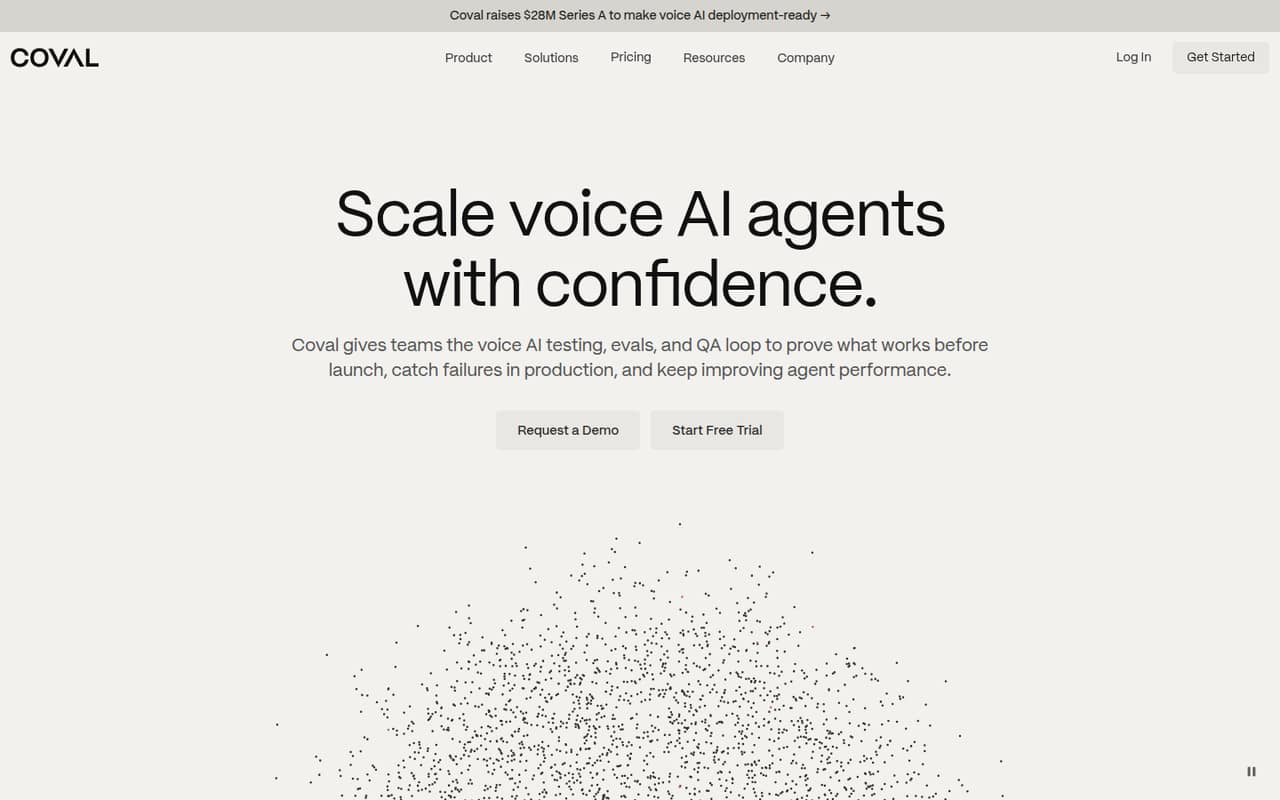
Coval covers voice-agent simulations, production monitoring, human review, regression testing, and vendor comparisons. Unlimited seats on Starter make it workable for a small team, but there’s no free plan and the cheapest option starts at $80 per month with annual billing.
Starter may suit a team validating one project on a tight call-evaluation budget. Watch the 100 monthly simulation minutes and overage rates; teams that need more capacity will pay substantially more for Growth.
Good fit if
- Small teams shipping voice agents
- Teams testing changes before launch
- Production teams reviewing agent calls
Skip it if
- Teams seeking a free QA tool
- Chat-only teams without voice needs
- Teams needing high volume on a small budget
ScoresHow it rates
What works
- Simulation, monitoring, human review, and regression testing in one product
- Starter includes unlimited seats
- Starter has one project and 100 simulation minutes monthly
- Compare voice AI vendors using the same tests
- API, CLI, MCP server, and skills framework available
What doesn't
- No free plan
- Starter includes only 100 simulation minutes monthly
- Starter overages cost $0.40 per simulation minute
- Starter trace retention is limited to 30 days
- Growth costs $400 monthly with annual billing
01Who Coval is for
Coval is for teams building voice agents that need to check quality before launch and keep an eye on calls afterward. Its tools cover caller simulations, production monitoring, human review, regression tests, and comparisons across vendors. That makes it a better fit for a team with a real voice-agent release process than for a small business that only needs a basic call log.
A team of one to ten people can share a Starter account: the pricing page lists unlimited seats, one project, and 100 simulation minutes per month. The budget starts at $80 per month with annual billing, or $100 month to month, before any overages. That is a meaningful spend for a small team, so the case is strongest when failures in live voice interactions are costly or frequent. If you need to evaluate several projects or run much more testing, Growth offers five projects and higher monthly limits, at a much higher price.
02Coval free plan and trial
Coval does not list a free plan. The pricing page lists a seven-day free trial, but it does not publish the trial’s usage limits or which plan features are included. Ask Coval what the trial allows before building a test plan around it.
The cheapest published way in is Starter: $100 per month, or $80 per month with annual billing. It includes 100 simulation minutes and 3,000 upload minutes per month, 30-day trace retention, one project, unlimited seats, and 10 metrics per call. Those limits make it possible for several teammates to share the account, but not to run unlimited simulations or keep traces indefinitely. If your team’s evaluation needs exceed Starter’s included minutes, check the overage rates before signing up.
03What a small team pays for Coval
Coval charges by plan, not by seat. Starter costs $100 monthly or $80 per month with annual billing, so one person pays that same total as a team of three or five. As a per-seat comparison, that works out to $100 or $80 for one person; $33.33 or $26.67 each for three; and $20 or $16 each for five. Annual prices are monthly equivalents, billed annually.
Starter includes 100 simulation minutes and 3,000 upload minutes per month. Overages cost $0.40 per simulation minute and $0.10 per upload minute. Growth costs $500 monthly or $400 per month with annual billing, with 1,000 simulation minutes, 30,000 upload minutes, and five projects. Its equivalent per-seat cost is $500/$400 for one, $166.67/$133.33 for three, or $100/$80 for five. Growth overages are $0.25 per simulation minute and $0.05 per upload minute. Enterprise starts at $4,500 monthly.
04Getting started with Coval
Coval’s listed developer tools include an API, CLI, MCP server, and skills framework. Its product also brings together simulations, production monitoring, human review, regression tests, and vendor comparisons. Those options give developer-led teams several ways to work with the product, but the pricing and feature details do not describe a required setup path or how much engineering time a first project takes.
For a small team, start by confirming what agent or call data you can bring in, how to configure simulations, and who will review selected calls. Coval’s published plan limits also matter early: Starter has one project and 10 metrics per call, while Growth allows five projects and unlimited metrics per call. The vendor does not publish setup time or a specific day-one integration list in the pricing details. Ask Coval which tools and data sources your current stack needs before budgeting implementation work.
05When small teams outgrow Coval
The first clear pressure point is Starter’s 100 simulation minutes per month. If your team regularly exceeds that allowance, overages are $0.40 per simulation minute. Uploads have a separate 3,000-minute allowance and cost $0.10 per extra minute. Track both types of usage; a busy test cycle can change the bill even when your seat count stays the same.
You may also outgrow Starter’s one project, 30-day trace retention, or 10 metrics per call. Growth raises those limits to five projects, 90-day retention, and unlimited metrics, while increasing monthly allowances to 1,000 simulation minutes and 30,000 upload minutes. The tradeoff is a jump from $100 to $500 month to month, or $80 to $400 with annual billing. Enterprise starts at $4,500 per month and is aimed at regulated, high-volume, multi-team organizations. Coval lists unlimited seats on each plan, so growth in headcount alone does not trigger a seat charge.
Questions people ask
Does Coval have a free plan?
No. The pricing page lists a seven-day free trial, but does not publish its usage limits or included features. The cheapest paid option is Starter at $100 per month, or $80 per month with annual billing. Confirm the trial’s limits with Coval before relying on it for a full evaluation.
How much does Coval cost for a team of five?
Starter costs $100 per month, or $80 per month with annual billing, regardless of whether one or five people use it. That is an effective $20 or $16 per person for five seats. The plan includes unlimited seats, but usage overages can add to the bill.
What does Coval Starter include?
Starter includes 100 simulation minutes and 3,000 upload minutes per month, 30-day trace retention, one project, unlimited seats, and 10 metrics per call. Extra simulation minutes cost $0.40 each, and extra upload minutes cost $0.10 each.
When should a team move from Starter to Growth?
Consider Growth if you need more than one project, longer trace retention, or more than 10 metrics per call. It includes five projects, 90-day retention, unlimited metrics per call, 1,000 simulation minutes, and 30,000 upload minutes monthly. It costs $500 monthly or $400 per month with annual billing.
What developer tools does Coval offer?
Coval lists an API, CLI, MCP server, and skills framework. The available pricing details do not specify a required setup path, setup time, or a day-one integration list. Ask Coval which tools and data sources your team needs to connect for its intended workflow.