
We may earn a commission if you buy through links on this page. It never changes a score or a ranking. How we make money
The bottom line
Strong scraping coverage and a free entry point, with an API-first setup and credit math to manage.
Crawlbase gives small teams several ways to collect current web data: a crawling API, asynchronous crawls, proxies, cloud storage, managed scrapers, and a Web MCP Server. Its pay-as-you-go option has no monthly fee and starts with free credits, making it possible to begin without committing to a subscription.
The cheapest paid plan is Starter at $99 monthly, or $90.75 per month with annual billing. Plans are based on credits, not published per-seat prices, so the cost for a team of three or five depends on how the account is shared and how much each crawl uses.
Good fit if
- Teams collecting live web data
- Developers building scraping workflows
- Variable-volume crawling projects
Skip it if
- Teams wanting a no-code scraper
- Very light, occasional page checks
- Buyers needing published seat pricing
ScoresHow it rates
What works
- Pay-as-you-go has no monthly fee
- Free credits are available to start
- Offers browser rendering and anti-bot handling
- Includes asynchronous crawling and callbacks
- No separate proxy or CAPTCHA charge
What doesn't
- Starter costs $99 monthly
- Credit use varies by feature
- Unused monthly credits reset
- Per-seat pricing is not published
- API-first setup may need developer time
01Who Crawlbase is for
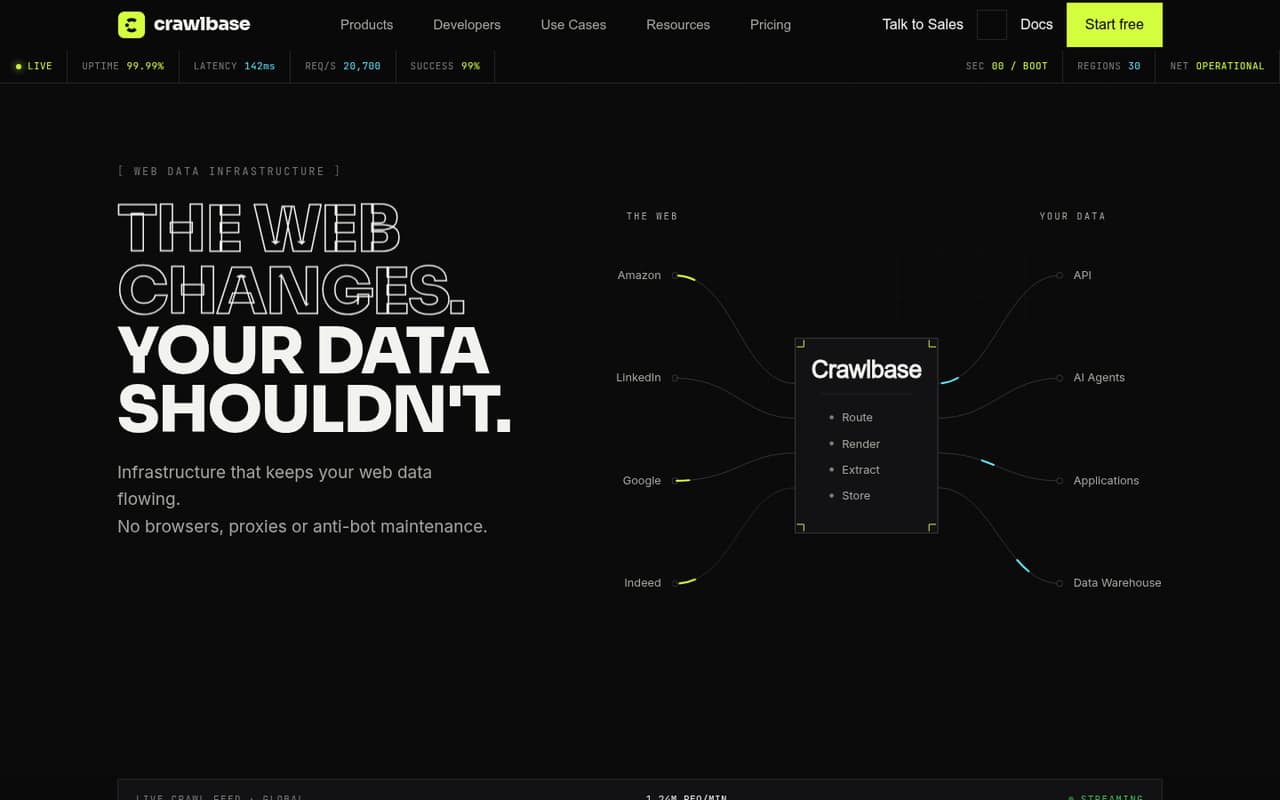
Crawlbase suits small teams that need web data for research, monitoring, lead generation, or AI workflows, and have someone who can connect an API to their process. It fetches pages as HTML or structured data, can render browser-based pages, and offers anti-bot handling. For larger jobs, its asynchronous crawler queues URLs and sends results through callbacks.
A one-to-ten-person team can start with pay-as-you-go rather than buying a seat bundle. That is useful when crawl volume changes month to month or a project is still being proved out. The product also includes residential proxies, cloud storage, managed scrapers for selected sites, and a Web MCP Server for AI agents. These are practical building blocks, not a ready-made no-code research app. If nobody on the team can work with APIs, plan for technical setup or ask Crawlbase what implementation help it offers.
02Crawlbase free plan and trial
Crawlbase’s pay-as-you-go option has no monthly fee and requires no card to start, per the pricing page. It includes 1,000 free credits initially, with up to 5,000 available after setup. This is a way to try a small crawl or validate a workflow before choosing a subscription. The plan then charges for successful requests using graduated rates, from $3.00 to $0.02 per 1,000 requests as volume rises. An optional hard spend cap can help keep costs bounded.
A separate free trial is not listed. The free credits are the lowest-cost way in, but they are limited; ongoing use is billed monthly in arrears. JavaScript rendering uses two credits per request, so rendered pages can consume the balance faster than basic requests. Check expected credit use before sending a large batch.
03What a small team pays for Crawlbase
The cheapest subscription is Starter: $99 monthly, or $90.75 per month with annual billing, for 200,000 credits each month. That works out to $1,188 over 12 monthly payments versus $1,089 at the listed annual rate. The plan is usage-based, not priced per seat. If three people split one account, the illustrative cost is $33 each monthly or $30.25 each at the annual rate; for five, it is $19.80 or $18.15. Those are cost splits, not published seat entitlements. Crawlbase does not publish per-seat pricing.
Pay-as-you-go has no fixed monthly fee, while the next listed plan, Scale 500K, costs $199 monthly or $182.42 per month annually. Starter overages continue at pay-as-you-go rates, and unused credits reset monthly. JavaScript rendering costs two credits per request, storage costs 0.5 credits per page per month, and screenshots cost two credits. The pricing page lists no separate charge for proxies, CAPTCHA handling, or block handling.
04Getting started with Crawlbase
Crawlbase is an API and infrastructure product, so a small team should expect to connect it to its own scripts or data workflow rather than just install a desktop app. The basic decision is what to fetch and whether the job needs browser rendering, structured extraction, or asynchronous processing. The pricing page lists a no-card pay-as-you-go start, which lets a developer begin without selecting a paid subscription.
The setup effort will depend on your target sites and how results need to reach the team. A simple fetch is a narrower job than setting up callbacks for a large URL queue, storing results, or connecting the Web MCP Server to an AI agent. Crawlbase describes these product capabilities, but does not publish a setup-time estimate or a per-seat onboarding requirement in its pricing details. Before committing, ask the vendor about the implementation steps, supported integrations, and support available for your specific workflow.
05When small teams outgrow Crawlbase
The first sign to move up is regular credit use beyond Starter’s 200,000 monthly allowance. Scale 500K includes 500,000 credits for $199 monthly, or $182.42 per month with annual billing; Scale 1M costs $349 monthly for one million credits. Overage continues at pay-as-you-go rates, so compare the expected overage with the next plan before upgrading. Credits reset each month, which can also make a subscription poor value when workloads are sporadic.
A growing team may also find that credit estimates take more attention as it adds rendered requests, screenshots, or stored pages. Those features each consume credits, while the product’s listed plans do not set out seat counts or per-seat access costs. Ask Crawlbase about account access and volume pricing if several people need separate credentials or your usage will exceed two million monthly credits; Enterprise offers custom volume, SLAs, and invoicing. If the team needs a no-code interface or predictable per-user billing, check whether Crawlbase supports that requirement before expanding.
Questions people ask
Does Crawlbase have a free plan?
Crawlbase’s pay-as-you-go option has no monthly fee or card requirement to start. The pricing page lists 1,000 free credits initially, with up to 5,000 after setup. After those credits, successful requests are billed monthly using graduated rates. There is no separate free trial listed.
How much does Crawlbase cost for a small team?
Pay-as-you-go has no fixed monthly fee. The cheapest subscription is Starter at $99 per month, or $90.75 per month with annual billing, and includes 200,000 monthly credits. Crawlbase lists credit plans rather than per-seat prices, so ask the vendor about account access for multiple team members.
Does Crawlbase support JavaScript-rendered pages?
Yes. Crawlbase’s crawling API offers browser rendering, and the pricing page lists JavaScript rendering at two credits per request. Include that extra credit use in your estimate, especially for a large batch. Crawlbase also lists anti-bot handling as part of its crawling features.
Can Crawlbase handle large crawls asynchronously?
Yes. Crawlbase’s asynchronous crawler queues large URL crawls and delivers results through callbacks. That can suit jobs that do not need every page returned in a single immediate response. The right plan depends on the crawl’s volume and credit use; Starter includes 200,000 credits monthly.
Can AI agents use Crawlbase to read web pages?
Crawlbase offers a Web MCP Server that lets AI agents request and read current web pages through MCP. The product also provides crawling APIs and managed scrapers for selected sites. Check with Crawlbase about the setup steps and compatibility for the particular agent and workflow you plan to use.