
We may earn a commission if you buy through links on this page. It never changes a score or a ranking. How we make money
The bottom line
Good starting economics for builders; expect engineering work and a bill tied to participant-minutes.
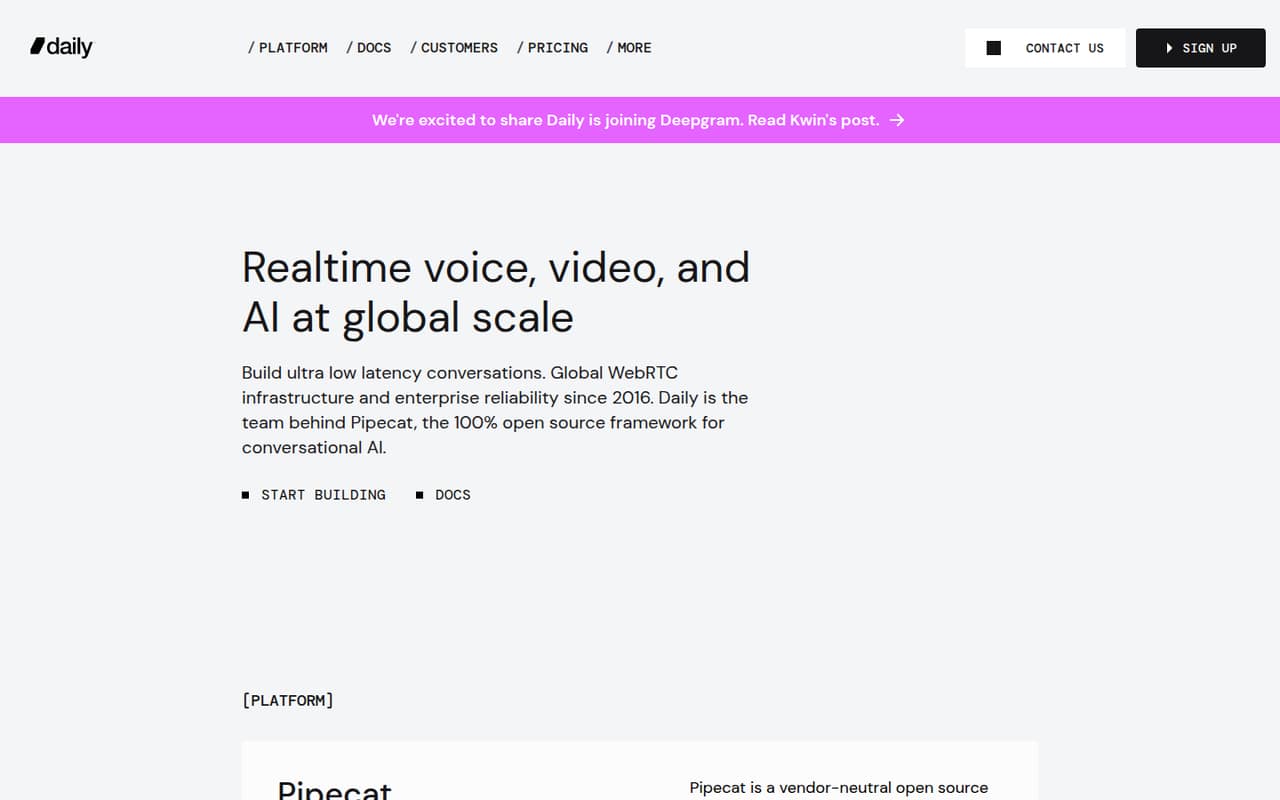
Daily is for teams building realtime voice and video into their own product. Its WebRTC infrastructure and SDKs support human calls, while Pipecat and Pipecat Cloud cover conversational AI agents.
The usage-based plan starts at $0 and includes 10,000 participant-minutes each month. There’s no per-seat price to calculate: costs depend on call minutes, so a team of five can pay the same base price as a solo builder.
Good fit if
- Teams adding calls to their product
- Developers building voice AI agents
- Small teams with variable call volume
Skip it if
- Teams seeking an off-the-shelf calling app
- Nontechnical teams avoiding SDK work
- Buyers who need fixed seat pricing
ScoresHow it rates
What works
- 10,000 participant-minutes included monthly
- No recurring base fee listed
- Usage-based pricing, not seat-based
- Supports calls and AI agent transport
- Homepage lists 75+ global points of presence
What doesn't
- Monthly cost changes with call usage
- No per-seat price for budgeting
- No annual price listed
- Setup requires product development
- Higher audio-only rates aren't listed
01Who Daily is for
Daily fits a small product team—one to ten people—that needs to build voice or video into software, rather than install a calling app for internal meetings. The product provides WebRTC infrastructure and SDKs for realtime calls, plus Pipecat, an open-source framework for conversational AI, and Pipecat Cloud for deploying Pipecat-built voice agents.
That makes it relevant to developers building customer calls, voice agents, or other realtime audio and video features. The homepage lists 75+ global points of presence, and Daily says it offers end-to-end encryption, signed HIPAA BAAs, and uptime SLAs. Those claims may matter for teams with specific security or reliability needs; ask Daily which terms apply to your use case. For a small team, the appeal is a $0 starting base fee. The catch is that this is infrastructure for your product, not a finished end-user calling workflow.
02Daily free plan and trial
Daily’s listed Pay-as-You-Go / Usage-Based plan has no recurring base fee and includes 10,000 free participant-minutes each month. The pricing material lists that allowance for video and audio calls; its audio-only rates also start with the first 10,000 minutes free. There is no separate free trial listed.
After the free allowance, video and audio calls are priced by participant-minute: $0.0040 for minutes 10,001–100,000, with lower listed rates at higher tiers. Audio-only calls have their own lower rates. The free allowance is usage, not a number of employee seats, and the source doesn’t list a seat cap. It can help a team start building and handle some usage without a base subscription, but it isn’t a free calling app or a promise of unlimited calls. Check which usage category applies before estimating your bill.
03What a small team pays for Daily
The pricing page lists Pay-as-You-Go / Usage-Based at $0 per month before metered usage. That means one developer, three developers, and five developers each have a $0 listed base cost; there is no per-seat price to multiply. Daily bills by participant-minutes, so the actual cost depends on how many people join calls and how long they stay. No annual price is published.
For video and audio calls, the listed rate is $0.0040 per minute from 10,001 to 100,000 minutes, then $0.0037 from 100,000 to 500,000, and $0.0034 from 500,000 to 1,000,000. The pricing material describes graduated volume tiers. Audio-only calls have a separate schedule: $0.00099 per minute from 10,001 to 100,000 and $0.00092 from 100,000 to 500,000. Higher audio-only tiers aren’t listed on the vendor’s site. For a team budget, estimate participant-minutes by call type; headcount alone won’t produce a useful bill.
04Getting started with Daily
Daily is developer infrastructure, so a team should expect to connect its SDKs to an application rather than switch on a finished calling service. The first decision is whether you’re building human-to-human calls with Daily’s WebRTC tools or a voice agent using Pipecat and Pipecat Cloud. That choice shapes the integration work.
Daily’s product description identifies SDKs, infrastructure, the Pipecat framework, and its cloud deployment service, but doesn’t publish a setup-time estimate. For a small team, the effort will depend on existing app architecture and the call or agent experience you’re building. We’d budget engineering time for integration and usage tracking, then confirm the relevant SDK path and deployment requirements with Daily’s docs. If your team wants a no-code calling tool, this is likely the wrong category of product.
05When small teams outgrow Daily
Daily doesn’t list a seat limit or a fixed monthly plan in the pricing material, so adding employees alone doesn’t trigger a published per-seat jump. The pressure point is usage: once a project passes 10,000 participant-minutes, calls move into paid tiers. Higher listed video and audio rates fall as volume increases, but a lower per-minute rate can still mean a larger total bill when usage grows.
A team may also outgrow the product if it needs an off-the-shelf calling app rather than infrastructure and SDKs, or if it needs a fixed budget that doesn’t vary with call activity. The listed audio-only schedule stops at 500,000 minutes, so ask Daily for rates above that level before forecasting larger audio workloads. For a growing product, track participant-minutes by call type and revisit the estimate as traffic changes.
Questions people ask
Is Daily free for a small team?
The listed Pay-as-You-Go / Usage-Based plan has a $0 monthly base fee and includes 10,000 participant-minutes each month. After that, calls are metered at the listed rates. It’s usage-based infrastructure, not a free app with a set number of employee accounts.
Does Daily charge per employee or seat?
The pricing material lists usage-based participant-minute charges, not a per-seat fee. A team of one, three, or five developers has the same $0 listed base cost; call usage determines the metered bill. Daily doesn’t publish a seat price in the listed plan.
What does Daily cost after the free minutes?
Video and audio calls are listed at $0.0040 per participant-minute from 10,001 to 100,000 minutes, with lower rates at higher tiers. Audio-only rates are separate and start at $0.00099 per minute from 10,001 to 100,000. Your bill depends on call type and usage.
Does Daily have an annual plan or free trial?
The pricing material lists a $0-base Pay-as-You-Go / Usage-Based plan and a monthly free-minute allowance. It doesn’t list an annual price or a separate free trial. Ask Daily whether any other commercial terms apply to your project.
Can I use Daily to build voice AI agents?
Yes. Daily maintains Pipecat, an open-source framework for conversational AI, and offers Pipecat Cloud to deploy Pipecat-built voice agents on Daily infrastructure. Daily also describes its infrastructure as transport for Pipecat-built agents.