
We may earn a commission if you buy through links on this page. It never changes a score or a ranking. How we make money
The bottom line
A broad finance platform for government and nonprofit teams; ask for a quote before budgeting.
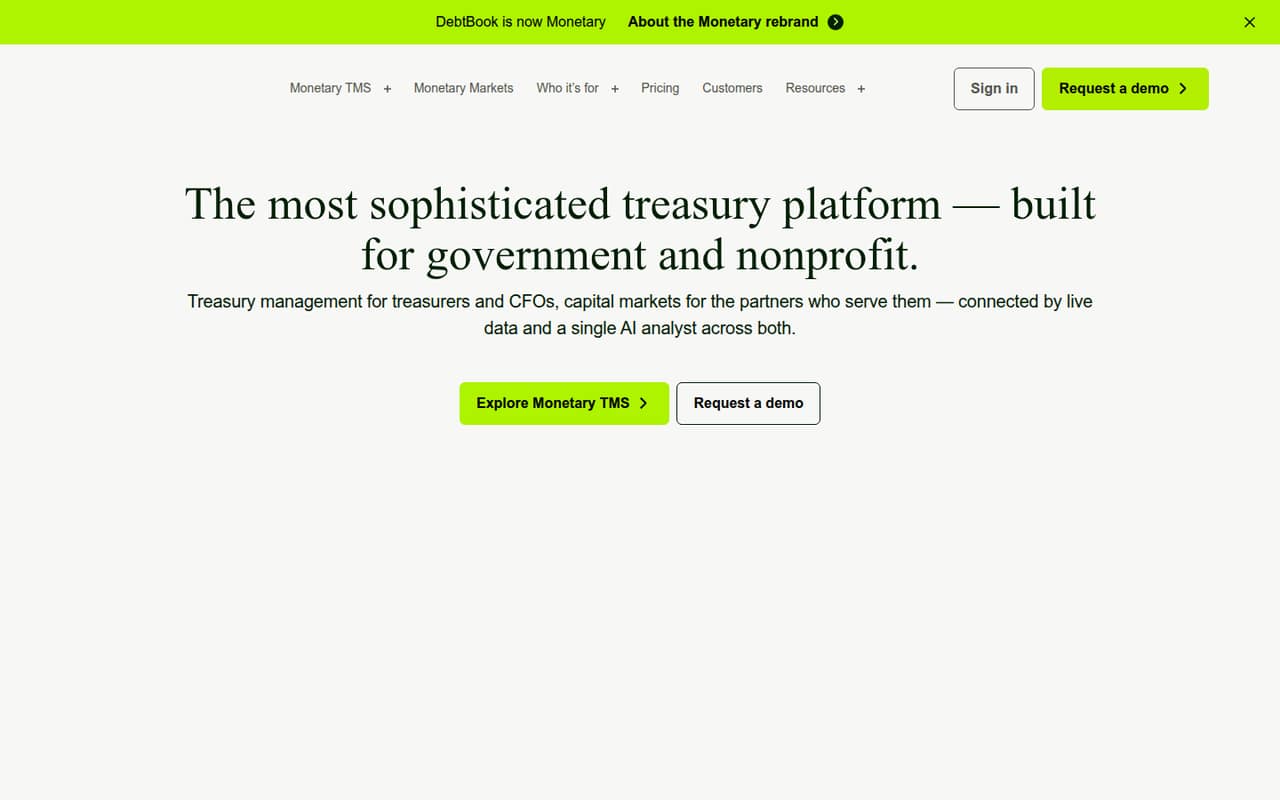
DebtBook, now Monetary, brings debt, cash, investments, accounting, and an AI analyst into one treasury and capital markets platform for government and nonprofit organizations. Its feature set reaches beyond basic debt tracking, including GASB accounting and bank reconciliation.
For a small team, the main drawback is cost uncertainty: the pricing page lists customized quotes, not rates. There is no listed free plan, and seat limits for most modules are not published, so get a quote for your team size and required add-ons before deciding.
Good fit if
- Government finance departments
- Nonprofit treasury teams
- Teams managing debt and cash
Skip it if
- Teams needing a free finance tool
- Buyers requiring public seat prices
- Small businesses outside government finance
ScoresHow it rates
What works
- Combines debt, cash, and investment management
- Includes GASB accounting tools
- Covers bank reconciliation workflows
- AI answers link to source data
- Lease Starter lists two users and 15 agreements
What doesn't
- No free plan is listed
- Monthly and annual prices are not published
- Most modules have unpublished seat limits
- Add-on costs are not published
- Setup details and integrations need vendor confirmation
01Who DebtBook is for
DebtBook is for government and nonprofit finance teams responsible for treasury or capital markets work. It brings debt, cash positions, cash-flow forecasting, investments, accounting, and bank reconciliation into one platform. The product also includes an AI analyst that can answer portfolio questions and flag exceptions, with answers linked to source data.
For a team of 1–10, it may fit when a few finance staff need to coordinate complex debt or treasury work rather than track finances in a general-purpose small-business tool. The budget case depends on how many modules and add-ons you need: the pricing page lists custom quotes, not a small-team rate. Ask for a quote covering your team size and workflows before treating it as a realistic option. It is a specialist platform, not an obvious fit for a small company that only needs basic bookkeeping.
02DebtBook free plan and trial
DebtBook does not list a free plan. The pricing page also does not publish whether a free trial is available, so ask the vendor directly rather than budgeting around trial access. That leaves no confirmed no-cost way to evaluate the platform.
The listed plans are organized by use case, including debt, cash, investment, lease and subscription, and contract management. For smaller lease and subscription portfolios, the Starter plan lists two users and up to 15 total agreements. Its price is not published, though, and it is not a free tier. The cheapest way in is therefore not clear from public rates: request a quote for the specific module you need, and confirm whether a demo or trial is available.
03What a small team pays for DebtBook
The pricing page lists customized quotes and does not publish monthly or annual prices. That means we cannot calculate a reliable per-person cost for one user or a team of three or five, or compare monthly billing with annual billing. Ask DebtBook for both billing options and quotes at your actual seat count before comparing it with a fixed-price tool.
The Lease & Subscription Management – Starter plan lists two users and up to 15 agreements; Complete lists unlimited users and agreements. Both are quote-priced. Debt Management, Cash Management, and Investment Management have no published seat or usage limits. Their add-ons include Debt Accounting, Sizing, Bond Proceeds Management, bank fee analysis, accounting, and custodial bank integrations. Ask which are included in your quote and which add cost. The listed prices for add-ons are not published either, so a headline module quote may not tell you the full cost of the workflow you need.
04Getting started with DebtBook
DebtBook covers several finance workflows, so a small team should first decide which ones it wants to bring into the platform: debt, cash, investments, GASB accounting, or bank reconciliation. That scope will shape the setup conversation and the modules to request in a quote. The product description also says its AI analyst uses live data and links answers to source data.
A setup timeline, learning curve, and integration inventory are not published in the pricing details. The listed features do not specify which bank, accounting, or custodial connections are available for your organization. Before signing, ask DebtBook what data it needs, which systems it connects to, how migration works, and what onboarding or training is included. For day one, confirm bank feeds or reconciliation requirements and any custodial bank integrations your team relies on; the Investment Management plan lists custodial integrations as an add-on.
05When small teams outgrow DebtBook
DebtBook is more likely to become a fit problem than a simple seat-count problem. For Lease & Subscription Management, Starter is capped at two users and 15 total agreements; a team that needs a third user or has more agreements would need to ask about Complete, which lists unlimited users and agreements. Its price is not published, so the cost of moving up is unknown.
For Debt, Cash, and Investment Management, the vendor does not publish seat or usage limits. A growing team should ask when its expected portfolio or user count would require a different quote or package. Add-ons can also change the scope: accounting, bank fee analysis, or custodial integrations may be separate. If your team mainly needs basic bookkeeping, or needs predictable per-seat pricing to plan a tight budget, DebtBook's specialist scope and custom quotes may be a reason to choose a simpler tool instead.
Questions people ask
Does DebtBook have a free plan?
DebtBook does not list a free plan. The pricing page lists paid modules with customized quotes, and does not publish whether a free trial is available. Ask the vendor whether it can provide a demo or trial, and confirm what data or setup is required to evaluate the workflows you need.
How much does DebtBook cost for a small team?
DebtBook's pricing page does not publish monthly or annual rates; it says pricing is customized by quote. Prices for one user or a team of three or five are therefore not available to calculate. Request a quote for your seat count, modules, add-ons, and both monthly and annual billing.
How many users can use DebtBook?
The Lease & Subscription Management – Starter plan lists two users, while Complete lists unlimited users. Contract Management also lists unlimited users and guests. Debt, Cash, and Investment Management do not have published seat limits, so ask DebtBook to confirm the limit and pricing for your chosen modules.
What does DebtBook include?
DebtBook brings debt, cash management, investment management, GASB accounting, and bank reconciliation together for government and nonprofit organizations. Its AI analyst answers portfolio questions and flags exceptions, with answers linked to source data. Some capabilities, including debt accounting and custodial bank integrations, are listed as add-ons.
Is DebtBook now called Monetary?
Yes. DebtBook is now Monetary, described as a treasury and capital markets platform for government and nonprofit organizations. The platform brings debt, cash, investments, accounting tools, and an AI analyst together using live data. Confirm with the vendor which product and plan names will appear on your quote.