
We may earn a commission if you buy through links on this page. It never changes a score or a ranking. How we make money
The bottom line
A broad model catalog and pay-as-you-go billing, without a free plan or predictable seat price.
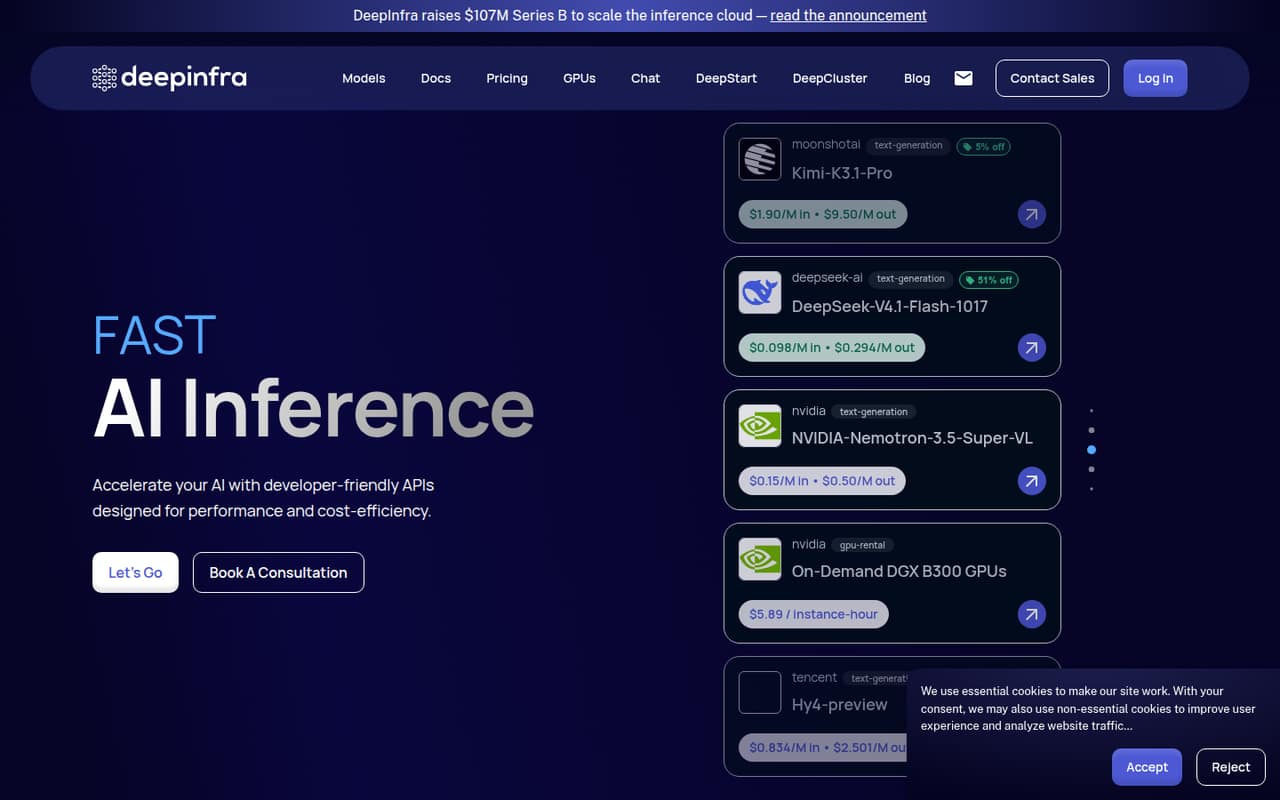
DeepInfra is for developers who want API access to a broad model catalog and bills tied to usage rather than seats. Its homepage lists 100+ models, zero data retention, and SOC 2 and ISO 27001 certifications.
There’s no free plan, and the pricing page lists no fixed monthly or annual price. Some models charge by tokens; most charge by inference time. That flexibility can suit a small product team, but makes budgeting depend on model choice and usage.
Good fit if
- Developers testing multiple models
- Teams with variable inference demand
- Privacy-minded API buyers
Skip it if
- Teams needing a free tier
- Buyers wanting fixed seat costs
- Nontechnical teams avoiding API setup
ScoresHow it rates
What works
- Homepage lists more than 100 models
- Pay-as-you-go, with no long-term contracts
- Some models have per-token rates
- Homepage says inputs and outputs stay private
- Lists SOC 2 and ISO 27001 certifications
What doesn't
- No free plan is listed
- Most models bill by inference time
- No fixed monthly or annual price
- Total cost depends on model and usage
- Reddit users report pricing and rate-limit concerns
01Who DeepInfra is for
DeepInfra is aimed at developers who need to run AI models through an API, rather than a ready-made tool for a whole office. A solo builder or a small product team of three to ten people can share the same account model: the pricing page lists usage-based billing, not a per-seat plan. That can work well when only part of the team builds or operates the product.
The homepage lists more than 100 models across text generation, speech, and image generation, with options for different priorities such as cost, latency, throughput, and scale. Its zero-retention policy and listed SOC 2 and ISO 27001 certifications may also matter to teams handling sensitive inputs. The budget fit depends on your chosen models and how often you call them. If you need a fixed monthly amount, a free sandbox, or an interface that nontechnical teammates can use without API work, DeepInfra is a less natural fit.
02DeepInfra free plan and trial
The pricing information lists no free plan, and it does not list a free trial. So a small team should budget for paid inference from the first billable use rather than expect a free allowance for evaluation. The vendor’s pricing page lists a pay-as-you-go option, with no long-term contract or upfront cost.
That is the cheapest way in: choose a model and pay according to its billing method. Some language models have per-million-token rates; most models are billed by inference execution time. The cheapest listed token-rate example is $0.02 per 1 million input tokens and $0.04 per 1 million output tokens. Those rates are an example, not a universal rate for the catalog. Before testing, check the rate for the exact model you plan to call and confirm how your workload is measured.
03What a small team pays for DeepInfra
DeepInfra lists one plan: Pay-as-you-go inference. There is no published seat price, monthly minimum, or annual price, so a one-person account and a five-person team do not have a fixed per-seat bill. The total depends on how much each person’s application uses and which models it calls.
For a simple illustration, the cheapest listed token-rate example costs $0.02 for 1 million input tokens plus $0.04 for 1 million output tokens: $0.06 for that combined usage. If three people each used that amount, the total would be $0.18; for five people, $0.30. This is usage arithmetic, not a monthly estimate, and it applies only to that listed example. Most other models use inference-time billing, so the same calculation will not apply.
The pricing page lists no add-ons or annual billing. We’d check the selected model’s rate and billing unit before setting a team budget, then track actual usage. There are no per-seat jumps listed, but spending can rise as requests or model use increase.
04Getting started with DeepInfra
DeepInfra is an inference API, so expect a developer to connect it to an application or workflow rather than invite teammates to a standard team workspace. The homepage describes model access through APIs, but the available product details do not specify setup steps, supported client libraries, or named integrations. The vendor does not publish those details in the pricing information, so check its current documentation before estimating implementation time.
For day one, a small team should settle on a model, confirm its price and billing unit, and decide which application or service will send requests. The catalog’s range is useful, but comparing models adds a choice to make before launch. The homepage says the service offers zero data retention and lists SOC 2 and ISO 27001 certifications; teams with specific security requirements should confirm how those policies apply to their use case. Reddit discussions mention provider routing and rate-limit errors in particular contexts, so it is sensible to monitor usage and errors after connecting an endpoint.
05When small teams outgrow DeepInfra
DeepInfra does not list seat tiers, so growth does not trigger a published per-seat upgrade. The more likely pressure point is usage: more requests, heavier models, or a change in model can change the bill. Because most models are billed by inference time, teams that need a predictable monthly budget should check whether they can forecast their workload before expanding use. The pricing page does not list a monthly or annual plan to cap that uncertainty.
There are also operational questions to revisit as the product grows. The homepage lists zero retention and security certifications, but teams with stricter procurement needs should verify that the policies and certifications meet their requirements. Reddit users have raised concerns about provider routing, cache pricing, and rate-limit errors in discussions involving DeepInfra through a routing service. A commenter said the pricing issue was fixed after it was reported, while another reported rate-limit errors. These are user reports, not a measure of typical performance. If reliability, support commitments, or spend controls become critical, ask the vendor what it offers before scaling.
From the threadsWhat users say
Reddit discussion is mixed and often concerns DeepInfra used through a routing service, rather than a direct account. Users raised pricing, routing, and rate-limit concerns; one commenter said a reported pricing error was fixed.
the put slightly cheaper input output price but jack up the cache price and the autorouting logic picked up deepinfra , resulting in much more expensive inference cost
Turns out our engineer mistyped one zero 🫠 In case you haven't, please come back 😅 We're always trying to have the most competitive prices
My experience as well, they kept returning "rate limit" errors for a paying customer, constantly shows on Openrouter as 9TPS as well
InferX and DeepInfra behaved much more like each other, while DeepSeek’s own endpoint initially gave me a noticeably better agent experience
Questions people ask
Does DeepInfra have a free plan?
The pricing information lists no free plan, and it does not list a free trial. The lowest-commitment option is Pay-as-you-go inference, with no long-term contract or upfront cost listed. Check the rate for your chosen model before sending production traffic.
How does DeepInfra charge for API use?
The pricing page lists per-million-token pricing for some language models and inference-time billing for most others. It does not list a fixed monthly or annual price. Your bill depends on the model and your usage, so check the model’s specific rate and billing unit.
What does DeepInfra do?
DeepInfra provides APIs and infrastructure for running AI models. Its homepage lists more than 100 models for tasks including text generation, speech, and image generation, with options aimed at different priorities such as cost, latency, throughput, and scale.
Does DeepInfra retain API inputs and outputs?
DeepInfra’s homepage says inputs, outputs, and user data stay private under its zero-retention policy. It also lists SOC 2 and ISO 27001 certifications. If your team has specific compliance or data-handling requirements, ask the vendor how those policies apply to your use case.
How much does DeepInfra cost for a small team?
There is no published seat price, so headcount alone does not determine the bill. Some models have per-token rates, while most are billed by inference time. The cheapest listed token example is $0.02 per 1 million input tokens and $0.04 per 1 million output tokens; your actual model may cost differently.