
We may earn a commission if you buy through links on this page. It never changes a score or a ranking. How we make money
The bottom line
Good token-rate value for developers who can estimate usage; there’s no free plan or seat pricing.
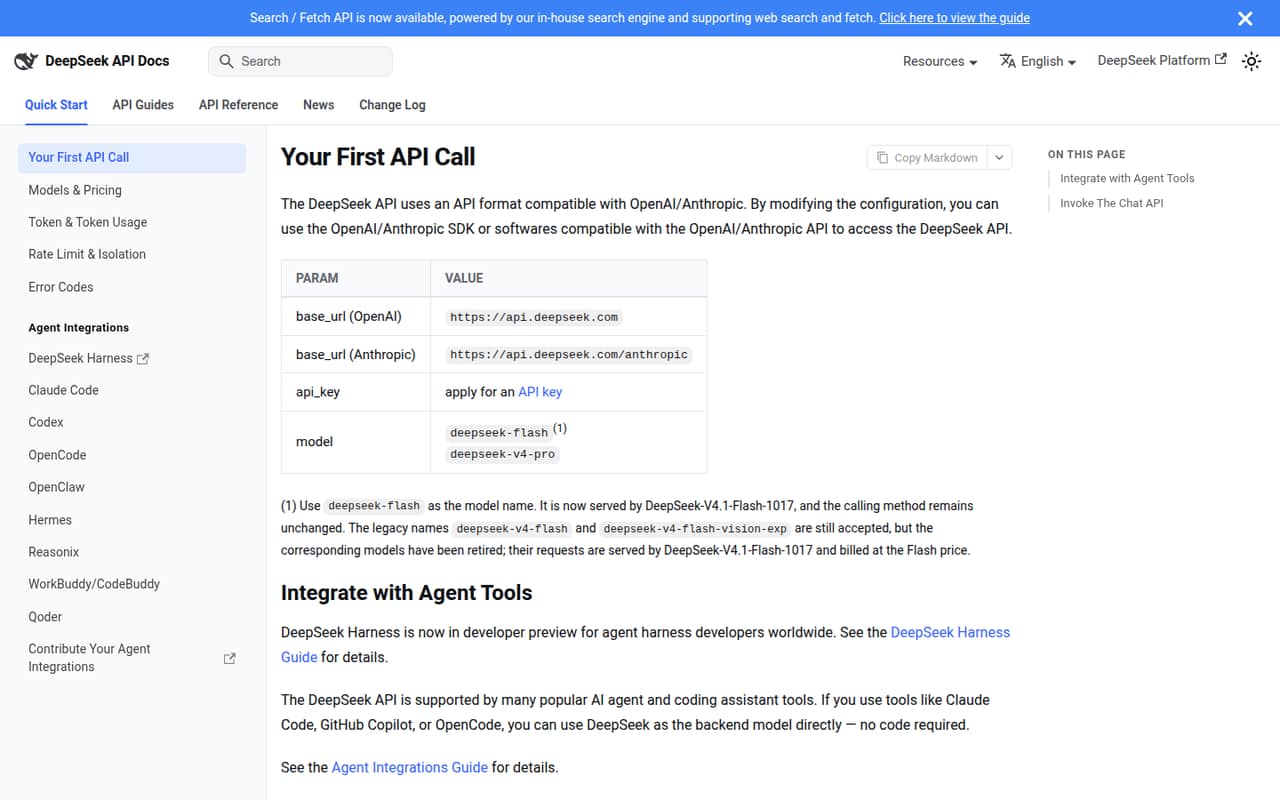
DeepSeek API gives developers access to deepseek-flash and deepseek-v4-pro through OpenAI- and Anthropic-compatible formats. It also offers standalone Search and Fetch APIs. The pricing page lists token charges rather than seats or monthly subscriptions, and there’s no free plan or published free trial.
For a small team, the draw is low listed flash rates and the option to pay only for usage. The trade-off is a bill that depends on tokens, cache status, time of day and any Search or Fetch requests. Reddit reactions include strong praise for value and a report of a sharp price increase.
Good fit if
- Small teams building API-powered apps
- Developers who can track token use
- Teams needing compatible API formats
Skip it if
- Teams that need a free tier
- Buyers wanting fixed per-seat costs
- Teams needing predictable monthly bills
ScoresHow it rates
What works
- OpenAI- and Anthropic-compatible formats
- Two models with different listed rates
- Flash supports thinking and non-thinking modes
- Streaming responses in Chat API examples
- Search and Fetch priced per request
What doesn't
- No free plan or published free trial
- Usage costs depend on token volume
- Peak rates are higher than off-peak
- No monthly or annual subscription listed
- Search and Fetch add usage charges
01Who DeepSeek API is for
DeepSeek API suits a small development team—one to ten people—building an app, automation or agent that needs model responses. It is an API, not a seat-based chat subscription: your team connects software to deepseek-flash or deepseek-v4-pro and pays for token usage. The docs list OpenAI- and Anthropic-compatible formats and SDKs, which can help teams already working with those formats.
It fits a budget-conscious team that can estimate or monitor usage and is comfortable with a variable bill. The pricing page lists flash input rates as low as $0.003 per million cache-hit tokens off-peak and $0.15 per million cache-miss tokens off-peak; output is $0.60 per million tokens off-peak. Rates rise during peak hours. Search and Fetch are separate paid APIs. If your team needs a free starting tier, fixed monthly costs or simple per-seat budgeting, this model of buying may not fit.
02DeepSeek API free plan and trial
The pricing page lists no free plan and no free trial. That means there is no published allowance of free API tokens or free Search and Fetch requests to test before paying. The cheapest way in is to make a small amount of paid deepseek-flash usage; its listed rates are billed per million tokens, with different prices for cache-hit input, cache-miss input and output.
The price you pay depends on token volume and whether usage falls in peak or off-peak hours. Search and Fetch are also paid per successful request. The API is therefore a poor fit if your team needs a free tier for experiments that may run up an unplanned bill. Before connecting a production app, check the current pricing page and decide how your team will monitor token and request usage.
03What a small team pays for DeepSeek API
The pricing page lists no monthly or annual plan, and no per-seat charge. A solo developer, a team of three and a team of five all pay for their combined usage rather than multiplying a seat price. With zero usage, the listed model charges are zero; with usage, the bill depends on tokens and request types, so there is no published fixed monthly total for any team size.
For each 1 million deepseek-flash tokens, the listed off-peak rates are $0.003 for cache-hit input, $0.15 for cache-miss input and $0.60 for output. Peak rates are $0.006, $0.30 and $1.20. For deepseek-v4-pro, off-peak rates are $0.022, $0.66 and $1.98; peak rates are $0.044, $1.32 and $3.96. Peak hours are weekdays 01:00–04:00 and 06:00–10:00 UTC. Search and Fetch each cost $0.75 per 1,000 successful requests. The vendor deducts usage charges from your balance.
04Getting started with DeepSeek API
Plan for developer setup rather than a no-code team rollout. Per the docs, DeepSeek supports OpenAI- and Anthropic-compatible API formats and SDKs, so a team already using either format has a familiar integration path. The docs also include Chat API examples with streaming responses and show that deepseek-flash has thinking and non-thinking modes, with thinking as the default.
The learning curve depends on your team's existing API experience and application. You will need to choose a model, handle usage-based costs and decide whether your application needs streaming, thinking modes or separate Search and Fetch requests. The docs list agent integrations including Claude Code, GitHub Copilot and OpenCode. For a team of one to ten, the main setup work is engineering integration and cost monitoring, not assigning paid seats. Check the docs for current integration details before building around a specific workflow.
05When small teams outgrow DeepSeek API
DeepSeek API does not sell seats, so a team does not hit a published seat tier when it grows from three people to ten. The practical pressure points are usage costs, concurrency and the limits attached to each model. The pricing page lists a concurrency limit of 2,500 for deepseek-flash and 500 for deepseek-v4-pro; flash lists a 1M context and 384K maximum output. A team with heavier usage should check whether current limits and billing fit its workload.
The variable bill can also become harder to forecast as more people or automated jobs send requests. A Reddit poster said flash had recently become four times more expensive for their use, while other Reddit users praised the API's low cost. Those reports are individual experiences, not a pricing guarantee. Consider another option or a different buying model if your team needs predictable monthly spend, a free tier or a support and service commitment you can verify before adoption.
From the threadsWhat users say
Reddit comments show enthusiasm about the API’s value, but users also discuss rising prices and the difficulty of comparing costs across workloads. The sentiment is positive on affordability for some, mixed on predictability.
the deepseek api directly is the cheapest way to go as I understand it
I believe Liang is doing charity. Insane
recently it raised prices four-fold
I spend far more
Questions people ask
Is DeepSeek API free?
The pricing page lists no free plan or free trial. Model usage is billed per token, and Search and Fetch are billed per successful request. The cheapest listed entry point is paid deepseek-flash usage, with charges depending on cache status and peak or off-peak time.
How does DeepSeek API billing work?
The pricing page lists token rates per million tokens for deepseek-flash and deepseek-v4-pro. Input rates differ for cache-hit and cache-miss tokens, and rates are higher during listed peak hours. Search and Fetch cost $0.75 per 1,000 successful requests. Charges are deducted from your balance.
What models are available through DeepSeek API?
The API offers deepseek-flash and deepseek-v4-pro. The docs say flash supports thinking and non-thinking modes, with thinking as the default. Check the current docs and pricing page for model details and rates before choosing a model for your application.
Does DeepSeek API support OpenAI-compatible requests?
Yes. DeepSeek API supports OpenAI- and Anthropic-compatible formats and SDKs, per the docs. The docs also include Chat API examples with streaming responses. Check the current documentation for implementation details that match your SDK and application.
How much do DeepSeek Search and Fetch cost?
The pricing page lists both Search API and Fetch API at $0.75 per 1,000 successful requests. These charges are separate from model token usage. Your total depends on the number of successful requests your application makes.