
We may earn a commission if you buy through links on this page. It never changes a score or a ranking. How we make money
The bottom line
Good creative range, but no free plan and no published Team price complicate the budget.
Dream Machine is Luma’s creative platform for generating and refining video, images, audio and text. Its Plus plan starts at $25 per person per month with annual billing, includes commercial use and 10,000 credits, and has no free-plan alternative listed.
For a small team, the main catch is pricing: Plus, Pro and Ultra have published individual prices, but Team pricing is not published. Team adds shared credits, projects and usage analytics, so ask Luma for a quote before planning a group rollout.
Good fit if
- Creators making several media types
- Small teams with commercial projects
- Teams sharing creative work
Skip it if
- Teams that need a free plan
- Buyers needing a fixed Team quote
- Teams needing published setup guidance
ScoresHow it rates
What works
- Creates and refines video, images, audio and text
- Plus includes commercial use
- Plus includes 10,000 credits
- Team includes shared credits and projects
- Annual billing saves up to 20%
What doesn't
- No free plan is listed
- No free trial is listed
- Team and Enterprise prices are unpublished
- Credit use by action is not listed
- Setup steps and integrations are not listed on pricing
01Who Dream Machine is for
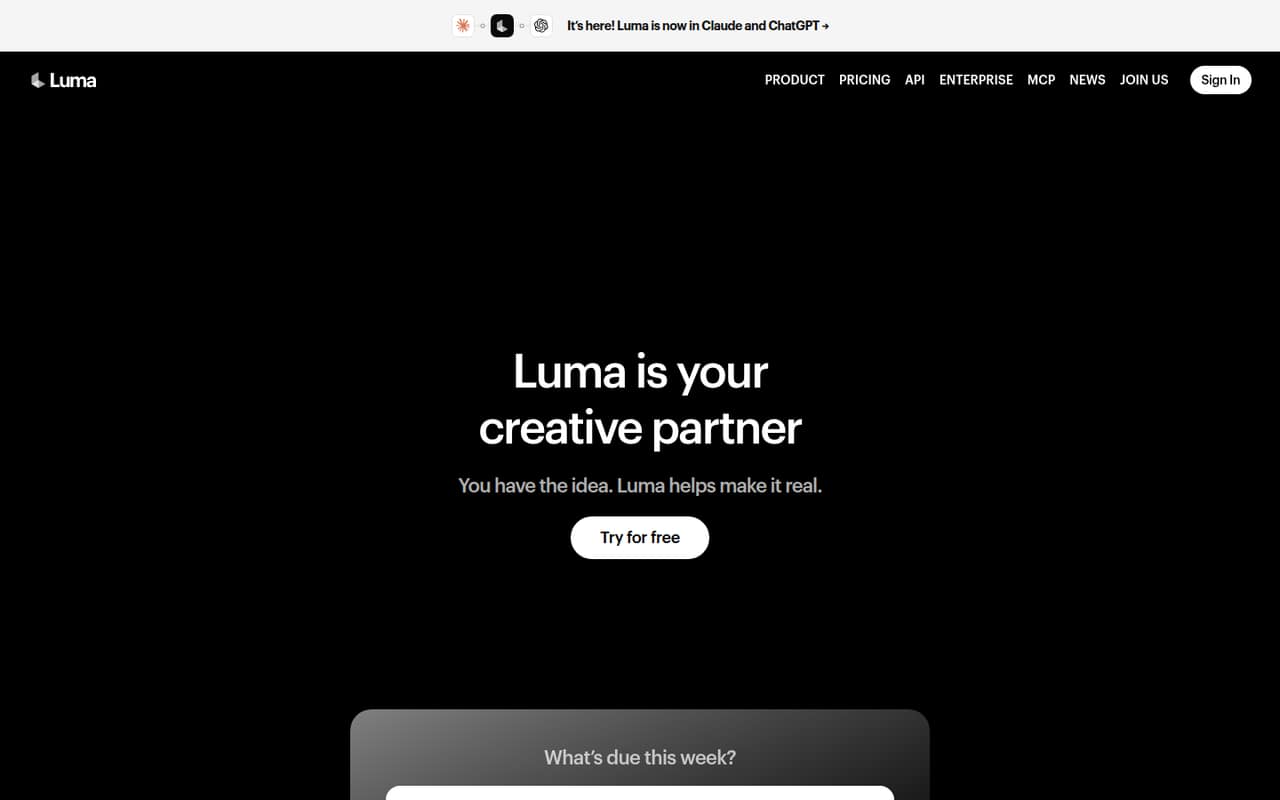
Dream Machine suits a solo creator or a small team of roughly 1–10 people that needs to make more than one kind of creative asset. Luma describes the platform as a place for Agents to research, generate and refine video, images, audio and text. That could fit a team making campaign concepts, brand visuals and video drafts without splitting each task across separate creative tools.
The clearest entry point for commercial work is Plus: the pricing page lists 10,000 credits, commercial use and access to Luma and third-party image and video models. It costs $30 per person monthly, or $25 per person monthly with annual billing. That is a real subscription commitment, not a free tool to keep around for occasional experiments. Teams that need shared projects, credits and usage analytics should look at Team, but Luma does not publish its price. For a team with a tight budget, get a quote before deciding whether those shared-work features are worth the extra spend.
02Dream Machine free plan and trial
Luma’s pricing lists no free plan and no free trial. That means there is no listed free allowance for trying image or video generation, and no published trial period to test the platform with a team before paying. If you only need occasional creative output, there is no $0 plan to keep as a backup.
The cheapest listed way in for commercial use is Plus. It costs $30 per month when billed monthly, or $25 per month with annual billing, charged annually. Plus includes 10,000 credits, Luma and third-party image and video models, edit access for guest collaborators and commercial use. The pricing page does not say how many generations those credits buy, so ask Luma how typical actions consume credits before committing. If you need a shared workspace rather than individual subscriptions, request Team pricing; its price is not published.
03What a small team pays for Dream Machine
Plus is the most affordable listed plan for commercial work: $30 per person monthly, or $25 per person monthly with annual billing. For one person, that is $30 month to month or $300 paid for a year. For three people using separate Plus subscriptions, it is $90 monthly or $75 per month equivalent with annual billing ($900 upfront for the year). For five people, it is $150 monthly or $125 per month equivalent annually ($1,500 upfront).
Those team totals assume each person needs an individual Plus account; Luma does not publish a per-seat price for Team. Team includes member management, projects, team-wide sharing, usage analytics, shared credits and SSO, but its monthly and annual prices are not listed. Pro is $90 monthly or $75 per month equivalent annually, with 40,000 credits and 4x usage with Luma Agents. Ultra is $300 monthly or $250 per month equivalent annually, with 150,000 credits and 15x Agent usage. The pricing page lists no add-ons. It also does not publish credit costs by action, so confirm expected usage and Team seat terms with Luma.
04Getting started with Dream Machine
Luma presents Dream Machine as a platform where Agents research, generate and refine creative work across video, images, audio and text. The feature list names Ray 3.2 for video direction, including frame control and continuity across cuts, and Uni-1 for brand-aware generation using style references, character references and visual grounding. That gives a team several capabilities to learn, rather than one narrowly defined video feature.
The pricing page does not list setup steps, onboarding time or a required integration. It also does not name integrations a small team needs on day one. Team includes member management, projects, shared credits, sharing and usage analytics; Enterprise adds dedicated education and training. For a small team, ask Luma what account setup and collaboration look like before buying, especially if shared access or brand references are central to your workflow. We would not budget a specific setup effort or assume a particular integration based on the published details.
05When small teams outgrow Dream Machine
A team may hit the first practical limit when its Plus credit allowance no longer suits its generation workload. Plus includes 10,000 credits, Pro includes 40,000 and Ultra includes 150,000; Pro and Ultra also list higher Luma Agent usage. The pricing page does not explain how many credits particular video or image actions use, so a team cannot confidently forecast when it will need to move up without asking Luma.
The next pressure point is collaboration. Plus lists edit access for guest collaborators, while Team adds member management, projects, team-wide sharing, usage analytics, shared credits and SSO. Those additions may matter as more people contribute, but Team pricing is unpublished, so there is no public seat-cost comparison against separate Plus plans. A growing organization may need Enterprise commitments, dedicated education and training, or custom fine-tuning; those are Enterprise features, and its price is also not listed. Get a written quote and confirm seat, credit and usage terms before moving up.
Questions people ask
What is Dream Machine used for?
Luma describes Dream Machine as a creative platform for researching, generating and refining video, images, audio and text. Its listed tools include Ray 3.2 for video direction and Uni-1 for brand-aware generation. It is aimed at creative work, rather than network or home-device management.
What can Dream Machine AI create?
The platform covers video, image, audio and text work. Its pricing page lists text-to-video, image-to-video and video-to-video actions, plus image creation and modification across multiple models. The listed features also include Ray 3.2 video direction and Uni-1 brand-aware generation.
Does Dream Machine allow commercial use?
The pricing page lists commercial use as part of Plus, which costs $30 per month or $25 per month with annual billing. The published plan details do not specify commercial-use terms for the other plans, so check Luma’s current terms if your work depends on a particular license.
How many generations do 10,000 credits cover?
Luma lists 10,000 credits with Plus, but the pricing details do not publish credit costs for individual actions. The number of generations will depend on the work you create. Ask Luma for current credit usage for the video and image actions your team expects to use.
What does Dream Machine Team add?
Team includes member management, projects, team organization and team-wide sharing, usage analytics, shared team credits and SSO. Luma does not publish the Team plan price in the listed pricing details, so request a quote and confirm how seats and shared credits work before purchasing.