
We may earn a commission if you buy through links on this page. It never changes a score or a ranking. How we make money
The bottom line
Strong Iceberg and AI capabilities, with costs and setup that need careful checking.
Dremio is worth considering if your small team needs to query Apache Iceberg data and connect analytics or AI agents to enterprise data. Its open catalog, semantic layer and managed cloud option are aimed at more than a basic SQL tool.
Dremio Cloud lists pay-as-you-go pricing at $0.20 per DCU, but the vendor doesn’t publish a per-seat or monthly starting cost. A free plan is listed, though its limits aren’t published; check the expected usage and setup before committing.
Good fit if
- Teams building on Apache Iceberg
- Analytics teams connecting AI agents
- Small teams wanting managed cloud
Skip it if
- Teams needing predictable per-seat costs
- Beginners wanting a simple SQL tool
- Teams without data platform ownership
ScoresHow it rates
What works
- Queries Apache Iceberg data without format conversion
- Open Apache Polaris catalog supports Iceberg REST engines
- MCP connects Claude, ChatGPT and Gemini
- Reflections can accelerate queries automatically
- Cloud option includes managed infrastructure and automatic upgrades
What doesn't
- Free-plan limits aren’t published
- No per-seat price or monthly estimate
- Enterprise consumption rate isn’t published
- Self-managed deployments require teams to handle upgrades
- Reddit users report hosting and scaling can be expensive
01Who Dremio is for
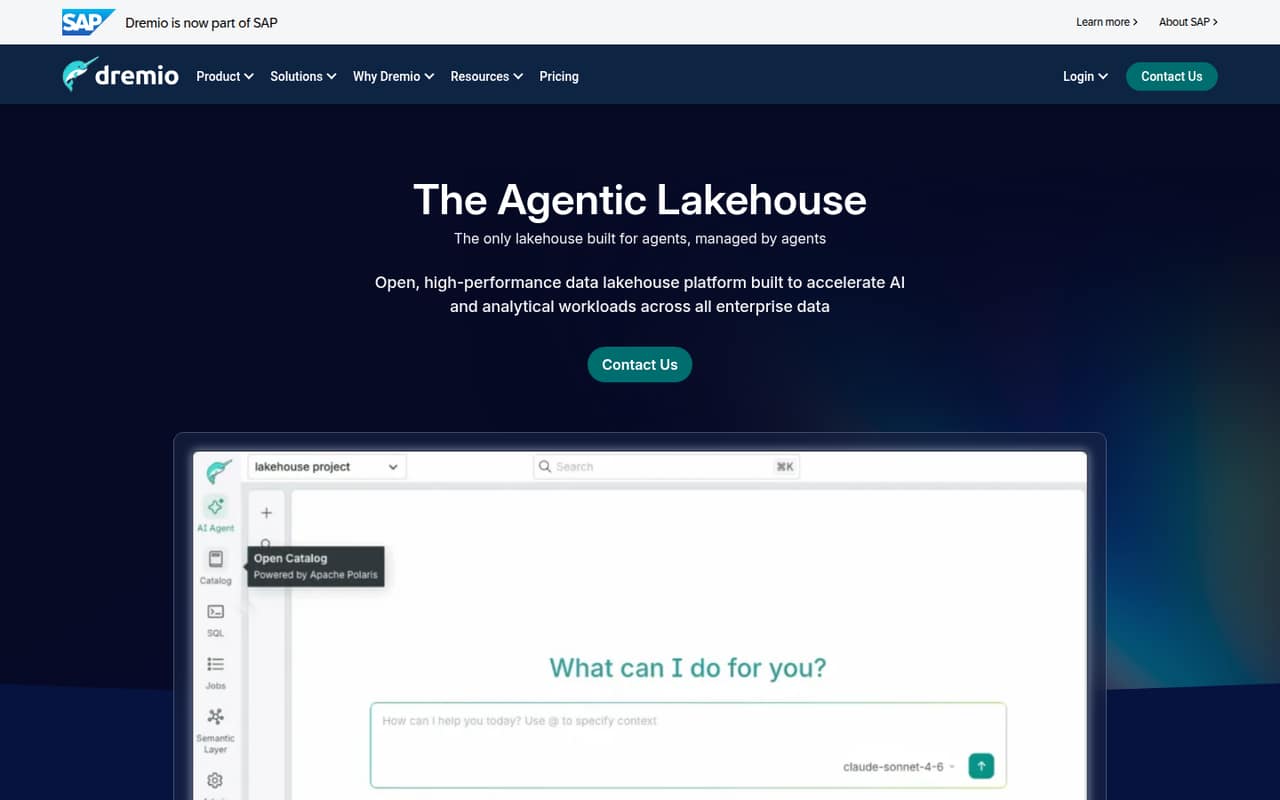
Dremio fits a small data team that already works with a lakehouse or is deliberately building one. It queries Apache Iceberg data natively, provides an open catalog, and adds a semantic layer for business metrics and context. Its MCP connectivity can also let agents such as Claude, ChatGPT and Gemini access enterprise data.
For a team of one to ten, the managed cloud service is the simpler starting point on paper: Dremio manages AWS infrastructure and lists automatic upgrades and scalability. Self-managed Enterprise is for organizations that need deployment control and can own operations. Either way, this is a data platform, not a low-cost tool for occasional spreadsheet queries. The price is consumption-based rather than per person, so budget depends on usage. If the team has no one responsible for data infrastructure, start by checking setup and support expectations with Dremio before choosing a plan.
02Dremio free plan and trial
Dremio lists a free plan, but its pricing information doesn’t publish what the plan includes, its usage limits, or whether it is the same as the cloud service. Don’t assume it covers a team’s production workload without confirming those details with the vendor.
The listed Dremio Cloud trial lasts 30 days and includes a $400 credit. That’s a separate, more concrete way to evaluate the managed service, which runs on Dremio-managed AWS infrastructure. The pricing page lists pay-as-you-go cloud usage at $0.20 per DCU after the trial credit, but does not specify a per-person allowance. Enterprise pricing is consumption-based, with the rate unpublished; the vendor says to contact sales about a trial. Before starting, ask what happens when the credit is used and what usage limits apply to the free plan.
03What a small team pays for Dremio
Dremio Cloud is listed at $0.20 per DCU, pay as you go. The price is tied to DCUs, not seats, and the pricing details don’t specify a billing period for that rate. So we can’t give a reliable monthly cost for one person, three people or five people: the vendor doesn’t publish a seat-based formula or usage estimate. Ask Dremio to model your expected workload and explain how DCU consumption is measured.
For scale, the listed rate means one DCU is priced at $0.20, but that alone isn’t a monthly bill estimate. Three or five seats do not translate to a known total without each person’s usage and the applicable billing period. Annual contracts with committed pricing are available, but annual and monthly rates aren’t published. Dremio Enterprise is also consumption-based, with its rate unpublished. The pricing page lists no add-ons, but that doesn’t establish that every service or support need is included. For a tight budget, get a written estimate for your team size and workload before planning around the trial credit.
04Getting started with Dremio
Setup effort depends on which deployment you choose. Dremio Cloud is managed on AWS, with automatic upgrades and scalability listed by the vendor. Enterprise is self-managed on Kubernetes or AWS, Azure or GCP; the pricing page says upgrades and scalability are manual. That gives teams deployment control, but also leaves more operational work with them.
The product description points to Iceberg, an open catalog, access controls and AI-agent connectivity as core pieces. For a small team, the day-one work is likely to include deciding where the data lives and which clients or agents need access. The vendor doesn’t publish a setup-time estimate here, so ask for one based on your sources and deployment.
A commenter on r/dataengineering describes Dremio’s interface as point-and-click, while also noting a learning curve with Spark and catalog configuration. Treat that as one user’s perspective, not a guarantee that setup is effortless.
05When small teams outgrow Dremio
The first pressure point is usually the bill, not a published seat cap. Dremio prices cloud by DCU and Enterprise by consumption, but doesn’t publish a typical team bill or a threshold for upgrading. As use grows, ask for a workload-based estimate and confirm how committed annual pricing compares with pay as you go.
The second pressure point is operational ownership. Cloud includes managed infrastructure and automatic upgrades; self-managed Enterprise leaves upgrades and scalability manual. A Reddit commenter says Dremio can be expensive to host and scale yourself, which is worth weighing if your team lacks platform engineers. Another commenter questions how clearly the product is positioned, while a different user says the cloud offering is strong. That mixed feedback suggests checking the fit against your actual Iceberg and analytics needs rather than buying on broad claims.
If your team mainly needs predictable seat pricing or a basic query interface, compare the total operating effort and ask Dremio what support and capacity options would apply as usage grows.
From the threadsWhat users say
Reddit sentiment is mixed: users praise Dremio’s potential and cloud offering, while others raise concerns about cost, positioning and what the platform provides. The comments are opinions, not a substitute for workload-specific evaluation.
Dremio is great
It's hard to understand what they are selling
Dremio offers a very point and click Ui
Questions people ask
Does Dremio have a free plan?
Dremio lists a free plan, but the vendor doesn’t publish its specific features or usage limits in the pricing details. The separate Dremio Cloud trial lasts 30 days and includes a $400 credit. Ask Dremio what the free plan covers and whether it supports your intended workload.
How much does Dremio cost for a small team?
Dremio Cloud lists pay-as-you-go pricing at $0.20 per DCU, not per seat. The vendor doesn’t publish a typical monthly bill or a way to convert one, three or five seats into a price. Ask for an estimate based on your expected DCU consumption and billing period.
Can I run Dremio myself?
Yes. Dremio Enterprise is listed as self-managed on Kubernetes or AWS, Azure and GCP. The pricing page describes it as consumption-based, but doesn’t publish the rate. It also lists manual upgrades and scalability, so ask the vendor what operational work and support your deployment would require.
Does Dremio work with Apache Iceberg?
Dremio’s product description says its engine queries Apache Iceberg data natively without format conversion. Its Apache Polaris catalog supports read and write across Iceberg REST engines. Confirm that your specific data sources, clients and required Iceberg workflows are supported before choosing a deployment.
Can Dremio connect AI agents to enterprise data?
Dremio lists MCP connectivity for agents including Claude, ChatGPT and Gemini. Its AI semantic layer is designed to define metrics, relationships and business context for agents and analytics. Ask the vendor which agents and access-control requirements are supported for your intended setup.