
We may earn a commission if you buy through links on this page. It never changes a score or a ranking. How we make money
The bottom line
Strong cash-flow modeling, but the $249/month annual-billing price is steep for a small team.
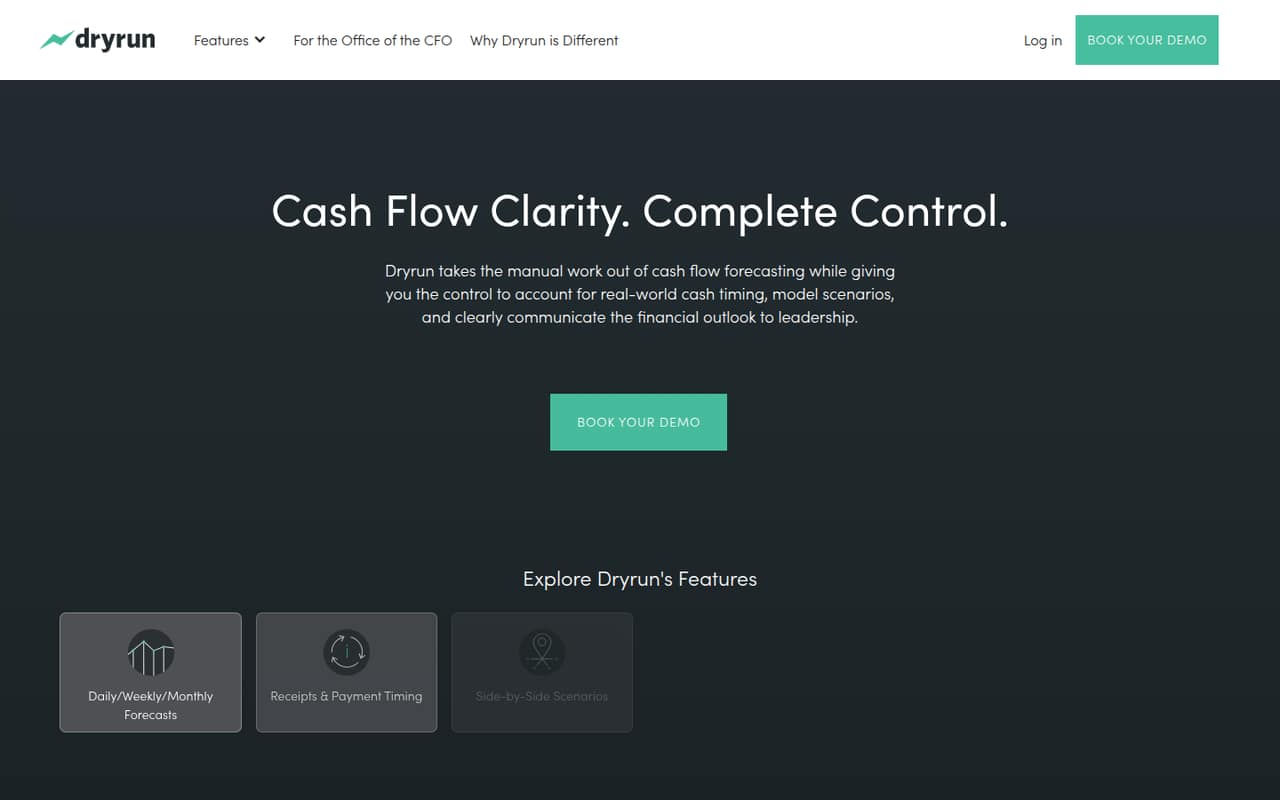
Dryrun combines accounting data, spreadsheet imports and manual assumptions to forecast cash flow and compare scenarios. It can show daily, weekly and monthly forecasts, adjust payment timing, and review cash across entities.
There’s no free plan. The Business Plan costs $249 per month when billed annually and includes three users and one entity; monthly pricing and extra-seat costs aren’t published. Try the 14-day trial before committing.
Good fit if
- Teams managing cash timing
- Businesses comparing hiring or purchase scenarios
- Finance teams combining data and assumptions
Skip it if
- Teams needing a free forecasting tool
- Businesses with five seats and a fixed budget
- Companies needing several entities on the entry plan
ScoresHow it rates
What works
- Daily, weekly and monthly cash forecasts
- Adjust expected receipt and payment dates
- Model projects, hires and purchases
- Combine accounting data with spreadsheets and manual inputs
- Business Plan includes three users
What doesn't
- No free plan
- $249 per month requires annual billing
- Monthly Business pricing isn’t published
- Business Plan covers one entity
- Extra-seat costs aren’t published
01Who Dryrun is for
Dryrun is for a small business that needs more than a static cash balance: its team wants to see how payment timing, planned hires or purchases could affect future cash. The tool combines accounting data with spreadsheet imports and manual inputs, then builds daily, weekly and monthly forecasts. Teams can change assumptions and compare scenarios rather than treating one forecast as fixed.
The Business Plan includes three users and one entity, so it could fit a finance lead and a couple of colleagues at a single-entity business. The budget is the catch: the pricing page lists $249 per month when billed annually, or $2,988 across a year. That is a substantial commitment for a small team, especially if it only needs occasional forecasts. Businesses managing multiple entities should look at the quote-based Enterprise Plan instead.
02Dryrun free plan and trial
Dryrun does not have a free plan. The pricing page lists a 14-day free trial with the Business Plan, which includes three users and one entity. The page does not spell out whether trial access has any feature restrictions, so confirm what is included before building a forecast around it.
After the trial, the cheapest listed option is Business at $249 per month when billed annually. That works out to $2,988 for a year; monthly billing is not published. The trial gives a small team a chance to assess its cash-flow forecasts and scenario modeling, but it does not change the annual price or provide a free ongoing tier. Ask Dryrun about billing timing and cancellation terms before starting.
03What a small team pays for Dryrun
The pricing page lists Business at $249 per month per account when billed annually, with three users and one entity included. That is $2,988 for a year. For one person using the account, the effective price is $249 per user per month. With all three included users, it works out to $83 per user per month. Those are per-seat calculations, not separate one-seat or three-seat plans.
A five-person team still pays the listed account price only if the plan allows those extra seats, but the included limit is three users and Dryrun does not publish extra-seat pricing. Ask the vendor for a five-seat quote before budgeting; don’t assume the per-seat math stays at $83. Monthly Business pricing also isn’t published. Enterprise is quote-based and designed for multi-entity businesses; the Partner Plan is quote-based with volume pricing for fractional CFOs managing multiple clients. No add-ons are listed.
04Getting started with Dryrun
Dryrun’s listed workflow relies on accounting data, spreadsheet imports and manual inputs. A team will need to decide which figures to bring in, what future cash movements to add, and which payment dates or assumptions to adjust. That gives finance staff control, but it also means a useful forecast depends on the quality of those inputs.
The available details don’t specify setup time, training requirements or a learning curve, so we wouldn’t promise a same-day rollout. They also don’t name supported accounting integrations. Before subscribing, ask Dryrun which accounting systems connect directly, what data syncs automatically, and whether spreadsheet imports need a particular format. A small team can then judge whether its current records and forecast assumptions are ready for the tool.
05When small teams outgrow Dryrun
The clearest limits to watch are the Business Plan’s three-user and one-entity allowances. A team that grows beyond three users should ask about extra-seat pricing, which Dryrun does not publish. If the business needs to forecast multiple entities, the listed route is Enterprise, a quote-based plan designed for multi-entity businesses. Its seat limits are not published either, so get both user and entity costs in writing before moving up.
A team may also outgrow the economics before it outgrows the features: Business costs $2,988 per year when billed annually, even if only one person uses the account. Monthly pricing and add-on prices aren’t published. That makes it hard to predict the cost of a larger setup from the public price alone. Revisit the plan when headcount, entity count or the need for clear monthly billing changes.
Questions people ask
Does Dryrun have a free plan?
No. The pricing page lists a 14-day free trial for the Business Plan, but no free plan. Business costs $249 per month when billed annually and includes three users and one entity. Ask Dryrun what the trial includes and confirm its cancellation terms before starting.
How much does Dryrun cost for a small team?
The listed Business price is $249 per month when billed annually, or $2,988 for a year. It includes three users, making the effective price $83 per user per month if all three seats are used. Monthly billing and extra-seat pricing aren’t published.
How many users are included in Dryrun Business?
The pricing page lists three users and one entity with Business. It does not publish the price for additional seats. If your team has more than three people, ask Dryrun for the total cost rather than relying on the included-seat math.
Can Dryrun forecast multiple entities?
Dryrun lists multi-entity views as a feature, while its Business Plan includes one entity. The quote-based Enterprise Plan is designed for multi-entity businesses. Its seat limits and pricing aren’t published, so ask for a quote based on your entity and user counts.
What accounting integrations does Dryrun support?
Dryrun combines accounting data with spreadsheet imports and manual inputs, but the available details don’t name supported accounting integrations. Ask the vendor which accounting systems connect directly, what data syncs, and whether spreadsheet imports require a specific format.