
We may earn a commission if you buy through links on this page. It never changes a score or a ranking. How we make money
The bottom line
Free, flexible SQL analytics for teams that can handle a little technical setup.
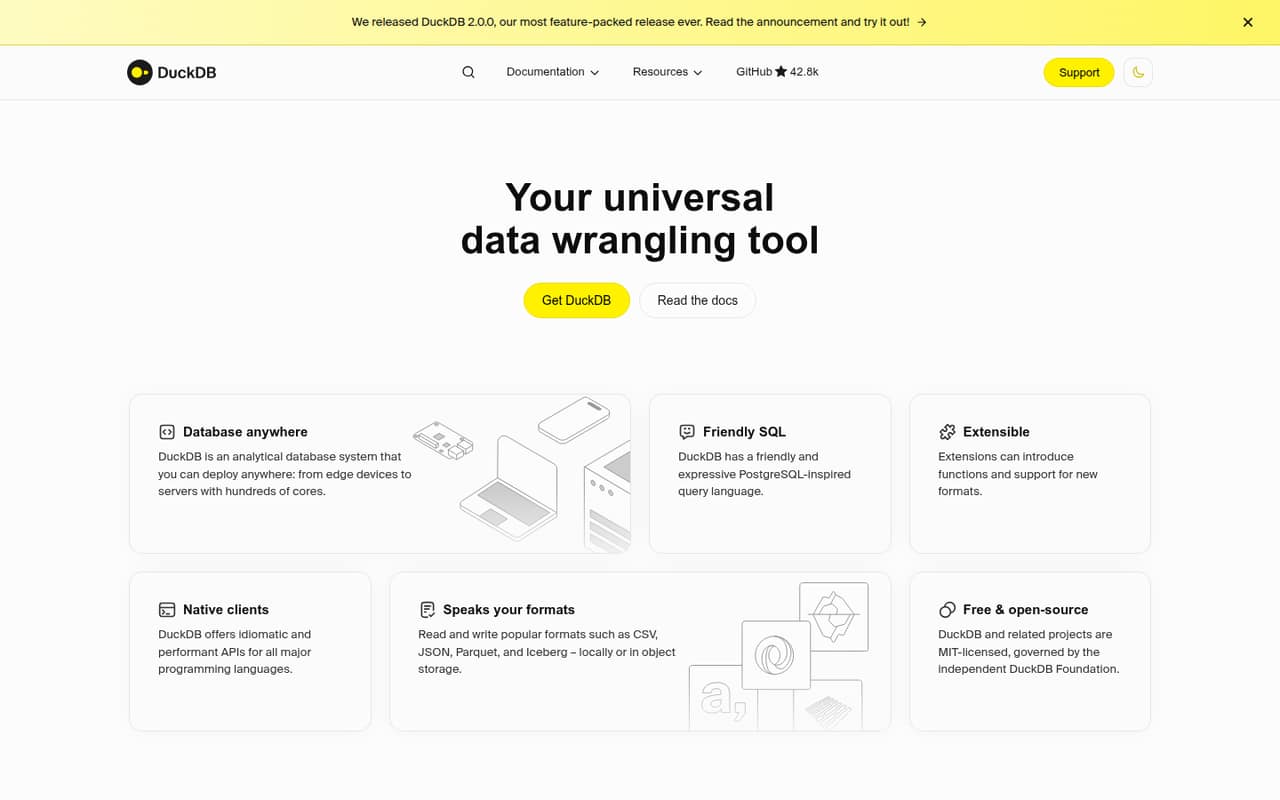
DuckDB is an analytical SQL database that runs inside an application or on a device or server. It reads and writes CSV, JSON, Parquet, and Iceberg, and the MIT license permits commercial use. For a small team doing data analysis or transformations, the price is hard to beat: $0, with no usage limits listed.
It is not automatically the right home for every shared production database. Reddit users describe production pipelines that work well, while one commenter flags concurrent updates as a limitation. Teams needing managed service, published support terms, or a conventional shared database should check those requirements before committing.
Good fit if
- Small teams doing SQL analytics
- Python-based data pipelines
- Budget-conscious data wrangling
Skip it if
- Teams needing a managed service
- Apps with frequent concurrent updates
- Teams avoiding technical setup
ScoresHow it rates
What works
- Free for personal and commercial use under MIT
- No usage limits are listed
- Runs in-process or on devices and servers
- Reads and writes CSV, JSON, Parquet, and Iceberg
- APIs include Python, Go, Java, Node.js, and Rust
What doesn't
- No paid plan or managed-service price is published
- Setup assumes some SQL or development knowledge
- Support terms are not published
- A Reddit commenter reports weak concurrent-update handling
- Not a universal replacement for pandas workflows
01Who DuckDB is for
DuckDB fits a one-to-ten-person team that needs to query files, transform data, or add analytical SQL to an application without taking on a software bill. It is an analytical database that can run in-process, so a developer can use it from an application rather than treating it only as a separate server. The homepage says it can run on edge devices or servers with hundreds of cores.
The practical draw is a familiar, PostgreSQL-inspired SQL language and support for CSV, JSON, Parquet, and Iceberg. Language APIs include Python, Go, Java, Node.js, and Rust. That makes it a reasonable option for a small engineering or analytics team that already works with data and code. It is less suited to a team looking for a managed, no-code database experience: DuckDB is the database engine, and the team still needs to decide how to build and operate its application or pipeline around it.
02DuckDB free plan and trial
DuckDB’s Free & Open-Source (MIT License) plan costs $0 per month or year. The pricing information lists personal and commercial use as permitted and does not list usage limits. There is no paid DuckDB plan or free-trial period published; the open-source project is the free way in.
That makes the starting cost unusually straightforward for a small team: there is no listed per-seat charge, and adding colleagues does not change the DuckDB license price. The trade-off is that the free project is not presented as a packaged, managed service with published support or service terms. If your team needs a hosted database, ask the relevant provider about its own costs and terms rather than assuming those come with DuckDB.
03What a small team pays for DuckDB
The pricing page lists one plan: Free & Open-Source (MIT License), at $0 monthly and $0 annually. The arithmetic is the same for one person, three people, or five: $0 per month and $0 per year for the DuckDB project. There is no listed per-seat price, minimum seat count, or annual-only commitment.
The project permits commercial use under the MIT license, and no usage limits are listed. That means the listed license cost does not rise as a small team adds seats or uses more of the database. The pricing page does not publish paid plans or add-ons. It also does not list a price for managed hosting or support. A Reddit commenter describes using MotherDuck, a managed cloud service associated with DuckDB, but that is a separate service and its price is not published in DuckDB’s pricing details. Ask any provider you plan to use about hosting, support, and service costs.
04Getting started with DuckDB
DuckDB is aimed at technical work, so expect some setup rather than a point-and-click team workspace. The project describes an in-process database and APIs for major programming languages, including Python, Go, Java, Node.js, and Rust. Its PostgreSQL-inspired SQL gives teams a familiar starting point if they already write queries.
For a first data task, the formats listed include CSV, JSON, Parquet, and Iceberg. That can cover common file-based analysis without first building a separate data-loading workflow. The exact installation steps and setup time depend on your language and deployment, so check the relevant documentation before planning a rollout. Reddit users describe using DuckDB from Python for pipelines and querying files locally; that points to a natural fit for teams already comfortable with code and SQL. Teams without that experience may need a developer to own setup and ongoing use.
05When small teams outgrow DuckDB
A growing team may outgrow DuckDB when its need shifts from analytical queries to a managed, shared service with clear support and operating terms. DuckDB’s published pricing is for the open-source project; it does not list paid tiers, hosting, or support prices. That leaves teams to evaluate any hosting or support provider separately.
Concurrency is another question to test against your workload. One Reddit commenter describes poor handling of concurrent updates as a limitation, while other users report production pipelines and application use going well. Those experiences are not a guarantee for your setup, but they suggest asking whether your workload is mostly analytical reads and transformations or frequent simultaneous writes. DuckDB can also be deployed on servers, according to its homepage, so growth alone does not mean you must leave. Move or add another service when your workload, operating requirements, or support needs call for it.
From the threadsWhat users say
Reddit sentiment is broadly positive among people using DuckDB for analytics, local wrangling, and production pipelines. Comments also stress that the right fit depends on the workload, and one user calls out concurrent-update handling as a limitation.
We've been using DuckDB in production for a year now, running and generating the queries we need with Python code. So far it's gone great. No major problems
The first step towards living an easy life is realizing we overcomplicate things without actual need
A lot of the oft-noted limitations of DuckDB (eg, its poor handling of concurrent updates) are more a feature than a bug with that in mind
It all depends on the size, complexity, and purpose of your stack
Questions people ask
What is DuckDB useful for?
DuckDB is for analytical SQL work, such as querying data files and building transformations in an application or pipeline. It reads and writes CSV, JSON, Parquet, and Iceberg. Teams can use language APIs including Python, Go, Java, Node.js, and Rust.
Can a small team use DuckDB for free?
Yes. The Free & Open-Source (MIT License) plan is listed at $0 per month and year, with personal and commercial use permitted. The pricing information lists no usage limits. Hosting or support from a separate provider may have its own costs.
Does DuckDB need a database server?
DuckDB can run in-process as an analytical SQL database, rather than only as a separate server. Its homepage also says it can be deployed on devices and servers. Choose the setup that fits your application and check the documentation for the relevant language and deployment.
What file formats does DuckDB support?
DuckDB reads and writes CSV, JSON, Parquet, and Iceberg, according to its product information. Extensions can add functions and support for new formats. Check the documentation for the specific format or extension your team needs before building a workflow around it.
Is DuckDB faster than other databases?
There is no general speed ranking here that will predict your workload. Performance depends on the queries, data, and deployment. Reddit users praise DuckDB for analytical transformations and file queries, but we would not treat those individual reports as a benchmark for your application.