
We may earn a commission if you buy through links on this page. It never changes a score or a ranking. How we make money
The bottom line
A practical research assistant for finding and organizing evidence, with paid plans that add up per seat.
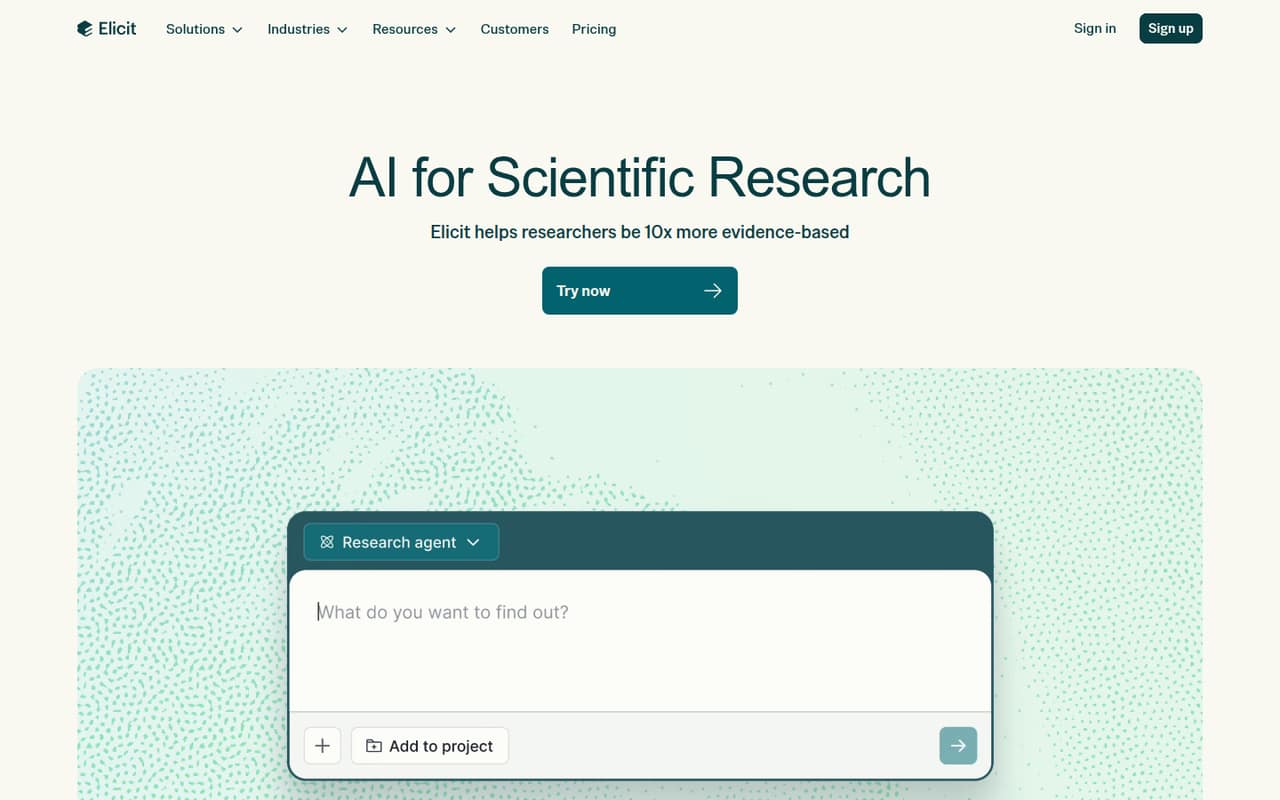
Elicit searches academic papers and clinical trials, then helps turn sources into cited answers, reports, tables, and reviews. Its free Basic plan covers casual exploration, but usage for Research Agent and Research Reports is limited.
For a small team, the main question is whether the extra workflow features justify paying per person. Plus starts at an $11 monthly equivalent with annual billing; systematic-review features start at Pro, and team collaboration is listed on Scale.
Good fit if
- Small evidence-focused research teams
- Researchers organizing papers and sources
- Teams building systematic reviews
Skip it if
- Teams expecting unlimited free research
- Groups needing a published monthly Plus rate
- Researchers seeking a fully repeatable process
ScoresHow it rates
What works
- Searches more than 138 million academic papers
- Includes unlimited summaries and paper chat on Basic
- Supports Zotero import and full-text access
- Creates reports with sentence-level citations
- Offers review workflows and team collaboration
What doesn't
- Basic limits Research Agent and Reports usage
- Plus monthly billing price is not published
- Paid plans charge per user
- Systematic-review workflows have plan-specific limits
- Researchers on Reddit question coverage and repeatability
01Who Elicit is for
Elicit suits solo researchers and small teams of roughly 1–10 people who regularly search papers, compare findings, or prepare evidence-based reports. It searches academic papers and clinical trials, and can help organize sources into summaries, tables, cited answers, and research reports. Systematic-review tools add screening and data extraction.
The fit depends on the work. A small research group that needs to find and sort evidence may get value from Basic before paying for seats. Teams that need exports, more table columns, or systematic-review workflows will need a paid plan. For collaboration features such as live editing and real-time collaboration, the pricing page lists Scale.
Elicit is less compelling if your team only searches occasionally or expects AI to replace research judgment. Reddit commenters recommend checking what gets missed and using a librarian’s guidance; one researcher also reported that Elicit found relevant papers faster for their study.
02Elicit free plan and trial
Basic is free and is aimed at casual research exploration. The pricing page lists limited Research Agent and Research Reports usage, search across more than 138 million papers, unlimited summaries and paper chat, full-text access, and Zotero import. That gives a solo researcher or a small team a way to try paper discovery and organization without a subscription.
The key stopping point is the limited usage for Research Agent and Reports. Elicit does not publish a numeric allowance for those limits in the plan details, so ask the vendor what applies to your workload before relying on Basic for a recurring process. A free trial is not listed. If you need deeper research features, Plus is the cheapest paid plan, at an $11 monthly equivalent per user when billed annually; its monthly rate is not published.
03What a small team pays for Elicit
The listed prices are per user. Basic costs $0. Plus is $11 per user per month with annual billing, or $132 per user yearly. That works out to $33 per month equivalent for three people ($396 yearly), or $55 per month equivalent for five ($660 yearly). Plus’s monthly billing rate is not published.
Pro costs $39 per user per month with annual billing, or $49 on monthly billing. Three seats come to $117 monthly equivalent on annual billing, or $147 month to month; five seats cost $195 monthly equivalent or $245 month to month. Annual billing is $1,404 yearly for three and $2,340 for five.
Scale is $89 per user per month with annual billing or $229 monthly: $267 or $687 per month for three seats, and $445 or $1,145 for five. No add-ons are listed. The plan limits that may prompt a jump are review size, table columns, data sources, usage, and collaboration features.
04Getting started with Elicit
The basic workflow is straightforward in outline: search for papers or clinical trials, work with summaries and paper chat, then organize sources or build a report. Basic includes Zotero import and full-text access, and Elicit also supports uploaded documents. Those are the clearest listed ways to bring existing research into a small team’s workflow.
The vendor does not publish a setup-time estimate or a detailed onboarding checklist in the plan information. Nor does it list other named integrations there, so teams that depend on a specific reference manager or document system should confirm compatibility before subscribing. Start with one research question and a small set of sources, then verify the papers and citations before using results in a report.
The learning curve is likely to depend on how formal your review process is; the product’s systematic-review features cover screening and extraction, but Reddit commenters caution that AI research tools may not be systematic or repeatable. One commenter said Elicit made paper discovery quicker after training.
05When small teams outgrow Elicit
A team can outgrow Basic when limited Research Agent or Research Reports usage gets in the way of regular work. Plus adds exports and more table columns, while Pro is the listed step for a 5,000-paper systematic-review workflow, API access, and reports using up to 135 data sources. Scale raises the review workflow to 9x usage and adds live editing and real-time collaboration.
Those upgrades carry a per-seat cost, so a growing group should price the number of researchers who need access, not just the person leading a project. Pro and Scale also have much higher monthly rates than their annual equivalents; Plus’s monthly price is not published.
There may be a process reason to move on, too. Reddit users report that research tools can mean switching between platforms and doing manual work, and one commenter questioned whether such tools are systematic and repeatable. Another said Elicit found papers faster, so the fit depends on whether speed outweighs the need to check coverage and workflow consistency.
From the threadsWhat users say
Reddit sentiment is mixed: one researcher said Elicit sped up paper discovery, while other commenters warned about missed sources, repeatability, and the value of building research skills. The comments reflect debate about AI research tools overall, not a clear consensus on Elicit alone.
I used elicit for finding papersIt was quicker for me and the literature was specific to my study
None of these tools are systematic and repeatable. Will they point you to worthwhile papers? Sometimes
The tools you list are for help with literature searching. Instead of jumping into those book an appointment with a librarian
For most disciplines there’s no one tool or database that “sees” everything
Questions people ask
What is Elicit good for?
Elicit searches academic papers and clinical trials, then helps researchers summarize and organize evidence. It can create research reports, tables, cited answers, and systematic-review workflows with screening and data extraction. It is designed to support research work, not to remove the need to check source coverage and claims.
Can Elicit write a literature review?
Elicit can generate customizable research briefs and supports systematic-review workflows, including screening and data extraction. Its reports include citations, but the available plan details do not say that it produces a complete, publication-ready literature review. Researchers should verify sources, coverage, and claims before relying on an output.
Does Elicit have a free plan?
Yes. Basic costs $0 and includes search across more than 138 million papers, unlimited summaries and paper chat, full-text access, and Zotero import. Research Agent and Research Reports usage is limited, but the vendor does not publish a numeric allowance in the plan details.
Does Elicit search clinical trials?
The pricing page lists clinical-trial search on Plus and higher plans, with Plus specifying more than 500,000 trials. Basic’s listed search coverage is more than 138 million academic papers; clinical-trial search is not listed among Basic’s included features.
Does Elicit cite its answers?
Elicit supports AI-generated claims with sentence-level citations from underlying sources. Those citations make it easier to inspect where a claim came from, but they do not guarantee complete coverage or that an answer is correct. Check the cited papers and the scope of the search.