
We may earn a commission if you buy through links on this page. It never changes a score or a ranking. How we make money
The bottom line
Enfos covers environmental obligations end to end, but quote-based pricing leaves small teams guessing.
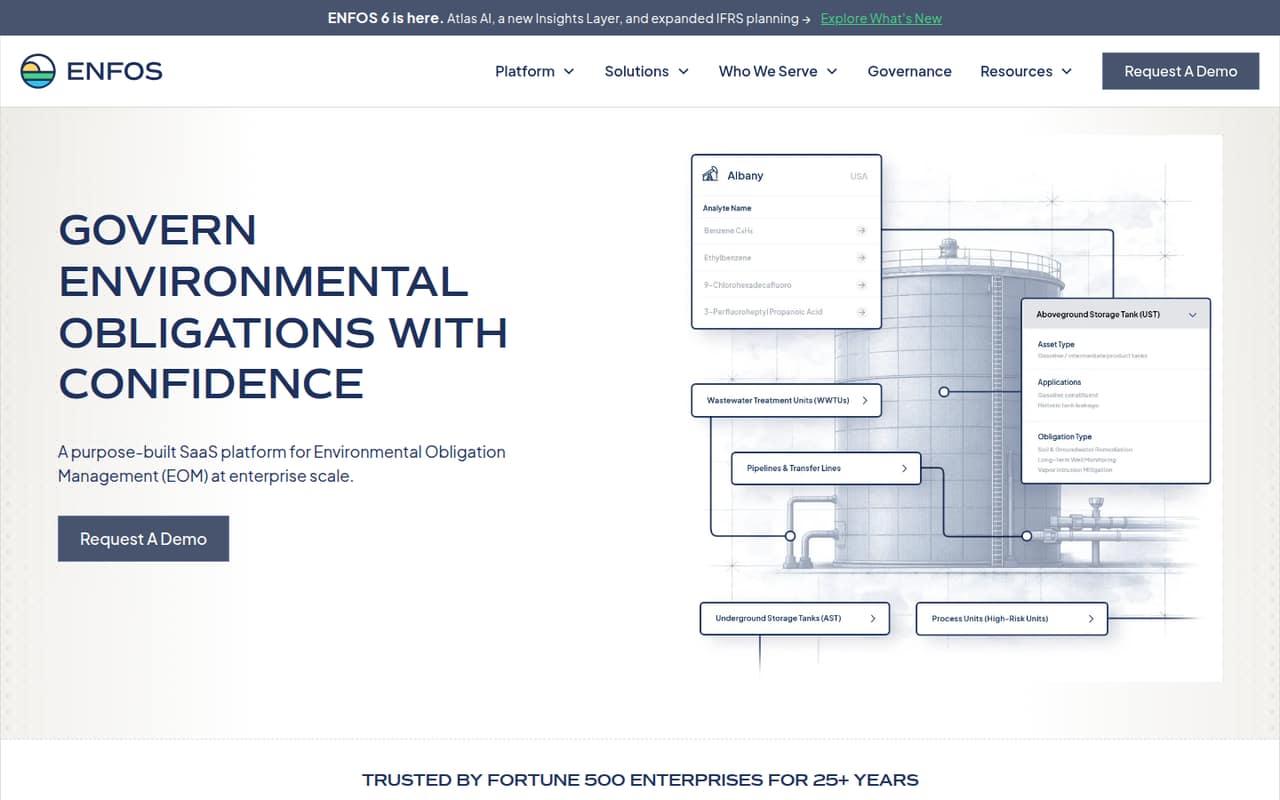
Enfos is a multi-tenant SaaS system for tracking environmental obligations, estimating risk and closure costs, managing project spending, and preparing audit-ready financial reporting. Its stated focus includes ARO and ERO liabilities, ASC 410-20 reporting, and COSO-aligned controls.
For a 1–10 person team, the main question is whether those specialized workflows justify an enterprise-focused tool. The vendor lists no free plan, and its pricing is quote-based, with no published starting price or billing terms. Ask for a quote and a walkthrough of setup, integrations, and costs for your team size before committing.
Good fit if
- Teams managing environmental liabilities
- Organizations needing ASC 410-20 reporting
- Teams tracking closure projects and budgets
Skip it if
- Teams wanting a free starting plan
- Small teams needing predictable seat pricing
- Businesses with few environmental obligations
ScoresHow it rates
What works
- Centralizes and classifies environmental obligations
- Assesses risk and estimates closure costs
- Forecasts budgets and prioritizes obligations
- Tracks and controls project expenditures
- Supports ASC 410-20 financial reporting
What doesn't
- The vendor doesn’t publish a starting price
- No free plan is listed
- Trial availability isn’t published
- Monthly and annual terms aren’t published
- Setup effort and integrations aren’t specified
01Who Enfos is for
Enfos is aimed at enterprises that need a system of record for environmental obligations, including asset retirement and environmental remediation liabilities. It brings obligation inventory, risk assessment, cost forecasting, project spending, and financial reporting into one platform. That is a specific job, not a general-purpose compliance tracker.
For a 1–10 person team, fit depends less on headcount than on the complexity and financial significance of its obligations. A small environmental or finance team inside a larger organization could have a real need for centralized records, cost forecasts, and audit-ready ASC 410-20 reporting. A small business with only occasional environmental tasks may find the scope and quote-based buying process hard to justify. The vendor doesn’t publish a starting price, so budget-conscious teams should ask for a quote based on their obligation volume, users, and reporting needs. We’d treat Enfos as a specialist option for teams with material obligations, not a default tool for every small company.
02Enfos free plan and trial
The pricing information lists no free plan. Trial availability isn’t published, so don’t assume you can test the platform at no cost. The vendor’s listed approach is quote-based pricing, making a sales conversation the cheapest published way in; there is no public entry-level plan or price to compare.
Before agreeing to a demo or quote, ask whether the vendor offers a time-limited trial, what a proof of concept includes, and whether any setup or implementation fees apply. Also ask which functions are included in the quoted package, such as obligation classification, risk and cost estimates, project expenditure controls, and ASC 410-20 reporting. Those details matter for a small team: a quote is only useful if it spells out the users, scope, and services covered. The vendor doesn’t publish those terms on the pricing information available to us.
03What a small team pays for Enfos
The pricing page lists quote-based pricing, but no plan prices or starting price. That means we can’t calculate a supported cost for one person, three people, or five people. Per-seat pricing is not published, and there’s no public monthly-versus-annual comparison; the vendor says neither billing term publicly. Add-ons aren’t listed either, so we can’t identify which extras a small team might need or what they cost.
For budgeting, ask the vendor for a written quote covering one, three, and five users, even if your team expects to add seats later. Have the quote separate subscription fees from implementation, data migration, training, and any optional modules or services. Confirm whether the price changes with the number of obligations, projects, or reporting requirements; those pricing measures aren’t published. Until the vendor provides those figures, a small team can’t compare Enfos fairly with tools that publish seat-based plans. The cheapest way in is a quote, not a known dollar amount.
04Getting started with Enfos
Enfos covers several connected work areas: building an obligation inventory, classifying obligations, assessing risk, forecasting closure costs, tracking project expenditures, and preparing financial reports. A team adopting those workflows should plan to agree on its obligation categories, risk inputs, cost assumptions, and reporting needs. The vendor doesn’t publish a setup timeline or describe how much configuration is required, so we can’t estimate the effort in days or hours.
The integrations a small team needs on day one are also not published. Before buying, ask how Enfos handles existing obligation and project data, what file formats or integrations it supports, and whether your finance and environmental teams can use the same records. Request a walkthrough using a representative obligation and project, and ask who handles configuration and training. Those answers will help reveal whether a lean team can manage setup itself or needs vendor help. We can’t verify a learning curve or user experience from the available product details.
05When small teams outgrow Enfos
Enfos is positioned for enterprises and supports a lifecycle that runs from obligation identification through financial reporting. The available pricing information doesn’t list user caps, obligation limits, project limits, or plan tiers, so we can’t identify a specific seat count or threshold that triggers an upgrade. It also doesn’t publish a public feature matrix to show which capabilities sit behind different packages.
A small team may outgrow the buying fit before it outgrows the software: if it needs a low-cost, self-serve plan or predictable per-seat billing, Enfos’s quote-based approach may not suit its budget. Conversely, a growing organization with more complex obligation tracking, forecasting, project controls, or audit-ready reporting may need to ask whether its quote covers that added scope. Get the vendor to explain capacity, price changes, and available packages in writing before rollout. Without those limits and prices, there’s no supported point at which to recommend upgrading or moving.
Questions people ask
Is Enfos a real company?
ENFOS is presented as the provider of a multi-tenant SaaS platform for managing environmental obligations, and enfos.com is the listed website. Those details describe the product, but they don’t independently verify the company’s legal status. Before signing a contract, confirm the contracting entity, billing terms, and support arrangements directly with the vendor.
What does ENFOS stand for?
The vendor's site describes ENFOS as an environmental obligations management platform but doesn’t give an expansion of the name. The vendor doesn’t publish what the acronym stands for in the information available to us. Ask Enfos directly if the name’s origin matters for procurement or company records.
How much does Enfos cost?
The pricing information lists quote-based pricing, but no starting price, plan prices, or per-user rates. Monthly and annual billing terms aren’t published either. Ask Enfos for a written quote that shows the price for your number of users and obligations, along with any implementation fees or optional services.
Does Enfos offer a free plan or trial?
The pricing information lists no free plan. Trial availability isn’t published, so a trial may or may not be available through the vendor. Ask whether Enfos offers a trial or proof of concept, what it includes, how long it lasts, and whether setup or support costs apply.
What does Enfos help teams manage?
Enfos helps enterprises identify and classify environmental obligations, assess risk, estimate closure costs, forecast budgets, and manage project expenditures. It also supports audit-ready environmental financial reporting under ASC 410-20 and describes COSO-aligned controls and ASC 410 accounting logic among its compliance features.