
We may earn a commission if you buy through links on this page. It never changes a score or a ranking. How we make money
The bottom line
Facets can govern AI-driven releases, but its $799/month entry price favors teams with real platform needs.
Small teams without AI agents shipping infrastructure probably don’t need Facets yet. For teams that do, it sets rules for agent-requested changes and handles provisioning, deployment, routing, monitoring, and alerts in one release flow.
The pricing page lists SaaS at $799 per month, including 20 Resource Instances and standard support. There’s no free plan, just a 14-day trial. That’s a steep starting point for a team of three or five, even though the price isn’t per seat.
Good fit if
- Teams governing AI infrastructure changes
- Platform teams with reusable deployment rules
- Organizations needing self-hosted control
Skip it if
- Teams without AI-driven infrastructure work
- Small teams seeking free IaC
- Teams needing published setup guidance
ScoresHow it rates
What works
- Checks agent requests against reusable contracts
- Supports human approval for some actions
- Combines infrastructure and release steps
- Includes 20 Resource Instances on SaaS
- Enterprise offers self-hosting and 24/7 priority support
What doesn't
- No free plan
- SaaS starts at $799 per month
- SaaS annual price is not published
- Setup time and integrations are not published
- Enterprise pricing is custom
01Who Facets is for
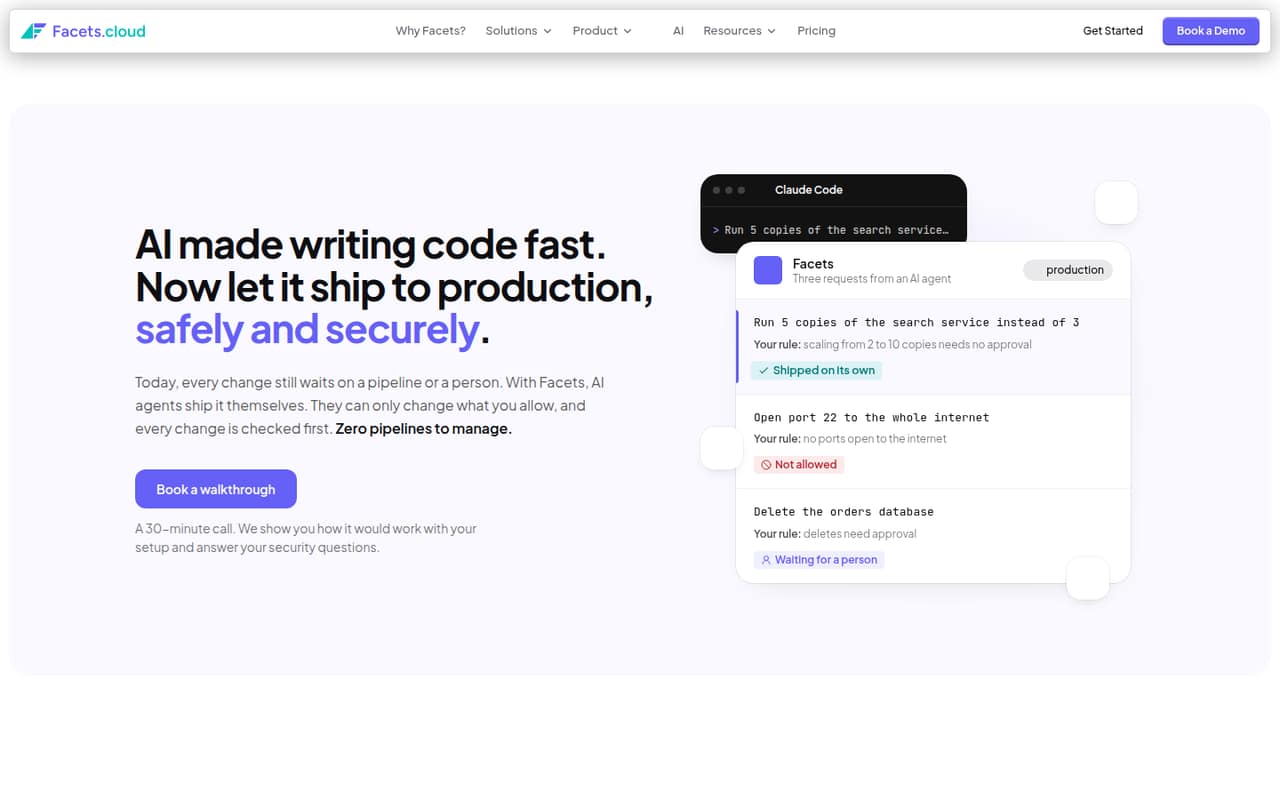
Facets is for teams that want AI agents to request and ship infrastructure changes without giving those agents a blank check. A platform team sets reusable contracts: permitted options, rules agents cannot change, and any actions that need human approval. Facets checks requests against those contracts before carrying them out.
It also handles release steps such as provisioning resources, connecting services, deployment, routing, monitoring, and alerts. The point is to let developers request approved resources in plain language or through a menu, rather than manage pipelines themselves.
For a 1–10-person company, the fit depends more on the work than the headcount. A small team with a platform owner and active AI-driven infrastructure work may value the guardrails. A small product team deploying a conventional app may not need a separate platform at all. At $799 per month, Facets makes more sense when it addresses a real governance or release-management problem.
02Facets free plan and trial
Facets has no free plan. The pricing page lists a 14-day free trial of SaaS, which starts at $799 per month after the trial. SaaS includes 20 Resource Instances, a Facets-hosted control plane, an isolated customer copy, and standard support.
The trial is the only no-cost route listed, so it gives a team two weeks to assess the product rather than an ongoing free tier for a small project. The pricing page doesn’t publish trial restrictions, such as whether all SaaS features or the full 20 Resource Instances are available during those 14 days. Confirm that with Facets before planning a trial around a production workload. If you need ongoing access, the cheapest listed option is SaaS at $799 per month; Enterprise has custom annual pricing.
03What a small team pays for Facets
The pricing page lists SaaS at $799 per month, with 20 Resource Instances included. It is a plan price, not a per-seat price, and no SaaS annual price is published. If three people split the monthly bill evenly, that works out to about $266.33 per person per month; for five, it’s $159.80. One person using the plan bears the full $799 monthly cost. These are cost-splitting calculations, not published seat rates.
At the same monthly rate for 12 months, the annualized total is $9,588: $3,196 per person for three people, or $1,917.60 each for five. That’s a run-rate calculation, not an annual billing offer.
The first listed add-on cost appears when you need more than the included 20 Resource Instances: additional instances cost $10 per month each through 250 additional instances, then $8 each from 251 to 500. Above 500, pricing is custom. Enterprise pricing is also custom, billed annually, and includes unlimited Resource Instances.
04Getting started with Facets
Facets is meant to take pipeline management off the team’s plate, but it still needs someone to define the guardrails. Expect a platform owner to set contracts, choose permitted options, decide which actions need human approval, and configure the resources and service connections the team can request. Facets then runs ordered steps such as creating resources, storing credentials, and connecting services.
That is meaningful platform work, not just inviting teammates to an app. Facets doesn’t publish a setup-time estimate or a learning-curve guide, so a small team should ask for a guided walkthrough before budgeting implementation time.
The vendor also doesn’t publish a specific day-one integration list or a detailed setup checklist. Ask which cloud providers, services, and monitoring tools are supported for your environment, and what you must configure yourself. The product description says Facets handles provisioning through monitoring, but it doesn’t spell out the connections required to make that flow work.
05When small teams outgrow Facets
The clearest pricing trigger is Resource Instances, not headcount. SaaS includes 20; additional instances cost $10 per month each through 250 additional, then $8 each from 251 to 500, with custom pricing above that. A team approaching those limits should compare the extra monthly bill with Enterprise, which includes unlimited Resource Instances but has custom annual pricing.
Enterprise may also fit organizations that require a self-hosted control plane in their own VPC, custom SLA guarantees, a dedicated success manager, or 24/7 priority support. SaaS instead lists a Facets-hosted control plane, an isolated customer copy, and standard support.
Facets doesn’t publish seat limits, so don’t treat the 20 Resource Instances as 20 users. Ask the vendor how your planned workloads count toward that allowance and whether your required cloud and service connections are supported. If you don’t need contract-based agent controls or the release workflow, the $799 monthly SaaS minimum may be the reason to choose a simpler tool instead.
Questions people ask
What does Facets do?
Facets lets AI agents request and ship infrastructure changes under rules set by a platform team. It checks requests against contracts before execution, can require human approval for some actions, and handles steps including provisioning, service connections, deployment, routing, monitoring, and alerts.
Does Facets have a free plan?
No. The pricing page lists a 14-day free trial, but no ongoing free plan. SaaS is the cheapest listed plan at $799 per month. The vendor doesn’t publish whether every SaaS feature or the full Resource Instance allowance is available during the trial, so confirm those terms before starting.
What does the Facets SaaS plan include?
The pricing page lists 20 Resource Instances, a Facets-hosted control plane, an isolated customer copy, and standard support with SaaS. The plan costs $799 per month. Additional Resource Instances cost extra, and no SaaS annual price is published.
Is Facets priced per user?
The listed SaaS price is $799 per month, not a published per-user rate. For budgeting, splitting that bill evenly among three people is about $266.33 each per month; among five, it’s $159.80. Those figures are simple cost splits, not seat prices or separate user plans.
Does Facets offer a self-hosted plan?
Yes. The Enterprise plan lists a self-hosted control plane in your VPC, unlimited Resource Instances, custom SLA guarantees, a dedicated success manager, and 24/7 priority support. Enterprise pricing is custom and billed annually; the vendor doesn’t publish a fixed price.