
We may earn a commission if you buy through links on this page. It never changes a score or a ranking. How we make money
The bottom line
Fortis covers embedded payments, but custom pricing makes small-team budgeting harder.
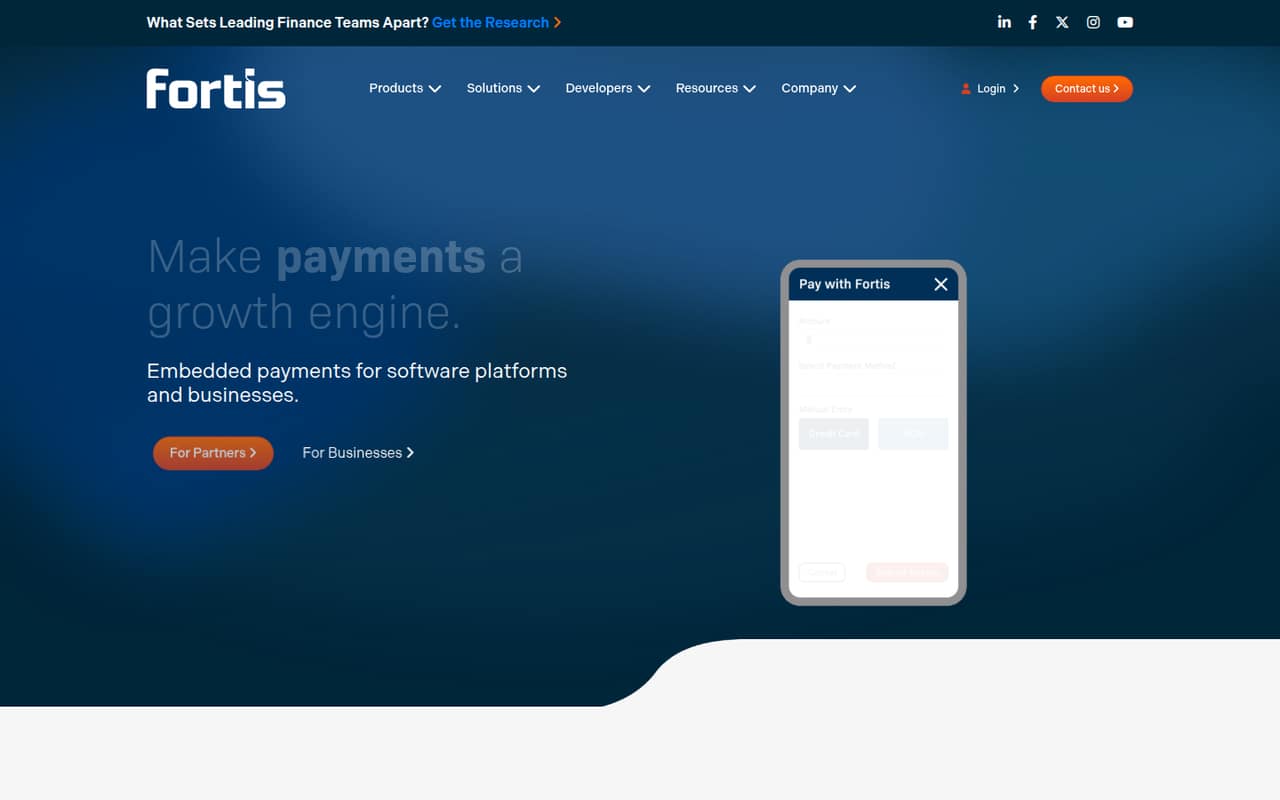
Fortis is built for software platforms and businesses that need to accept payments online, in person, or on mobile, or add payment processing to their own software. Its APIs, ERP integrations, and developer resources cover several ways to build that capability.
There’s no free plan listed, and the pricing page gives no public monthly or annual rate. Small teams should ask Fortis for a quote that spells out transaction costs, fees, and any implementation charges before deciding whether the fit works for their budget.
Good fit if
- Platforms adding payments to software
- Businesses needing ERP payment integration
- Teams accepting payments across channels
Skip it if
- Teams needing a free payment tool
- Buyers requiring public prices
- Teams seeking a simple seat-based app
ScoresHow it rates
What works
- Accepts payments online, in person, and on mobile
- Offers APIs and SDKs for integrations
- Provides an API console and code samples
- Supports ERP payments and click-to-pay invoicing
- Includes a sandbox and integration guides
What doesn't
- No free plan is listed
- Trial availability is not published
- Monthly and annual prices are not listed
- Per-seat costs cannot be calculated
- Ask the vendor about fees and add-ons
01Who Fortis is for
Fortis is for software platforms and businesses that need payment processing built into the way they operate. A small team might consider it when it wants customers to pay through its own software, connect payments with an ERP system, or accept transactions online, in person, and on mobile. Fortis lists payment APIs, SDKs, ERP integrations, and tools for compliance, reconciliation, and transaction security.
For a team of one to ten, the fit depends less on headcount than on whether embedded payments are a real business need. This is not positioned as a general-purpose team app; it is payment infrastructure to evaluate for a product or payment operation. The vendor publishes no entry-level price, so a founder watching subscription costs should get a quote before committing engineering time. If the team only needs a low-cost, standalone payment option, Fortis may be more involved than necessary.
02Fortis free plan and trial
Fortis does not list a free plan. The pricing material also does not publish whether a free trial is available, so ask the vendor directly rather than assuming you can test the service at no cost. The listed pricing route is a custom quote for merchants needing tailored payment solutions.
That means there is no published free tier to use for a small rollout, and no listed trial terms to help a team budget a pilot. Fortis does offer developer resources, including documentation, integration guides, and a sandbox. Those resources can help a team explore the integration, but the vendor does not describe them as a free product plan or specify what access to the sandbox costs. The cheapest way in, based on the listed pricing, is to request a quote and confirm any setup, processing, and ongoing charges.
03What a small team pays for Fortis
The pricing page lists a custom quote, with no monthly or annual price. It does not publish a starting price, a per-seat rate, or add-on prices. So the cost for one person, three people, or five people cannot be calculated from public rates. Fortis describes pricing as customized per merchant, which also means a small team should not assume the bill scales by headcount.
Before signing, ask for a written estimate based on your payment channels, expected transaction volume, ERP needs, and integration scope. Ask whether the quote includes implementation, payment processing, compliance or security tools, and ongoing support; the public pricing material does not itemize these as priced add-ons. Also ask whether any fees vary by transaction type or payment method. Until Fortis provides those details, a team cannot compare its total cost with a monthly subscription or make a reliable three- or five-person budget. The listed entry route is a vendor quote, not a published low-cost plan.
04Getting started with Fortis
Fortis lists APIs, SDKs, code samples, an API console, documentation, integration guides, and a sandbox. These resources are aimed at teams building payment integrations, rather than buyers switching on a basic app with no development work. A platform adding payments should plan for technical implementation; the exact effort depends on its product, payment flows, and any ERP connection, and Fortis does not publish a typical setup timeline.
For day one, identify which channels you need—online, in-person, or mobile—and whether you need ERP features such as click-to-pay invoicing or Level 2 and Level 3 processing. Then ask Fortis which integrations fit your system and what the quote covers. The docs and sandbox can support evaluation, but the vendor does not publish a required skill level, onboarding duration, or implementation cost. A small team without developer time should confirm what integration help is available before budgeting.
05When small teams outgrow Fortis
Fortis’s listed offering already spans payment APIs, ERP integration, multiple acceptance channels, and payment operations. A team is more likely to reconsider it because the commercial or implementation fit stops working than because a published seat limit has been reached: Fortis does not list seat tiers, usage caps, or public plan limits.
As transaction needs, channels, or ERP requirements change, ask the vendor whether the existing quote covers the added scope and how any new fees are calculated. The pricing page does not publish upgrade thresholds, add-on rates, or a migration path, so growing teams cannot estimate those costs from the public information. If a quote becomes too expensive or fails to cover a new payment workflow, compare alternatives before renewing. The key trigger is a mismatch between your payment requirements and the written terms—not a known Fortis user or seat ceiling.
Questions people ask
How much does Fortis cost?
Fortis lists custom-quote pricing for merchants needing tailored payment solutions. The vendor does not publish a monthly or annual rate, starting price, or per-seat cost. Request a written quote and ask what it includes, including processing, implementation, and any ongoing fees.
Does Fortis have a free plan or free trial?
Fortis does not list a free plan. Trial availability is not published, so ask the vendor whether a trial is available and what it includes. The company lists developer resources such as documentation and a sandbox, but those are not described as a free product plan.
What payment types does Fortis support?
Fortis lists payment acceptance for online, in-person, and mobile transactions. It also offers payment APIs and ERP integrations. Ask the vendor which specific payment methods and workflows are available for your business, since the public pricing material does not itemize them.
Can Fortis connect to an ERP system?
Fortis describes ERP integrations, including click-to-pay invoicing and Level 2 and Level 3 processing. The specific ERP systems supported are not listed on the vendor's site. Ask Fortis to confirm compatibility with your system and whether integration work changes your quote.
How difficult is it to integrate Fortis?
Fortis provides APIs, SDKs, code samples, an API console, documentation, integration guides, and a sandbox. Those resources support development, but the vendor does not publish a typical setup time or required skill level. Ask about implementation help and costs for your specific integration.